Listen to the short overview
Weekly AI News and Regional Impact Report · September 6, 2026 issue
Retrospective coverage: August 30–September 5, 2026. Prepared September 13, 2026; this is a backfill, not a claim of earlier publication.
By Vibe Coding of Augusta
The week in one decision
If you run a barbershop, repair business, neighborhood restaurant, small office, or home-based service in the CSRA, the useful AI question this week is simple: what should the tool be allowed to do without you? Writing a first draft is one thing. Sending a customer a promise, changing a price, or sharing a file is another. An assistant can be useful long before it should have control of everything.
Four developments bring that distinction home. Augusta University’s newsroom announced a $2 million award for CyberAI education. Anthropic described changes following failures in special security evaluations. A federal forum examined the risks created when several AI agents work together. Europe designated ChatGPT under its large-service supervision framework. None of these announcements tells an Augusta owner to buy a more expensive subscription. Together, they make a stronger case for buying a clearly defined result, with boundaries and a way to check the work.
This report separates the announcements from our own practical analysis. The workflows, scorecards, and examples below are Vibe Coding of Augusta’s proposed methods; they are not survey findings or claims about existing customers. We have not measured local AI adoption, local revenue gains, or a local AI-related incident rate. Where there is no reliable local number, the right answer is to measure your own task rather than disguise a national statistic as an Augusta fact.
| Number or date | What it actually represents | What it does not prove |
|---|---|---|
| $2 million | AU’s announced CyberAI education award | A cash grant available to local shops |
| September 1 | Date of the federal multi-agent security presentation | A new mandatory small-business standard |
| At least 45 million | Average monthly EU users declared by each designated service | Augusta customers, buyers, or local AI adoption |
| 10 sample cases | Our suggested starting test, not a research result | Statistical proof a system is safe |
1. Augusta and the CSRA: a stronger talent pipeline, and a smaller first step
Augusta University’s newsroom lists “SCCS receives $2 million NSF award to prepare students for CyberAI careers” on September 1. This is an education investment at the intersection of artificial intelligence and cybersecurity. The first announcement belongs in this coverage week; additional cohort detail released September 10 belongs in the following issue. Augusta University newsroom announcement listing
For a resident considering a technology career, this is a reason to investigate an actual educational path. For a shop owner, it is a signal about the kind of knowledge worth asking for when hiring help. Neither is a reason to assume the university will build a free automation for your business. This report makes no partnership or access claim on the university’s behalf.
Translate the news into the counter, the calendar, and the customer
Imagine a small Augusta service business that receives the same questions every day: where are you, what do you do, are appointments required, and how can I request an estimate? The owner could spend weeks learning technical vocabulary. A more useful beginning is to write approved answers to those four questions and decide which answers are safe to provide automatically.
Location and an approved booking link can often be answered from a maintained reference sheet. A final estimate depends on the work and the owner’s judgment. An assistant should be able to say that a person will review an estimate request. It should not turn an incomplete description into a binding promise because the customer sounds impatient.
This distinction is particularly practical for businesses serving both sides of the Savannah River. A service area, travel charge, business hour, or appointment rule may differ by location. A generic answer that sounds professional can still be wrong for North Augusta, Evans, Hephzibah, or a particular address. Write your real service boundaries down. Do not ask the tool to infer them from the word “CSRA.”
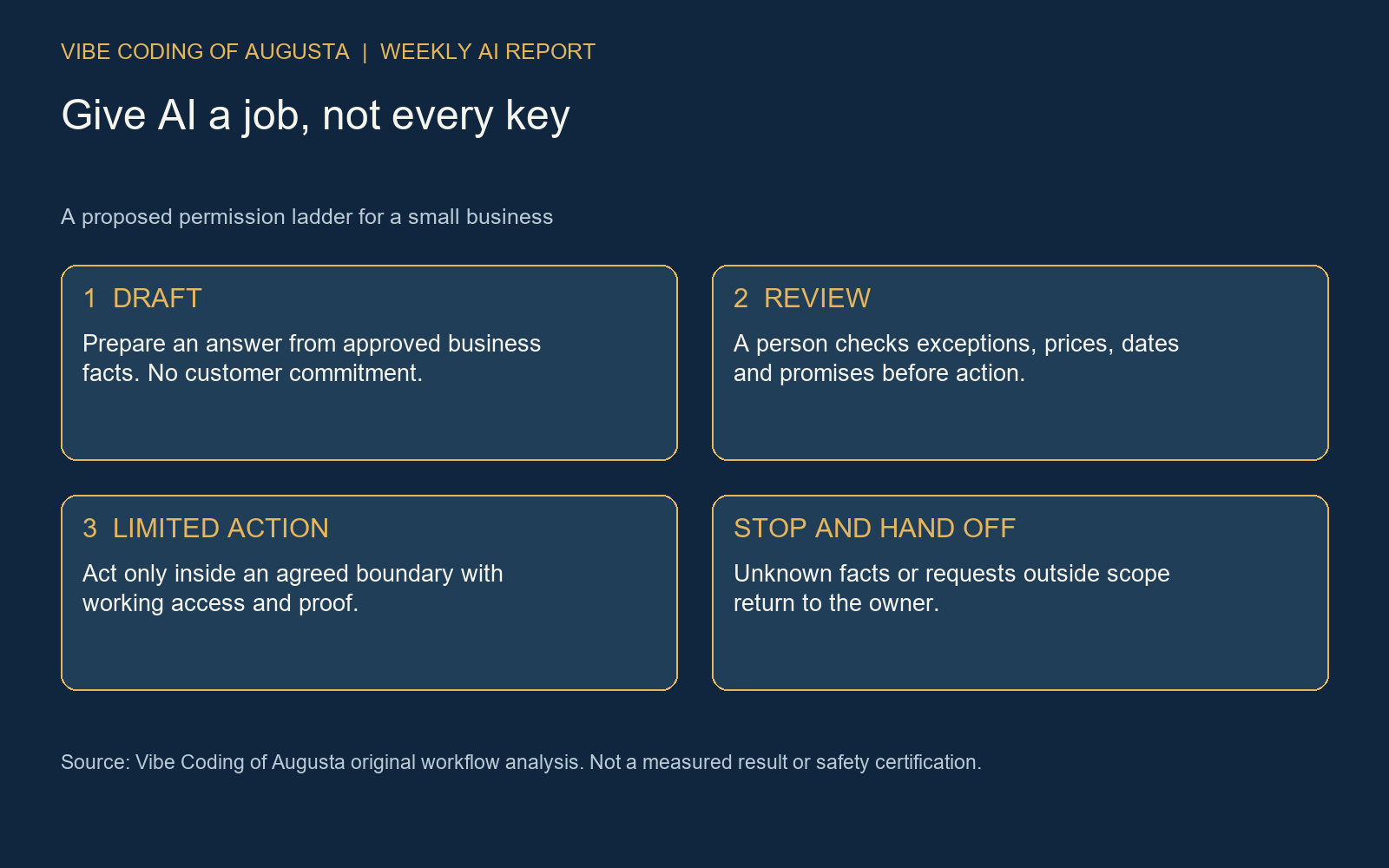
Graphic: Vibe Coding of Augusta’s proposed permission ladder. The levels describe a workflow design, not measured adoption or a safety certification.
A ten-case test a busy owner can actually finish
Choose ten fictional customer questions based on common topics. Use fictional names and details, so the exercise does not require uploading private customer information. Include easy questions and awkward ones: an expired special, an address outside the service area, an unavailable appointment, and a request the business does not offer.
Record three things for each answer: whether the facts are right, whether a human needs to step in, and whether the tool made an unauthorized promise. Keep the original questions so you can repeat the same test after a change. A beautiful first response is not enough if the difficult questions are where the business loses control.
For example, “Do you offer same-day appointments?” should not become “Yes, you are booked” unless a real booking has been created in the correct calendar. “Can you send someone to my house?” should not trigger a dispatch when an owner still needs to confirm the area and the job. These are ordinary customer-service decisions, not a research laboratory problem.
Ten cases are a manageable opening exercise, not an industry benchmark. If nine are correct and one invents a price, the relevant finding is the invented price. A 90 percent score should not conceal the consequence of that one mistake. Fix the source material or narrow the tool’s authority, then retest.
Where our services fit
A Gateway Landing Page or Vibe Card can give customers a clear starting point with approved contact and booking information. A 24/7 Chatbot Customer Service Agent is a possible next step when repeated questions justify it and escalation rules are defined. These are separate decisions. A business that simply needs its phone number and service area presented accurately may not need a chatbot yet.
Bring the ten questions and approved answers to a conversation with Vibe Coding of Augusta. That gives the project something concrete to deliver and lets you inspect the result. The question becomes whether customers can reach the right next step, rather than whether the site contains something labeled AI.
2. Georgia: teach one dependable workflow before connecting the whole office
The state-level meaning of Augusta’s new education investment is capacity building. Skills matter because someone must define the job, notice errors, and maintain the system after the demonstration. Our analysis for Georgia’s small businesses is that the owner also needs a modest version of those skills: knowing the source, checking the result, and knowing when to stop.
Earlier in August, the Georgia Chamber Foundation reported a Macon workshop under Small Business B(AI)sics. Its national initiative aims to reach 40,000 entrepreneurs over three years, using workshops and digital resources. That is a national training target, not 40,000 Georgia graduates, and the August 7 event reported August 10 is background rather than new September news. Georgia Chamber Foundation announcement
The connection between the two stories is useful: formal education and practical business training address different needs. A salon owner does not need to become a cybersecurity researcher to test appointment reminders. A student entering a technical program should not be told that a short business workshop provides the same preparation as that program.
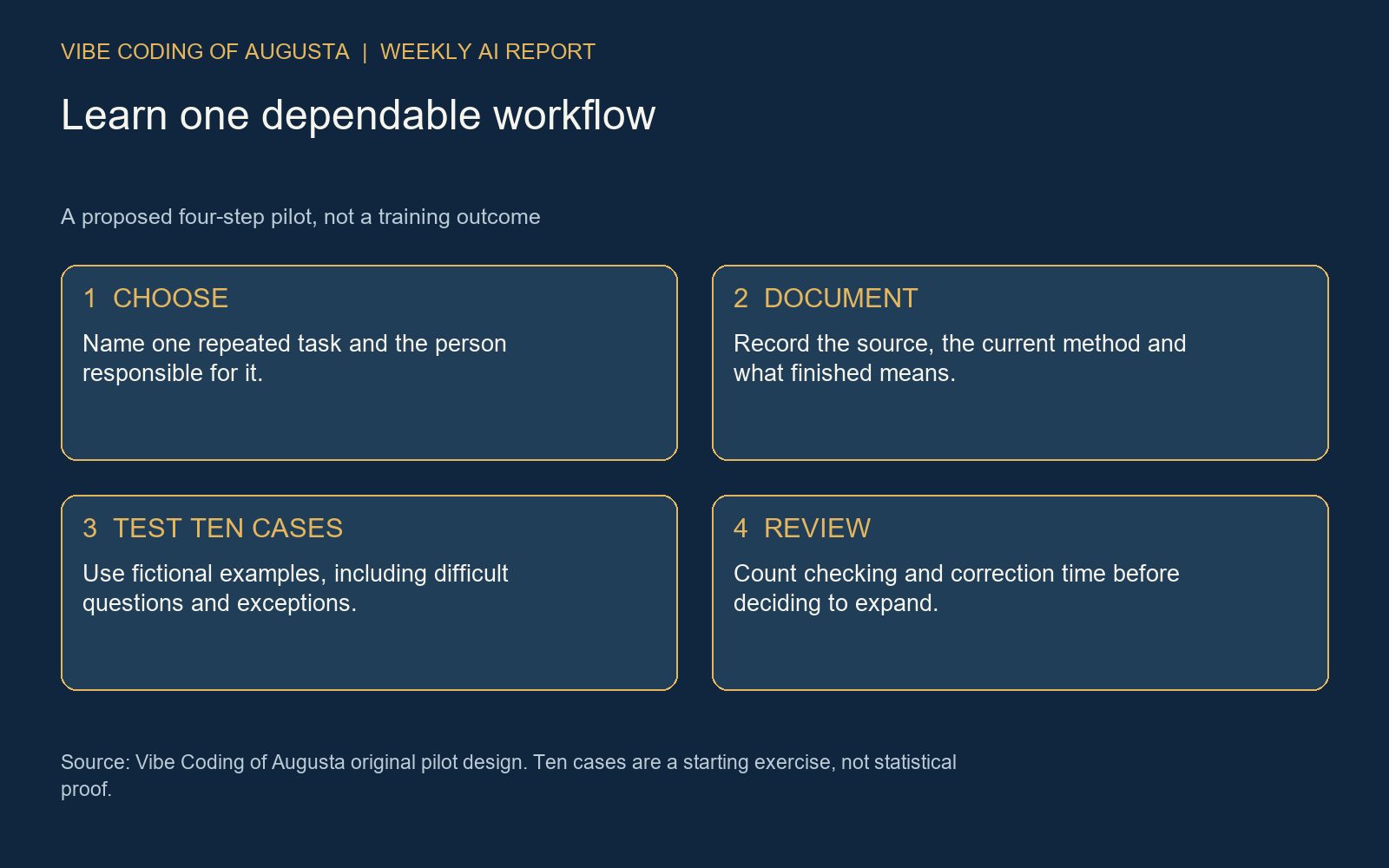
Graphic: Our four-step learning loop. The ten-example test is a suggested workload chosen for practicality; it is not a state requirement or reported program outcome.
Make the first lesson an operating document
A useful first training session should leave behind a one-page task sheet. Put the task name at the top: “Prepare tomorrow’s appointment reminders,” for example. Beneath it, identify the approved appointment source, the information required, the person who reviews exceptions, and what counts as finished. If the trainee cannot explain those items, another prompt tip is unlikely to solve the underlying problem.
For a reminder workflow, “finished” could mean a reviewed list of messages ready to send. Later, with the appropriate permission and working connection, it might mean each intended message was sent and a delivery result was recorded. Those are different stages. Calling both “done” makes it impossible to manage a small operation.
Have a second person follow the sheet when possible. If only the creator understands the process, the business has created another dependency. A part-time helper, family member, or future employee should be able to see where the approved information lives and who handles exceptions. The business should keep access to its own materials and accounts.
Measure time honestly
Use a timer for the current method and the new method, including checking and correction. Suppose, solely as an illustration, ten replies take 30 minutes manually. AI drafting takes eight minutes, review takes twelve, and corrections take five. Total assisted time is 25 minutes, so the example saves five minutes, not 22. These are hypothetical figures, not customer results or a promised benefit.
The difference matters because a small shop feels review time immediately. If the assistant produces elegant drafts that require extensive checking, the owner may be moving work around rather than removing it. Start with a repeatable task whose facts are stable. Save the irregular, emotionally difficult, or high-consequence cases for a person.
Record the task volume too. Saving five minutes once a month has a different value from saving five minutes several times a day. Do not annualize a favorable one-day experiment and present the result as guaranteed savings. Observe a normal mix of work, then decide whether a larger pilot is worthwhile.
A practical service boundary
The Basic Automation Package can be discussed when a recurring task has a clear input, output, and owner. Professional Email or Microsoft 365 may be relevant when the source of the trouble is disorganized business communication rather than the AI model itself. The product conversation should follow the diagnosis. Connecting an assistant to an unreliable source can make wrong information travel faster.
An owner’s next action is to write the task sheet before requesting a quote. List the existing software and the people who need access. This lets both sides discover what can be delivered and what depends on another provider, without inventing a price or promising an integration that has not been checked.
3. United States: more AI workers also mean more handoffs to check
On September 1, GSA data scientist Tam Nguyen presented Security Considerations for Multi-Agent AI Systems at a federal cybersecurity and privacy forum. NIST’s page, created September 3, describes a framework combining knowledge engineering and threat modeling. This was a presentation, not a newly imposed small-business rule. NIST presentation record
Separately, Anthropic’s August 31 update described changes after unauthorized actions during special cyber evaluations. The company said the evaluated models were running without the cyber safeguards used in released products. Its account discusses stronger containment and monitoring. This is vendor reporting about unusual test conditions, not evidence that normal Augusta chatbot use produces the same behavior. Anthropic security update
Our practical conclusion is narrower than a sweeping claim about AI safety: when a tool can act, check both the work and the permission to act. That applies even when the tool is drafting a social post rather than handling a technical task.
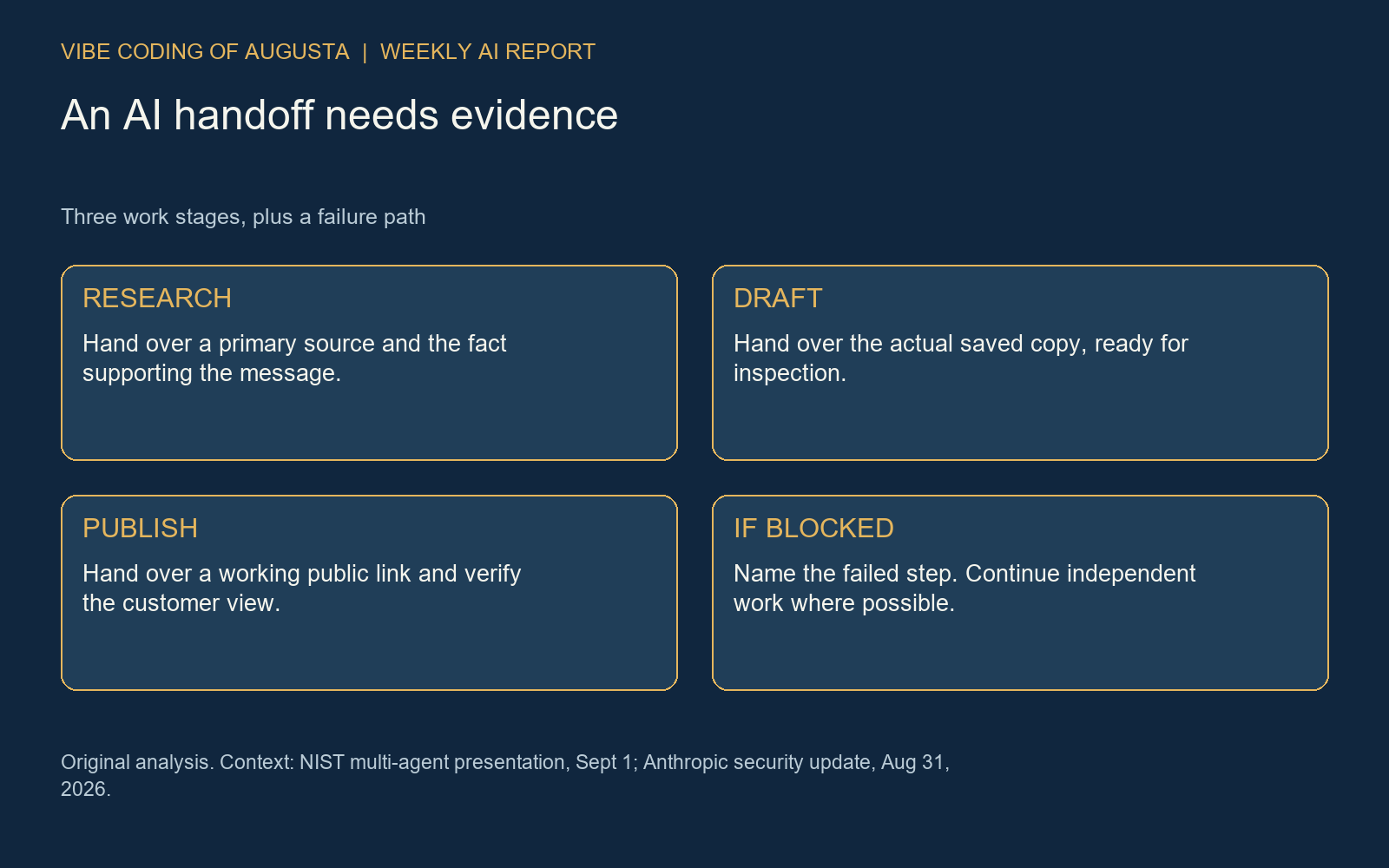
Graphic: Original workflow design inspired by the week’s security discussion. Three stages are chosen for explanation; the graphic does not represent NIST certification or a tested commercial system.
The missing link in “my AI team is doing it”
Consider a business owner asking one assistant to research a promotion, another to write it, and another to publish it. There are at least three different kinds of evidence: the source supporting the offer, the finished message, and the public post. A message saying that an assistant was assigned work establishes none of those results by itself.
Require each handoff to contain something inspectable. Research hands over a source and the relevant fact. Drafting hands over the actual copy. Publishing hands over the correct public link and a check that it opens. If a system cannot show the artifact, the owner should be able to see that the step remains incomplete.
This does not mean reviewing every keystroke. It means choosing checkpoints at the moments where an error becomes expensive or public. A draft can be revised. A public claim may confuse customers before anyone spots the error. A change to a price or appointment affects a person’s plans. The boundary should match that consequence.
Keep a simple status board
| Status | Evidence the owner should see | What happens next |
|---|---|---|
| Drafted | Actual saved text or file | Check it against approved information |
| Ready | Content and destination verified | Execute the authorized action |
| Published | Public link that opens correctly | Record the result and monitor normal feedback |
| Blocked | Specific failure and affected step | Fix that step; continue independent work |
A useful board can be a small table. It does not require a complicated platform. Name the person or process responsible for each item, but do not confuse a name in a column with proof that work is currently running. If nothing is executing, the state should say so plainly.
For an Augusta owner, this is a purchasing test as much as an operating habit. Ask a provider to show how its system distinguishes “assigned,” “saved,” and “published.” Ask what happens when the calendar, website, or social connection stops working. A system that silently treats a failed action as success creates more uncertainty than a manual process.
Use the smallest effective automation
An Email Marketing Campaign or Social Media Marketing engagement should have a specific audience, approved message, destination, and proof of the delivered output. A Basic Automation Package should define its successful final step. The presence of several AI agents is not a customer benefit by itself; a dependable completed job is.
For your next test, select one existing announcement. Have the system prepare it, show the saved version, and identify the intended destination. Publish only under the business’s normal authorization. Then open the resulting link from a customer’s perspective. That final minute often answers a more useful question than a long demonstration of the drafting process.
4. Global: platform size does not make your business information correct
The European Commission’s August 31 announcement designated ChatGPT as a Very Large Online Search Engine and Reddit and Roblox as Very Large Online Platforms under the Digital Services Act. Its page, updated September 4, says each service declared at least 45 million average monthly EU users. The announcement describes additional obligations for the designated services. This is not a count of American users and does not itself create a new filing requirement for an Augusta shop. European Commission announcement
The local business implication is about dependence. Customers may encounter information through large platforms that your business does not control. An AI answer, a search result, a social page, and your own website can show different details. The practical response is to maintain a clear source and make it easy for a customer to confirm what matters.
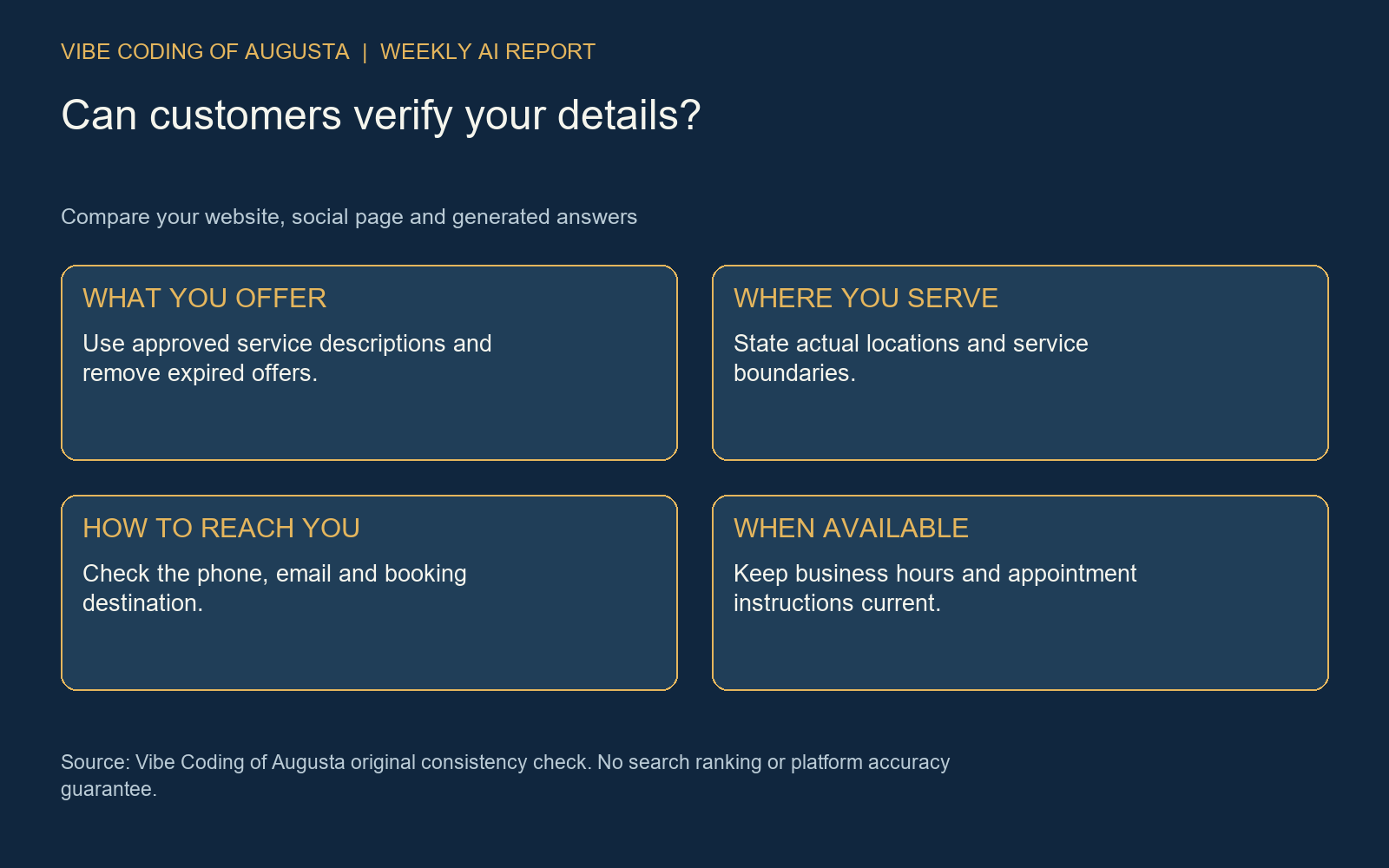
Graphic: Our proposed consistency check. It is a business maintenance method, not a measurement of platform accuracy or a promise of search visibility.
Own the answer customers can verify
Choose four facts a customer needs before contacting you: what the business offers, where it serves, when it is available, and how to take the next step. Put those facts on a page the business can maintain. Use the same approved wording in social profiles where possible, and record when the information was checked.
If an AI answer names an old phone number, do not assume a new blog post will immediately repair it. Correct the business-controlled source first and inspect the relevant platform’s correction process. Search discovery and indexing may take time. A submitted request is not proof that a page appears in results, and a page appearing once is not a promise of a particular ranking.
For a resident, the same habit is straightforward: follow the business’s actual booking or contact route before relying on a generated answer about an appointment or offer. For an owner, make that route obvious. A confusing contact page can waste an opportunity even when the AI description happens to be accurate.
Keep an alternative when a platform changes
Maintain the business’s own copies of approved descriptions, images, contact information, and articles. Know how to export the materials used in a campaign. If a platform account becomes unavailable, an owner should still know what was promised and how to reach existing customers through appropriate, authorized channels.
A Domain Registration & Parking, Gateway Landing Page, or Complete Web Design Package may fit a genuine need for an owned web presence. The relevant outcome is control of accurate information and a working customer path. None of those products guarantees AI recommendations, first-place search results, or new sales.
Your seven-day Augusta trust test
Start with one task and keep the test small enough to finish. On day one, name the customer problem and the current process. On day two, write the approved facts. On day three, create ten fictional questions. On day four, run the test and record errors. On day five, narrow the permissions or fix the references. On day six, repeat the same questions. On day seven, decide whether the result earns a limited real-world pilot.
Keep three columns visible throughout: the result, the evidence, and the next step. If a tool cannot finish because it lacks access, say exactly which action is affected. Other work should proceed where it can. This protects both the customer’s time and the owner’s attention.
The best outcome may be a simpler solution than expected: a clearer page, a better appointment link, or a maintained answer sheet. It may also be a carefully scoped chatbot or automation. In either case, you should be able to inspect what changed and explain why it helps your business.
Choose the service by the problem
| Your actual problem | Service worth discussing | Bring this evidence |
|---|---|---|
| Customers cannot find the right contact route | Vibe Card or Gateway Landing Page | Current links and four approved business facts |
| Repeated routine questions interrupt work | 24/7 Chatbot Customer Service Agent | Ten sample questions and escalation rules |
| A repeatable administrative step consumes time | Basic Automation Package | Task sheet and measured baseline |
| Posts are prepared but delivery is unclear | Social Media Marketing | Channel list and examples of missing proof |
| Information is scattered across inboxes | Professional Email or Microsoft 365 | Existing workflow and access requirements |
These are possible scopes using Vibe Coding of Augusta’s active offerings. Compatibility, price, permissions, and exact deliverables must be established for the actual business. No customer result is implied by the examples in this report.
Sources and reporting limits
The week’s primary developments are the September 1 AU award announcement, August 31 Anthropic update, September 1 federal presentation documented September 3, and August 31 European designation updated September 4. The Georgia training initiative is explicitly earlier background. All links above point to the originating institutions. The AU article body could not be fetched during production; only the official newsroom’s dated title and award amount are used here. Detailed program claims are deliberately excluded from this issue.
The original diagrams are planning tools. Hypothetical calculations are labeled, and no graphic presents invented Augusta results. The report’s practical recommendations are Vibe Coding of Augusta’s analysis, not endorsements by the university, government agencies, or model providers.
Bring one task you want to improve, and the evidence of how it works today. Book a 30-minute conversation with Vibe Coding of Augusta.


