Listen to the short overview
Weekly AI News and Regional Impact Report | Issue August 23, 2026
Retrospective coverage: August 16–22, 2026. Published as a backfill; this is not an August publication claim.
By Eric Roane · Vibe Coding of Augusta
This week’s decision for Main Street
Augusta hosted a major technology gathering during this coverage week. For the person running a small shop, repairing equipment, making meals, or answering customer messages after closing, the useful question is straightforward: what can I actually do differently? A conference can bring attention to a place. It cannot, by itself, fix a missing booking link, an unclear service description, or a customer inquiry nobody answered.
Our recommendation is to use the moment to build one complete customer path: someone discovers what you do, understands whether it fits, takes one clear next step, and receives a dependable response. AI can help prepare the words and organize the information. The owner remains responsible for the promise. This is an original Vibe Coding of Augusta application of the developments below, not a claim that local businesses have already achieved measured gains.
Two developments fall inside this issue’s week: TechNet Augusta, August 17–20, and an August 19 Department of Energy small-business session on AI-assisted opportunity discovery. Two earlier developments supply clearly labeled context: Georgia’s August 10 training announcement and the OECD’s August 15 discussion of young people and AI. We separate those dates because a useful retrospective must show when the news happened, rather than making older information look newly announced.
| Evidence or planning number | What it means | What it does not mean |
|---|---|---|
| August 17–20 | Official TechNet Augusta event dates | Verified local sales, attendance, or economic impact |
| 40,000 over three years | National entrepreneur training target in the Georgia Chamber announcement | 40,000 Augusta businesses trained or a completed outcome |
| Five public data sources | DOE webinar’s starting research resources | Five qualified buyers for your company |
| 138 organizations | Coverage of the DOE contact directory described in the webinar | 138 open contracts or reachable customers |
| 10 practice inquiries | Our suggested small test before launch | A scientific sample or a guaranteed success threshold |
The event dates come from AFCEA’s official event page. Training and federal resource figures are explained with their sources in the relevant sections. The practice test is our own proposed operating method.
Augusta and the CSRA: make the next step easier to take
What happened here
AFCEA listed TechNet Augusta for August 17–20, 2026. Its program included an August 17 AI Governance course from 1–2 p.m. The event’s focus was military, government, academic, and commercial collaboration. That is useful local context, but a neighborhood business does not need to adopt defense terminology or claim a connection to the event to improve its service. Official program.
We are not reporting a verified attendance total, a spending estimate, or a list of buyers from this event. Those measurements were not established for this report. What the public program demonstrates is that AI and the responsibility for using it were on Augusta’s calendar. Our local interpretation is that small businesses can borrow the habit of asking who checks a system and who is responsible when it fails.
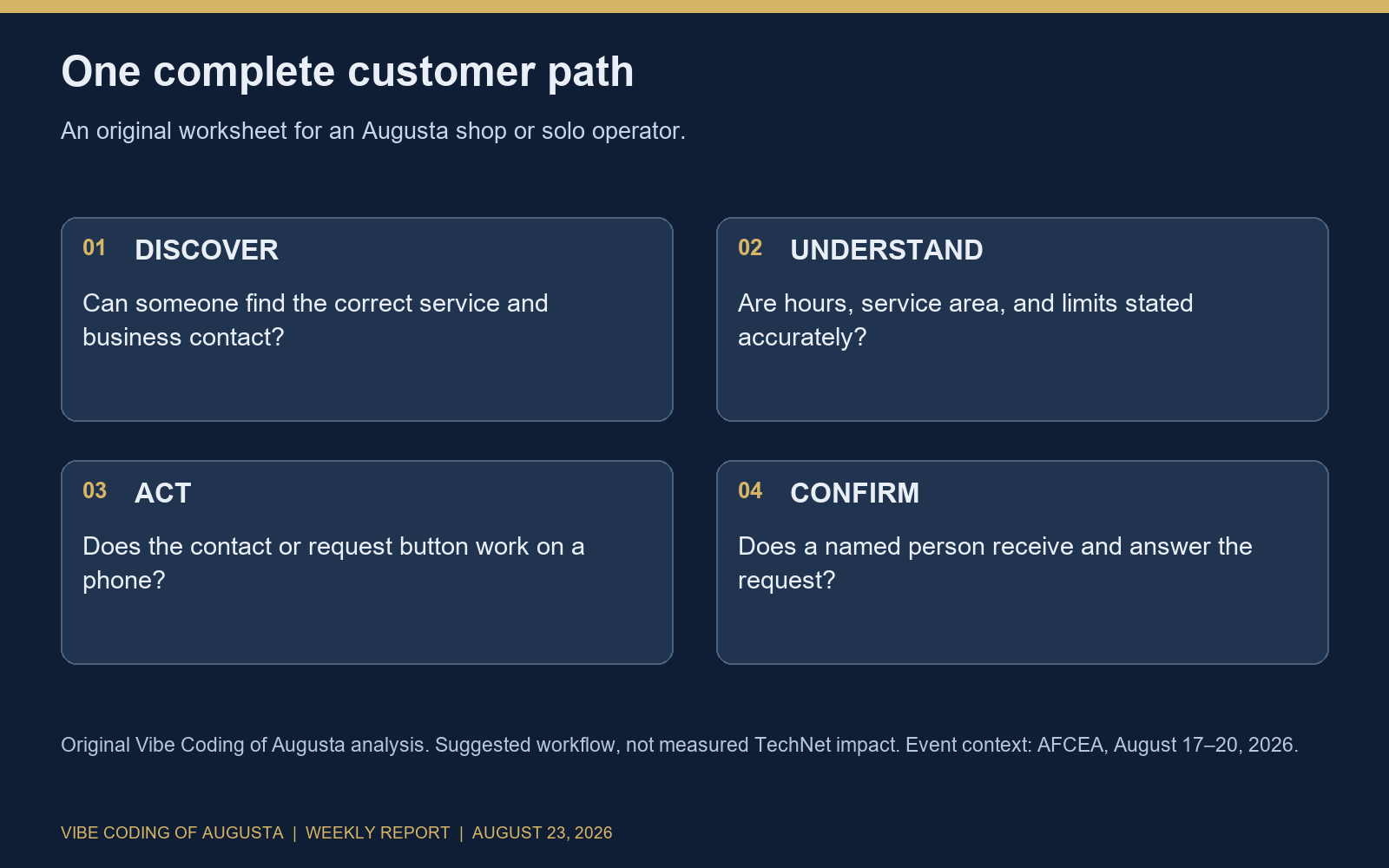
Original Vibe Coding of Augusta process graphic. It shows a proposed customer journey, not measured event impact or a customer result.
The neighborhood version of AI governance
Consider a hypothetical Augusta repair shop. Its AI-assisted page can explain normal service categories and help a customer describe the problem. It should not promise a repair price that the owner has not approved. An appointment request should arrive somewhere that a person checks. If the shop is closed or a job falls outside its service area, the customer should hear that before relying on an apparent booking.
The same principle applies to a home baker, a cleaning company, or a barber. The important boundary is the difference between helping someone ask a question and making a commitment on behalf of the business. A polished reply that promises the wrong thing creates more work. A simple form that clearly says what happens next may be much more useful.
Write down the current customer path in four sentences. Where does the person first encounter you? What information do they need before contacting you? What action do you want them to take? Who confirms that the action was received? If any sentence is vague, that is a better first project than adding a new AI subscription.
A local test that fits into an ordinary workday
Choose ten practice inquiries without using private customer information. Include a normal request, a request outside your hours, a service you do not offer, a question about price, and a person who needs to speak to someone. Ask a colleague to follow the same path on a phone. Record where they hesitate and whether the right person receives the inquiry.
The number ten is a manageable starting exercise, not proof that a system is safe in every situation. If one practice message is lost, investigate before sending more traffic. If the answer is unclear, rewrite the sentence. If a phone number is difficult to tap, correct the page. These observations are actionable even when you do not have enough customers to produce a statistically strong conversion analysis.
| Customer friction | Owner check | Possible service path |
|---|---|---|
| People cannot tell what I do | Ask someone unfamiliar with the business to explain the page back to you | Gateway Landing Page |
| A meeting ends without a usable contact route | Open your own shared contact link on another phone | Vibe Card |
| Questions repeatedly arrive after closing | List approved answers and a clear human escalation route | 24/7 Chatbot Customer Service Agent |
| An inquiry must be copied between tools | Trace one test inquiry from submission to receipt | Basic Automation Package |
These are service matches to investigate, not statements that a particular package includes every feature in this example. Scope the work before buying. The useful outcome is a confirmed customer path with an owner, not merely another page or bot.
Georgia: turn training into a finished small-business task
The earlier announcement that matters this week
The Georgia Chamber published an August 10 account of a free AI training event held in Macon on August 7. It described a national initiative targeting 40,000 entrepreneurs over three years, supported by in-person and digital learning. This is earlier context, not an event held during August 16–22, and the target is national rather than a Georgia participation count. Georgia Chamber announcement.
For an Augusta owner, the practical follow-up is to check the organizer’s current resources and availability rather than travel to a past event. The announcement does not establish an Augusta class date, an open seat, or a guaranteed business result. Training is valuable when it equips someone to complete a specific job after the session.
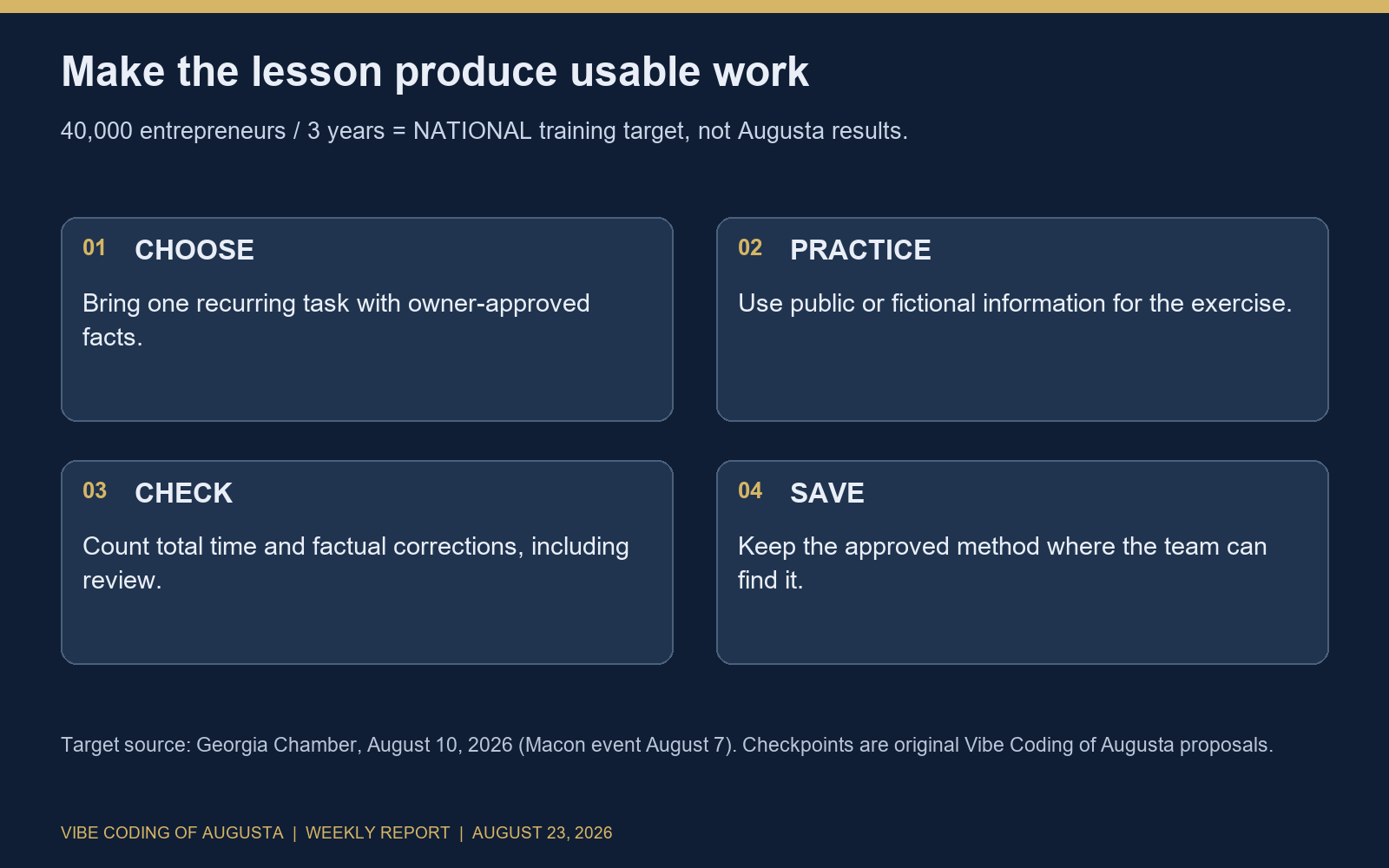
Original application worksheet. The 40,000 figure is the program’s national target over three years; the four checkpoints are our suggested practice sequence.
Bring a problem to the lesson
Suppose a small catering business needs a clearer way to explain its order process. A useful training exercise is to bring its existing, owner-approved ordering instructions and ask AI to draft a shorter version. The owner can check whether minimum notice, pickup arrangements, and contact details survived the rewrite. That produces something the business can inspect immediately.
An unhelpful exercise would ask a tool to invent the entire catering policy. The output might sound professional while adding a deposit rule or a delivery area the business never offered. The difference is the input: a known business process versus a request to manufacture one. Good preparation makes the owner the source of truth.
Before a class or self-directed lesson, create a one-page practice sheet. Name one task, the information the tool may use, the facts it must preserve, and the person who approves the result. Add one example of an unacceptable answer. This turns an abstract lesson about prompts into a test you can repeat after the instructor is gone.
Measure the whole task
A draft produced quickly is not automatically a task completed quickly. Include reading, correcting, formatting, and sending in your time record. If a tool writes an answer in seconds but the owner spends several minutes removing invented claims, the initial speed was misleading. Record the finished result and the effort needed to make it dependable.
Use a simple comparison sheet rather than a large dashboard. On one side, record how the task is currently handled. On the other, record the AI-assisted version. Include total minutes, factual corrections, and whether the customer can take the next step. Do not convert minutes into payroll savings unless paid working hours actually change; time returned to an owner can still matter without being presented as cash recovered.
After the exercise, keep the approved instructions in the business’s own workspace. Another employee should be able to find the current version. A screenshot of a successful chat is less useful than a short procedure that explains the inputs, review, and destination. If implementation is the remaining problem, a Basic Automation Package may be a fitting discussion. If the problem is simply unclear instructions, edit those first.
United States: AI can narrow a search, but a lead still needs proof
An August 19 small-business development
The Department of Energy’s August 19 webinar materials introduced free and low-cost AI tools for small-business opportunity research. The materials organized five public data sources and described a directory covering 138 DOE organizations. These resources concern federal opportunity discovery; the numbers do not represent contracts available to Augusta firms. DOE webinar materials.
For a local owner who already sells relevant services, the useful idea is to make research more selective. For someone whose customers are neighborhood households, federal contracting may not fit at all. We are not recommending that every shop become a government supplier. The transferable habit is to require evidence before treating any attractive name as a sales opportunity.
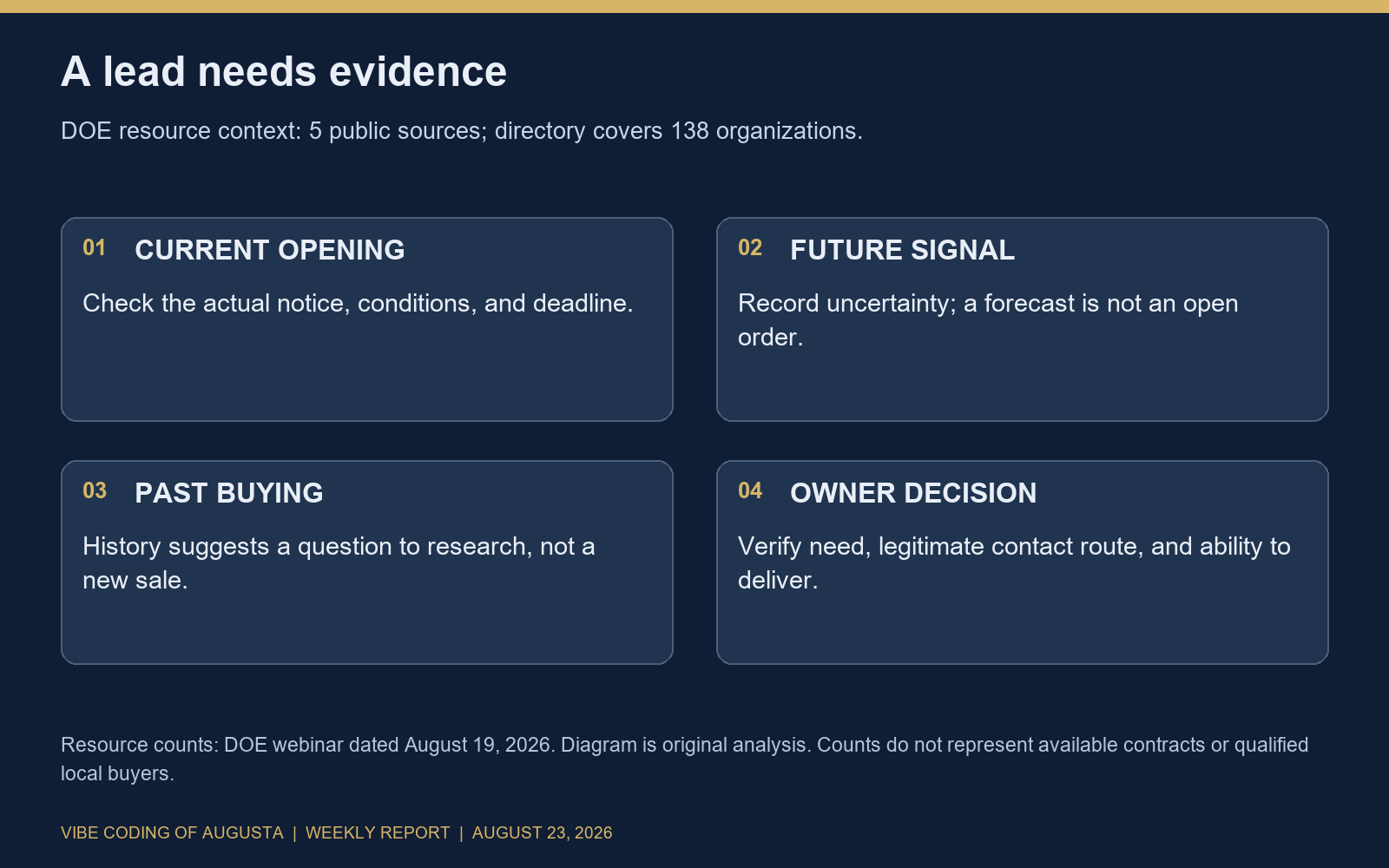
Original Vibe Coding of Augusta decision diagram. A current opening, a future signal, and past buying are different kinds of evidence, not interchangeable promises of work.
The Augusta owner’s opportunity filter
Start with what the business can actually deliver today. A hypothetical local cleaning company might have an established service area and a limited crew. A lead requiring a larger geography or staffing level may be unsuitable, even when an AI system assigns it a high score. The owner knows the operating limit; the software may not unless it is explicitly supplied.
Write a short capability description in ordinary language. List the service, area, capacity, and evidence of work you are authorized to share. Do not claim certifications, insurance, past clients, or performance that you cannot substantiate. AI can help make the wording clearer, but the information must come from the business.
Now ask three questions about a possible customer. Is there evidence they need the service? Is there a legitimate way to approach them? Can the business deliver under the stated conditions? A company name and an impressive logo do not answer those questions. If the evidence is missing, label the entry as research rather than a qualified lead.
This framework also applies to ordinary local selling. A neighborhood organization announcing an event may need catering, but the announcement does not prove it is accepting bids. An expanding shop may need cleaning, but you still need permission and a suitable contact route. AI-generated confidence is not a substitute for the actual facts.
Make the evidence easy to inspect
Keep one row per opportunity. Include the source link, the date you checked it, the specific need, and the next permitted action. If the entry is based on a historical purchase, say so. If the deadline has passed, do not recycle it as current. A short list of well-supported opportunities is easier for a busy owner to act on than a long list of guesses.
For a household-service business, an even better first use may be reviewing its own public presentation. Does its page state where it works? Does it explain which requests it accepts? Is there a clear way to ask for a quote? A Gateway Landing Page or Vibe Card may support those needs without pretending to deliver buyers automatically.
Do not spend a week polishing a capability statement for a market that does not fit. Set a small research budget in time, review the evidence, and decide whether to continue. Choosing not to pursue an unsuitable opportunity protects the time needed to serve existing customers. That is a legitimate business outcome even though it produces no dramatic AI success story.
Global: teach people to check the work, not fear the headline
Earlier international context
In an August 15 discussion, the OECD said young people face labor-market challenges but that current evidence did not establish AI as the cause of that trend. The publication also acknowledged that technology could change tasks and hiring. This is prior-week international context, not an Augusta employment measurement. OECD discussion.
That distinction matters locally. A business owner should not turn a broad story about AI into a prediction that a particular Augusta worker will lose a job. A resident should not assume that learning a single tool guarantees employment either. The useful question is which concrete skill becomes more valuable when software can produce a plausible first draft.
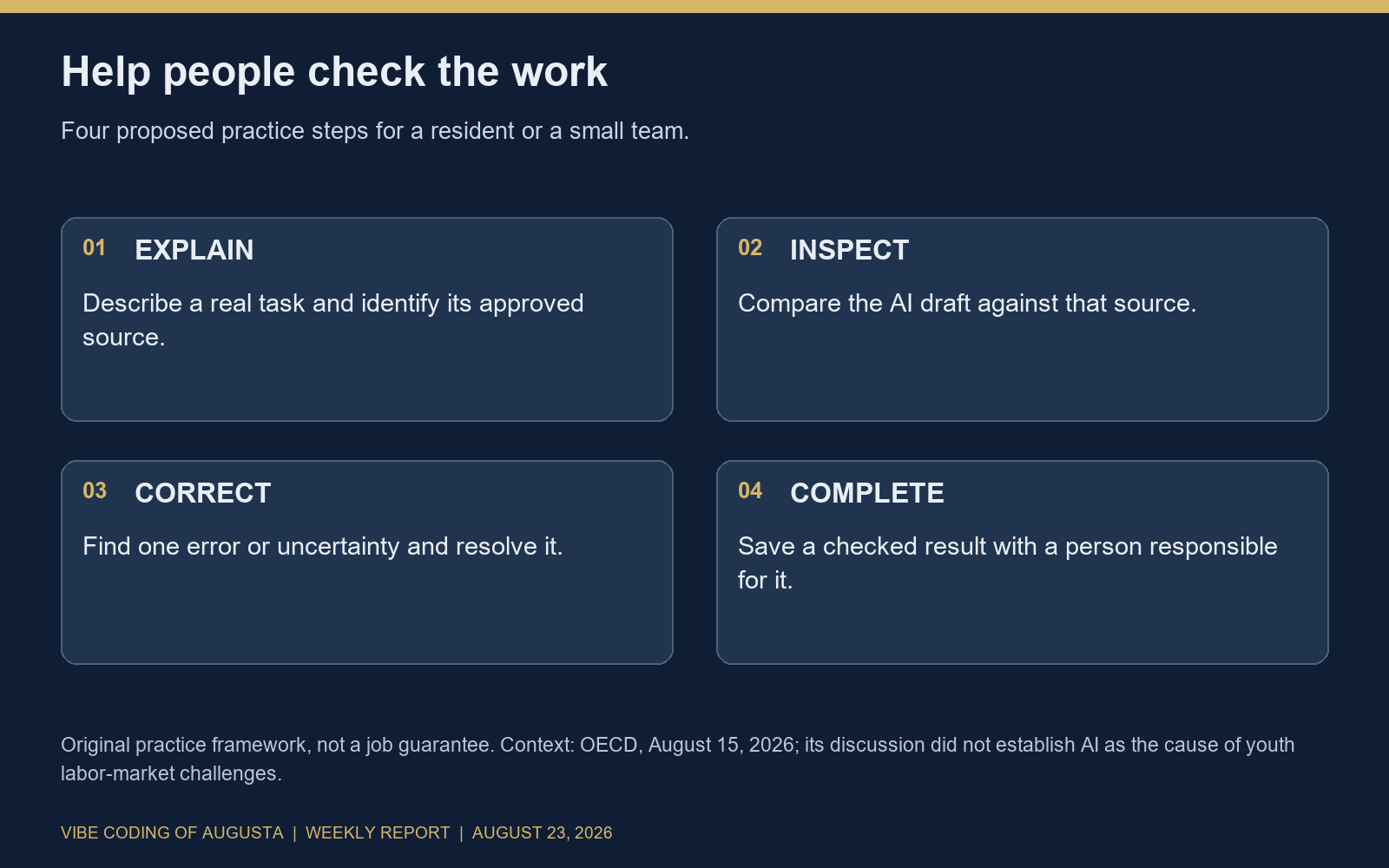
Original learning diagram for residents and small teams. It describes proposed practice steps, not a credential, job guarantee, or measured employment effect.
A better first assignment for a new employee
Give a new employee an approved service description and ask them to explain it to a customer in plain language. Let them use AI for a draft if the business permits it. Then ask them to point to the source for each factual statement. The exercise tests comprehension and judgment, not merely the ability to produce polished sentences.
Include one deliberate uncertainty, such as a service whose availability must be confirmed. A useful response preserves that uncertainty and names the next step. A weak response invents an answer to sound helpful. This distinction is particularly important for a small business, where one employee may represent the entire customer experience for several hours.
Residents can practice the same skill using public information. Compare an AI summary of an event with the organizer’s page. Check the date, location, and registration requirements. Notice which details the system omitted. Avoid practicing with private medical, financial, or customer records. Public information is enough to learn the essential habit of checking the source.
Keep the benefit visible to the team
Ask workers what part of the day repeatedly interrupts useful work. Their answer may be a missing template, an unclear handoff, or repeated searches for the same instruction. Solving that problem with the employee is more practical than announcing a broad transformation without explaining what changes tomorrow morning.
A small team can keep an error notebook alongside its approved examples. Record what went wrong, how it was corrected, and whether the procedure needs changing. The purpose is to improve the process rather than embarrass the person who found the error. If nobody feels comfortable reporting a bad answer, the owner loses the feedback needed to make the system dependable.
The fitting service depends on the problem discovered. Repetitive public questions may justify a customer-service agent with an approved knowledge base. Repeated hand-copying may justify basic automation. An unclear policy still needs an owner decision before either service helps. Technology should carry an agreed process, not conceal the absence of one.
Your seven-day Augusta action plan
This is a proposed practice sequence you can start whenever you read the backfill. It is not a claim that these actions were performed during the historical week.
| Day | One useful action | Evidence to keep |
|---|---|---|
| 1 | Choose one customer path | Four sentences describing discovery, understanding, action, and confirmation |
| 2 | List approved facts | Current service, hours, contact route, and limits |
| 3 | Run ten practice inquiries | Results and the point where each failed or succeeded |
| 4 | Repair the largest confusion | Before-and-after wording or a corrected handoff |
| 5 | Ask someone else to test on a phone | Their observations without coaching |
| 6 | Review an optional service fit | Defined task, owner, and acceptance check |
| 7 | Decide whether to keep or revise | A short record of what worked and what remains uncertain |
Do not try to repair every part of the business at once. If the inquiry form is broken, fix it before generating more marketing posts. If the form works but nobody checks the inbox, assign the responsibility. If both work and the questions are repetitive, then investigate whether an approved answer library or automation can reduce the burden.
The order protects a small owner’s attention. Marketing brings people to a path. The path needs to work before more people arrive. AI can help you produce many versions of an invitation, but the invitation must lead somewhere useful. That relationship is the practical connection between this week’s technology news and the day-to-day work of a local business.
Where Vibe Coding of Augusta can help
Bring one real problem and one example of how it happens. We can discuss whether a Vibe Card, Gateway Landing Page, Basic Automation Package, or 24/7 Chatbot Customer Service Agent fits the work. These are active service names; this report does not quote prices, promise sales, or define a package contract.
The first conversation should establish the result you want to inspect. That might be a contact page someone can use on a phone, a confirmed inquiry handoff, or a set of customer answers that stay within approved information. Agree on the evidence before calling the project finished. A tool being installed is different from a customer successfully using it.
Book a 30-minute conversation with Vibe Coding of Augusta and bring the customer step that currently causes the most friction.
Source ledger and reporting limits
| Source | Publication or event date | Geography and use |
|---|---|---|
| AFCEA TechNet Augusta and official program | Event August 17–20, 2026; page publication date not supplied | Augusta event dates and one AI-governance session; no attendance or economic-impact estimate |
| Georgia Chamber training announcement | Published August 10; event August 7, 2026 | Earlier Georgia context and a national three-year training target |
| DOE small-business webinar | Materials dated August 19, 2026 | United States opportunity-research resources; no verified local contract access |
| OECD youth and AI discussion | August 15, 2026 | Earlier international context; no local job-loss estimate |
Sources were checked while preparing this retrospective in September 2026. Event pages can change after an event. Examples, diagrams, practice counts, and the action plan are original proposals, not observations of named customers. No private customer records were used. Local savings, new contracts, attendance, and employment effects remain unmeasured in this report.


