Listen to the short overview
Weekly AI News and Regional Impact Report — August 30, 2026
Coverage: August 23–29, 2026 | Retrospective edition prepared September 13, 2026
By Eric Roane, Vibe Coding of Augusta
The decision this week
For an Augusta shop owner, the useful AI question is becoming more specific: which small piece of work deserves a trial, and what evidence would justify paying for it? A convincing demonstration is easy to watch. A dependable process that fits your opening hours, customers, staff, and budget takes more thought.
This week’s Georgia developments give ordinary owners two concrete entry points. A beginner class was scheduled in Albany on August 25, and the state announced a future financial-literacy webinar on August 27. Neither announcement proves that an Augusta business will save money. Both raise a practical question worth answering here: can learning lead to a controlled business decision instead of another subscription?
Our original local analysis follows that question from the CSRA through Georgia, the United States, and the world. The recommendation is a small, observable trial with an owner who can stop it. For a restaurant, that might mean drafting answers to catering inquiries. For a cleaner, it might mean organizing estimate requests. For a resident, it might mean turning a confusing public announcement into a list of questions to verify.
Evidence boundary: This is a retrospective report, not a claim that these pages were published in August. Two developments occurred during the coverage week. The national evaluation consultation was already open, and the local labor figures and international research are clearly dated background. We found no defensible weekly count of Augusta small businesses using AI and publish no invented adoption rate.
| Number or date | What it actually measures | Decision it helps |
|---|---|---|
| 10.6%, 9.8%, 8.8% | Augusta metro employment shares in office support, food service, and sales, May 2025 | Choose familiar everyday workflows |
| $39; two hours | Advertised Albany beginner class price and duration, August 25 | Evaluate learning effort; not an Augusta offer |
| September 21, 6 p.m. | Future free Georgia webinar announced August 27 | Prepare questions before attending |
| October 6 | Closing date of the open NIST evaluation-draft comment period | Recognize evaluation is an active national concern |
| More than 2,000; 12 countries | Participants and coverage of a nonrepresentative OECD SME survey | Learn from examples without claiming a local rate |
CSRA first: fix the handoff that customers actually experience
Augusta’s everyday economy gives this discussion a useful starting point. In May 2025, office and administrative support represented 10.6% of employment in the Augusta-Richmond County metropolitan area; food preparation and serving represented 9.8%; sales represented 8.8%. These are job shares across employers in a Georgia–South Carolina metro, not shares of small businesses, not counts of AI users, and not a prediction of jobs that will disappear. The Bureau of Labor Statistics released the figures July 7, 2026. BLS local employment release
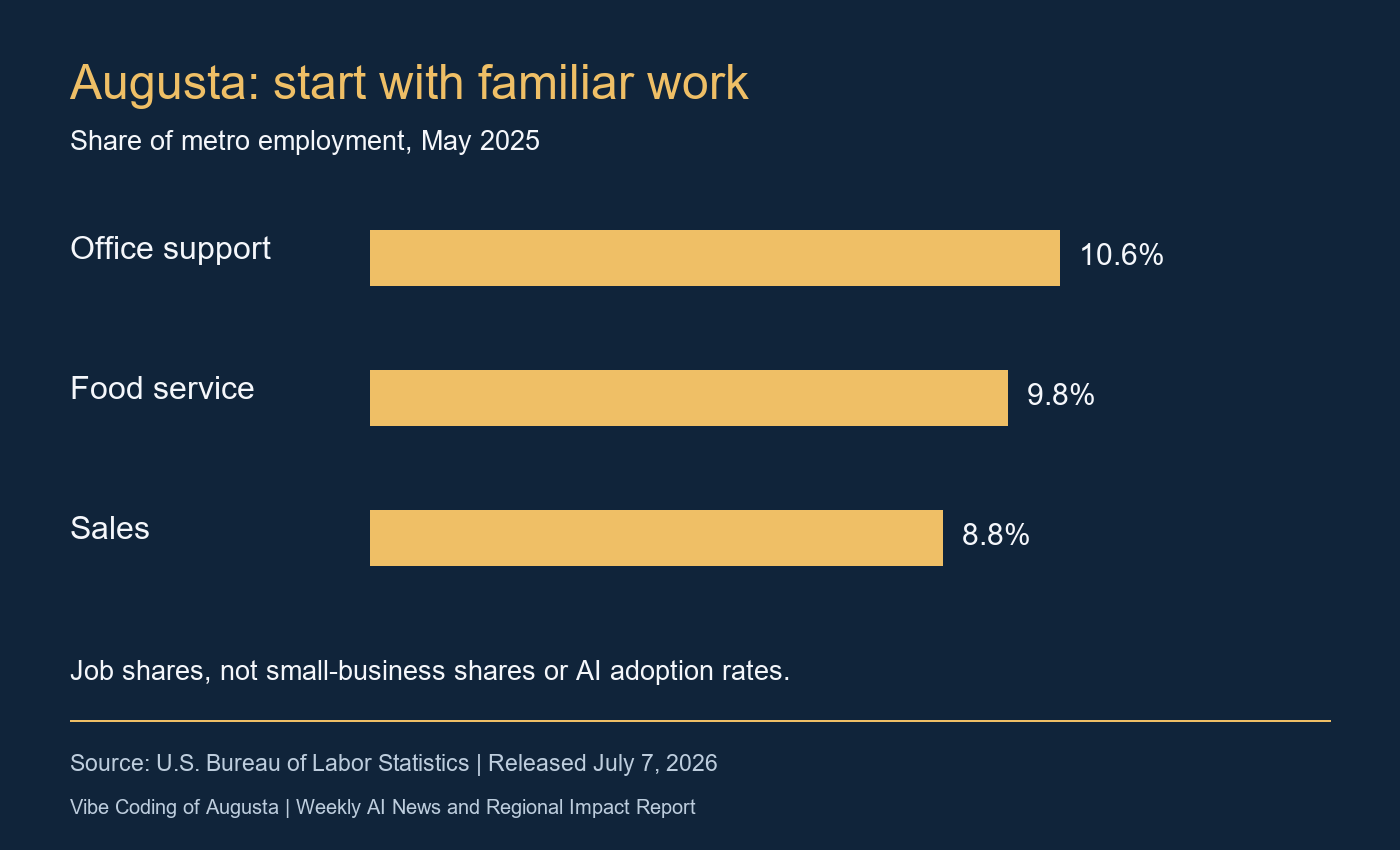
Local context: BLS, May 2025 employment, released July 7, 2026. The chart points to familiar work; it does not estimate automation or small-business ownership.
Our interpretation is straightforward: a useful local report should discuss the work people already recognize. Someone takes a call, records a request, checks an answer, passes it to another person, and eventually follows up. AI might assist a step, but the business still owns the entire customer experience.
Consider an illustrative Augusta home-service operator. A prospect asks whether the business covers their neighborhood and can provide an estimate. The owner is on another job. A delayed reply may be frustrating, but a quick inaccurate answer creates a different problem. An assistant that confidently promises a visit outside the service area has not solved the handoff. It has created an appointment the owner must unwind.
The first improvement is therefore a reliable source sheet: the actual service area, hours, estimate policy, contact method, and questions that require the owner. This may fit on one page. The first AI task is to draft an answer using only that sheet, with uncertain requests sent to a person. It should not invent availability, accept a deposit, or promise a price merely because the customer asked.
For a food business, the same method could organize catering inquiries. Approved package descriptions can help draft a response. Ingredients, allergies, substitutions, and final availability still need the business’s established checks. For a retailer, a draft can explain the published return process; an unusual dispute should reach the owner. These examples are proposed workflows, not reports of named local customers or proven results.
A trial you can measure before buying more
Pick one task that happens often enough to observe this week. Write down the current method, then record the next ten examples. Ten is a practical starter sample selected for this exercise, not a statistical standard. Include easy requests and inconvenient ones, because the inconvenient ones are where a polished demonstration can fail.
For each example, record minutes spent, whether the answer was correct, whether a correction was needed, and whether the customer reached the next step. During a trial, keep the same definitions. Count the time spent checking and correcting AI output. Otherwise, work moved from writing to cleanup may look like savings that never happened.
Suppose ten manual responses take 100 minutes in total. Suppose AI drafting plus review takes 70 minutes. The observed difference would be 30 minutes for that sample, not guaranteed weekly savings and not cash profit. If two of the assisted replies also contain unacceptable errors, the owner must decide whether the process needs revision before further use. This example uses invented round numbers solely to demonstrate the calculation.
Residents can use a simpler version. Ask an AI tool to explain an announcement, then compare its dates, eligibility statements, and contact details with the original. The win is understanding a document well enough to ask a better question. It is not outsourcing judgment about money, health, or a legal obligation.
Where our services fit: A Gateway Landing Page or Vibe Card may address an unclear customer next step. A Basic Automation Package may fit a stable handoff between known steps. A 24/7 Chatbot Customer Service Agent may be worth discussing when approved answers and a human escalation path already exist. The appropriate starting point depends on the problem; a chatbot is not automatically the answer to every missed inquiry.
Georgia: turn a class or webinar into a business decision
The SBA event listing advertised a UGA Small Business Development Center Albany beginner AI class for August 25, 2026, from 9:30 to 11:30 a.m., at $39. Its advertised subjects included choosing tools, improving prompts, recognizing risks, and beginning internal AI processes. This was an Albany event, not a free class in Augusta. The listing establishes the scheduled opportunity, not attendance or outcomes. SBA event listing
On August 27, the Georgia Secretary of State announced a free FIN FIT webinar for September 21 at 6 p.m., covering funding and responsible AI-supported decision-making. The announcement offered online and phone participation. As of this report’s August coverage window, that session was still in the future; it was not training already delivered. Georgia announcement
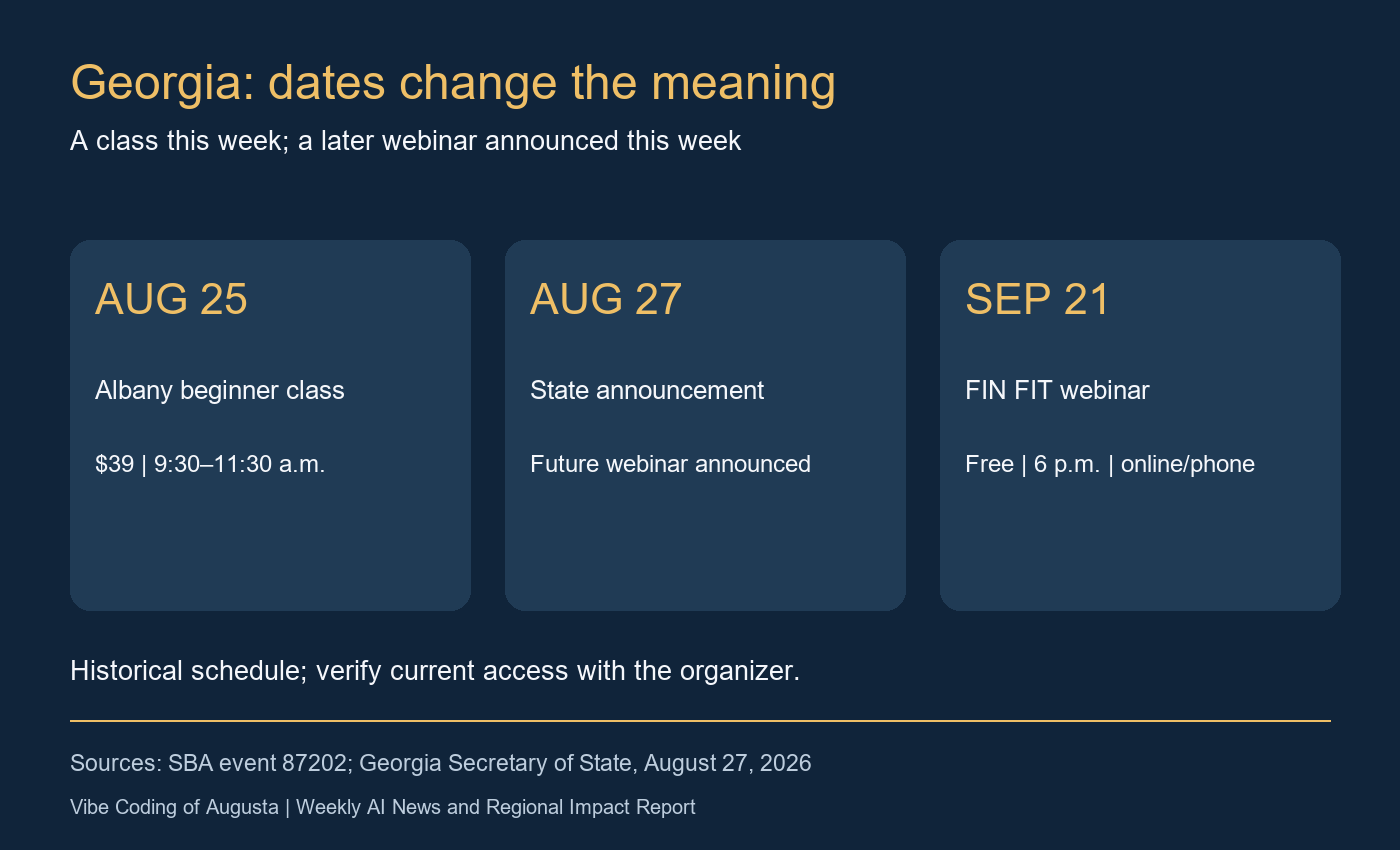
Dates and advertised access from SBA and Georgia Secretary of State. A scheduled event is not evidence of participation, continuing availability, or business results.
The distinction matters to a CSRA owner with limited time. A statewide news item can be useful without being conveniently local. Before committing to any future session, check the organizer’s current page for location, access, date, cost, and registration. For a historical session, look for a verified recording or a later equivalent; do not assume either exists.
Our practical recommendation is to arrive at training with a single work example. “I want to understand AI” is a reasonable beginning, but “I need a first draft of a catering response without inventing a menu price” is a better test of whether a session helps. Remove private customer details before using the example. Bring the approved facts that should control the answer.
After learning a technique, repeat that same example on your own. A class can feel clear while an instructor is guiding every step. The independent repeat reveals missing instructions, unclear inputs, and the amount of supervision the process requires. Ask a second person to follow the written process if someone else will eventually operate it.
Keep funding literacy separate from a sales pitch
A shop may be tempted to combine a tool purchase, a new website, marketing, and financing into one large decision. That makes it difficult to identify which change is useful. Separate the operational problem from how anything will be paid for. First define the job. Then identify a modest test. Only after that should the owner compare actual proposals and obtain appropriate professional advice on financing questions.
AI can help organize questions from documents, but an answer generated from incomplete terms can omit the very detail that matters. Ask where each extracted number appears in the original. If a document does not state an item clearly, record it as unknown. Do not let a plausible answer fill the gap. A qualified adviser should address suitability and obligations; this report is an operating checklist, not a recommendation to borrow.
For an illustrative independent retailer, a useful preparation sheet might have separate rows for the tool’s quoted cost, setup work, staff learning time, ongoing support, and cancellation process. Some rows will have numbers; others will be unresolved questions. That is an honest buying document. A single attractive monthly figure with the other rows missing is not enough to compare alternatives.
There is also an opportunity to avoid buying prematurely. If the business cannot state its opening hours consistently, locate its approved service descriptions, or identify who follows up on a request, those gaps deserve attention first. A clear information page and a dependable contact path may make the next AI experiment easier to assess.
Where our services fit: Complete Web Design Package, Gateway Landing Page, and Professional Email can be discussed when the customer-facing foundation is the problem. Basic Automation Package can be scoped after the handoff is understood. These are service options, not claims that any particular purchase qualifies for funding or pays for itself.
United States: a tool should pass your work test
During this coverage week, NIST’s public consultation on an AI-evaluation draft remained open. Announced August 7, with comments due October 6, the draft described a four-stage approach to constructing assessments around an organization’s objectives. It was an initial draft, not a certification that a commercial product is safe or effective. NIST evaluation initiative
That is the national context. Our Augusta application is smaller and deliberately practical: ask a potential tool to handle a defined set of examples before giving it a larger job. The following scorecard is our own exercise, not a NIST test, endorsement, or compliance standard.
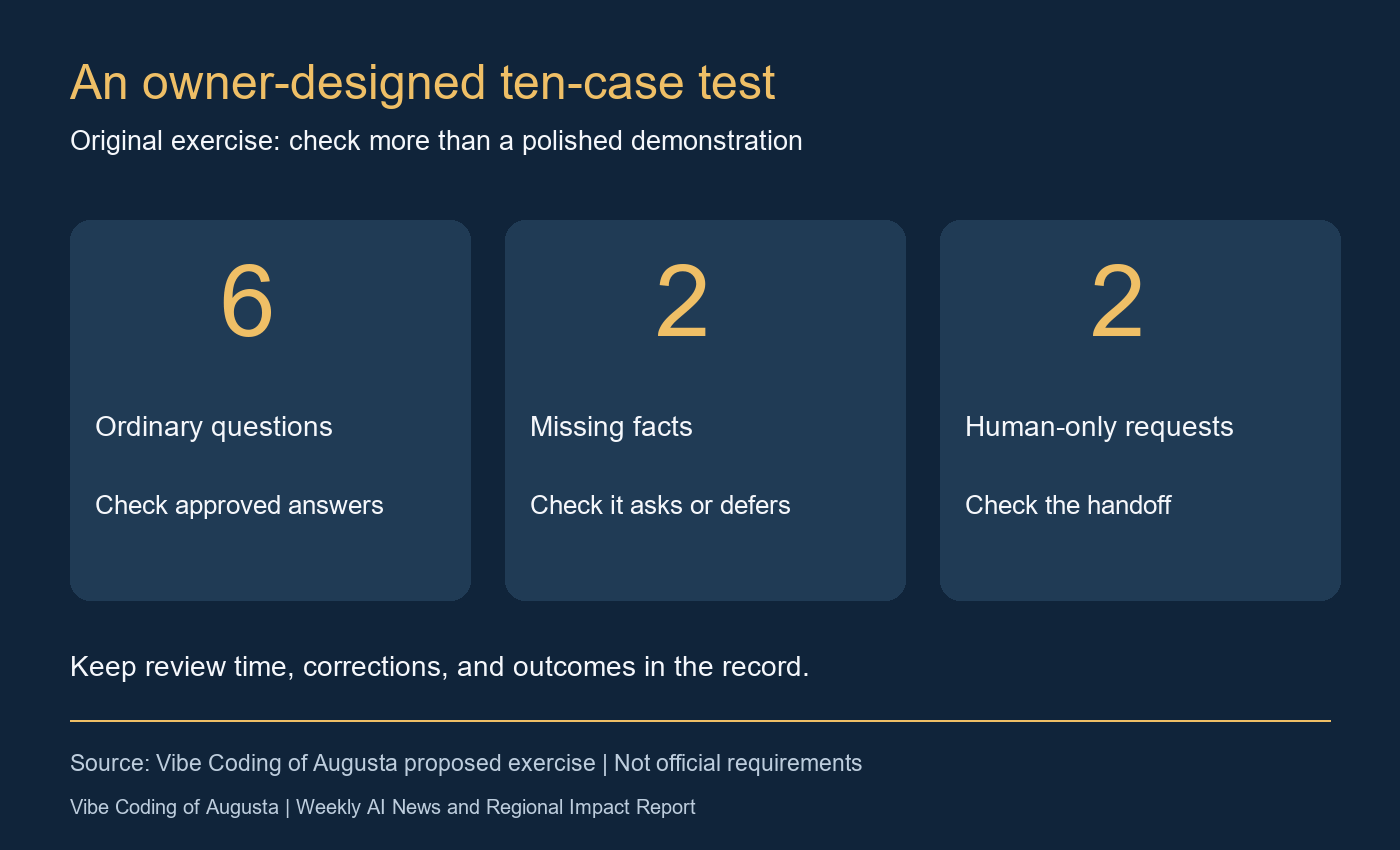
Vibe Coding of Augusta proposed test design. The counts are an illustrative starter exercise, not measured research or official requirements.
Start with six ordinary examples that have clear approved answers. Add two requests where an important fact is absent. Add two that should go to a person. A cleaning business might know the published service area but need a human to discuss a damaged item. A repair shop might explain how to request an appointment without diagnosing a problem from a vague message.
The exact mix will vary. What matters is testing more than the easy demonstration. A tool that writes a pleasant paragraph has shown writing ability. It has not yet shown that it can recognize a missing fact, stay inside the business’s policies, or hand off an exception without losing the customer’s question.
Score correctness and handling separately. A response may contain accurate facts but be too confusing for the customer. Another may sound helpful while promising something the business cannot deliver. A third may appropriately say that someone will follow up, but fail to record where the request needs to go. Keep these distinctions visible so that fixing one issue does not hide another.
Decide what “ready” means before the demonstration
The owner should write down unacceptable behaviors in advance. Examples might include fabricated prices, disclosure of another customer’s information, or an appointment confirmation without access to verified availability. Those are examples of operational boundaries; each business must establish the ones relevant to its work.
Then agree on what happens after a failure. Will the wording be corrected and the same example rerun? Will a new example be added to check that the correction generalizes? Will the task remain human-only? A trial that can only end in purchase is not a useful evaluation.
Keep a copy of the approved instructions, the examples, the outputs, and the review notes. This gives the owner something concrete to compare when a tool or process changes. It also makes handover easier if the employee who built the trial is absent. The record can be simple; its value is that another person can reproduce the check.
For a solo operator, the largest benefit may be discovering a narrower useful job. Perhaps the tool cannot reliably answer customers directly, but it can organize incoming questions for the owner. Perhaps it should draft three versions of a social post while the owner selects and checks one. A smaller assignment can still be valuable when its boundaries are clear.
Where our services fit: An automation or customer-service engagement should begin with the proposed inputs, outputs, reviewer, and escalation path. Social Media Marketing may fit the drafting-and-review example. Ask for a demonstration using your approved information and a documented next step, rather than assuming that a generic demonstration proves your use case.
Global: learn from small firms without importing a false statistic
The OECD’s April 13, 2026 report on its digital small-business survey described more than 2,000 small and medium-sized enterprises across 12 countries. It explicitly called the sample nonrepresentative. That research is useful background for learning about patterns and barriers; it cannot tell us the percentage of Augusta businesses using AI. It is not a new release from August 23–29. OECD survey description
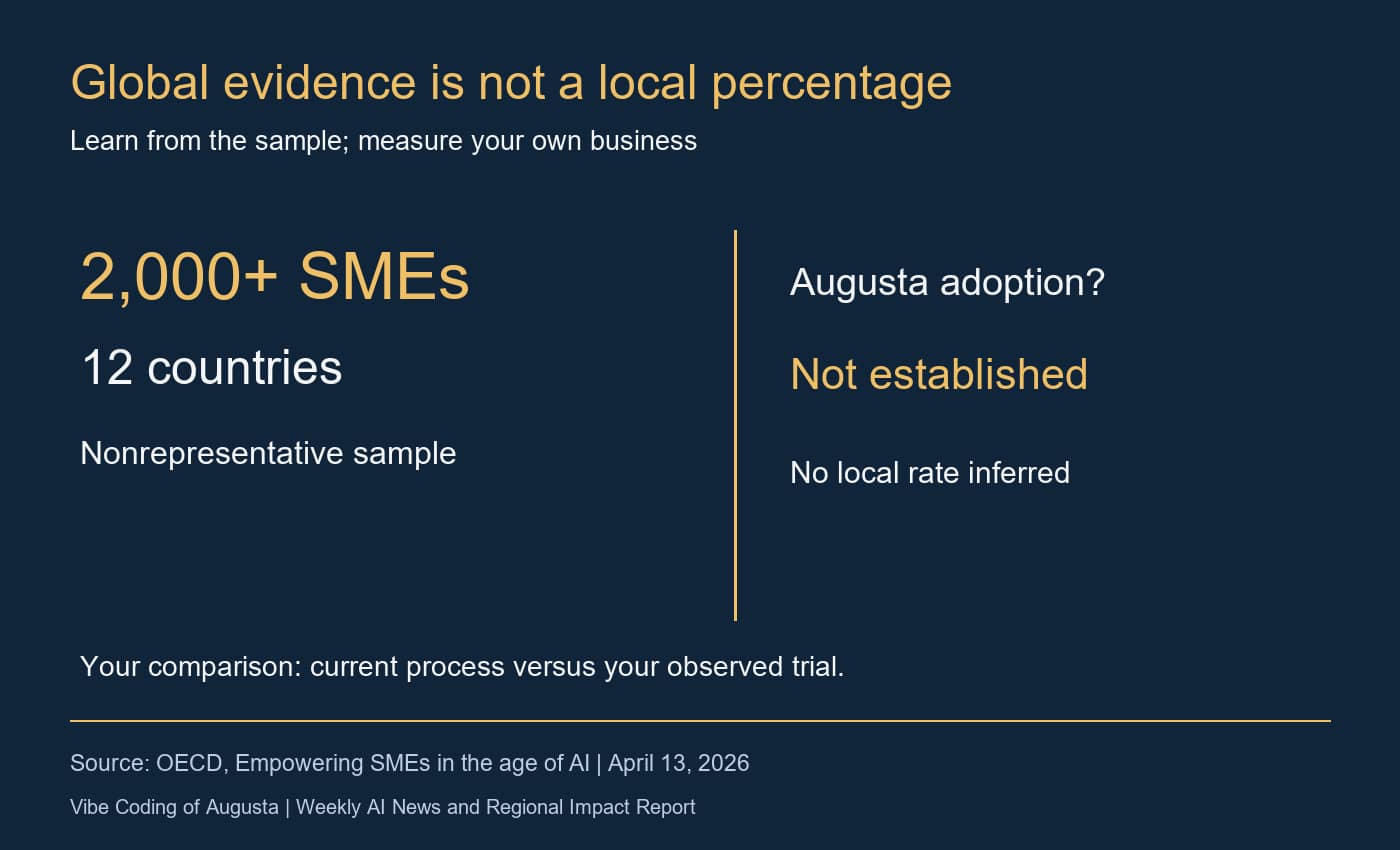
OECD, April 13, 2026. A nonrepresentative international sample does not establish an Augusta adoption rate. No local percentage is estimated here.
Our local conclusion is that examples travel more safely than percentages. An owner can study how another firm organized its customer information, then ask whether the method fits a shop in the CSRA. But a finding from different countries, business sizes, and recruitment methods should not become a claim that neighbors are already far ahead.
This matters because fear is a poor purchasing brief. “Everyone is using it” does not identify a task, show a cost, or explain who fixes an error. A better comparison is between your current process and a documented trial under your conditions. That remains useful even when international adoption headlines change.
A local business may also rely on a tool supplied from elsewhere. Before adopting it, establish where the business can get help, whether its own material can be exported, and how to continue if access stops. Verify the actual provider terms for the account and service being considered. A product name alone does not answer those questions.
For an Augusta owner, continuity can be very practical. Keep an accessible copy of approved answers and service information. Know the ordinary email or phone route that works if the assistant is unavailable. Make sure an employee knows which requests are waiting. Those habits help preserve the customer relationship while the technical issue is resolved.
Residents should apply the same preference for traceable information. If an AI explanation mentions a public program, follow the original agency link. If the answer gives a number, ask what place and period it describes. If it cannot identify a source, treat the statement as unresolved. Fluency is a presentation quality; it is not evidence.
Where our services fit: Professional Email and a clearly maintained website can support a stable contact path. Any proposed automation should explain its handoff and recovery process. These are requirements to discuss during scoping, not promises that a named package includes every continuity feature.
Your seven-day Augusta action plan
Use this sequence at a pace your business can sustain. It is an original implementation exercise rather than a guaranteed timetable. If a step exposes an unresolved problem, resolve it before extending the trial.
| Day | Owner’s action | Evidence to keep |
|---|---|---|
| 1 | Choose one repeat customer question | A plain description of the problem |
| 2 | Gather approved facts | One dated source sheet |
| 3 | Record the manual process | Time and corrections for sample cases |
| 4 | Try assisted drafts with review | Drafts and corrected versions |
| 5 | Test missing facts and exceptions | Examples routed to a person |
| 6 | Compare effort and quality | Review time included in totals |
| 7 | Continue, narrow, revise, or stop | A written owner decision |
Do not judge the trial only by whether it produced more words. Ask whether the customer got a clearer answer, whether staff could verify it, and whether the next action actually happened. A completed draft that sits unseen does not resolve a customer request.
If the test succeeds, expand one dimension at a time. Add a type of question, an operating hour, or a staff user, then check the result again. Changing several things together makes problems harder to trace. If the test fails, preserve the examples. They are useful information for a better process, not a reason to hide the outcome.
Match help to the problem
| Problem you can demonstrate | Service worth discussing | Question to settle before scope |
|---|---|---|
| Customers cannot find the next step | Vibe Card or Gateway Landing Page | What single action should the visitor take? |
| Requests stall between people | Basic Automation Package | Who receives each request and confirms completion? |
| Repeated questions interrupt work | 24/7 Chatbot Customer Service Agent | Which answers are approved and which require a person? |
| Useful posts never reach review | Social Media Marketing | Who checks the claims and approves the message? |
| Contact information is inconsistent | Complete Web Design Package or Professional Email | Which source is authoritative? |
These are fitting conversations, not universal prescriptions. Bring a real example, the current process, and the result you want to observe. Vibe Coding of Augusta can discuss an appropriate scope using the service options above. No price, savings guarantee, customer outcome, or financing eligibility is asserted in this report.
Book a 30-minute conversation with Vibe Coding of Augusta.
Source ledger and reporting limits
- BLS Augusta occupational release. Published July 7, 2026; data May 2025; Augusta-Richmond County GA–SC metropolitan employment. Background, not a weekly AI adoption measure.
- SBA Albany beginner event. Event scheduled August 25, 2026; $39 and two hours advertised. In-week event listing; attendance and delivery not independently established.
- Georgia FIN FIT announcement. Published August 27, 2026; announced September 21, 6 p.m. free webinar. Future opportunity as of coverage.
- NIST evaluation draft consultation. Announced August 7, updated August 14; comments due October 6, 2026. Ongoing national context; initial draft, not product certification.
- OECD small-business AI report. Published April 13, 2026; nonrepresentative international sample. Background, not a CSRA statistic.
All links were checked September 13, 2026. Proposed local examples, scorecards, arithmetic, and service mappings are original analysis. They are not customer case studies or measured Augusta outcomes. Historical events are described as scheduled or announced where those are the facts the sources establish.


1 Comment
bdpk0k · September 14, 2026 at 12:37 pm
Really impressed with how polished everything looks and feels. The navigation is intuitive and I never feel lost when switching between different sections. It just makes my downtime so much more enjoyable. Check it out bdpk0k
Comments are closed.