Listen to the short overview
Weekly AI News and Regional Impact Report | Retrospective issue: August 16, 2026
Reporting window: August 9–15, 2026. Prepared September 13, 2026.
By Vibe Coding of Augusta
The decision for Main Street
An Augusta shop owner does not need another reason to be busy. The useful question about artificial intelligence is whether it can remove a specific piece of work without creating another problem for the customer. This issue starts with a concrete development: on August 10, the Georgia Chamber reported that its foundation and national partners had brought free small-business AI training to Macon. The workshop itself occurred August 7; the announcement falls within this report’s coverage week. The national program aims to reach 40,000 small businesses over three years. That is a training target, not a count of companies already trained, and not an Augusta enrollment figure. Georgia Chamber announcement
For a CSRA business, the practical implication is a sequence: learn one technique, test it on one recurring customer question, and measure the work from beginning to end. Completing a class is useful preparation. A correct response that reaches the customer, at a lower total effort, is the business result.
This report separates the week’s announcement from earlier background research. National survey findings and a May product release help evaluate the opportunity; they are not presented as August breaking news. The local examples below are illustrative workflows, not accounts of actual Augusta customers or claims of measured local savings. No representative Augusta AI-adoption survey was established for this issue.
| Number | What it actually describes | What it does not establish |
|---|---|---|
| 40,000 | National three-year training goal | Augusta businesses enrolled or trained |
| 750 | Owners/operators in an earlier national survey | A sample of Augusta owners |
| 54% | AI-using employers reporting a mostly positive impact on task time | A guaranteed percentage reduction in time |
| 15 | Workflows advertised in an earlier vendor release | Fifteen suitable automations for your shop |
The most useful number will come from your own business: how many minutes it takes to give one customer a complete, accurate answer today.
CSRA: start where the customer is waiting
There is also a regional connection beyond Macon. The national program’s current public calendar lists a July 28 training through the Thomson-McDuffie Chamber of Commerce. That is a CSRA location and earlier background, not an August 9–15 event. The listing establishes a regional training stop; it does not disclose attendance, participant results, or a new registration opportunity. A Thomson or Augusta owner can use that connection to ask about follow-up resources without assuming another class is scheduled. National program calendar
Consider an illustrative owner-operated repair business in Augusta. A potential customer asks what information is needed before an estimate. The owner is on a job, the message waits, and the eventual answer must explain the same process again. AI could draft a clearer response from an approved checklist. But it cannot know the shop’s current availability, service area, or quoting policy unless those facts are supplied and maintained.
The first improvement is therefore a short, reliable reference sheet. Write down the services offered, the information needed for an estimate, the hours when a person answers, and the next step for an unusual request. Mark who owns each fact. A customer-facing answer should not guess that a technician is available tomorrow just because tomorrow sounds helpful.
For a salon, the recurring question might concern preparation before an appointment. For a caterer, it might be the details needed to discuss an event. For a lawn-care operator, it might be the property information required before scheduling a visit. These are different businesses, but the same design works: approved facts, a bounded draft, human checking, and a clear next step.
A measurement example you can replace with your own numbers
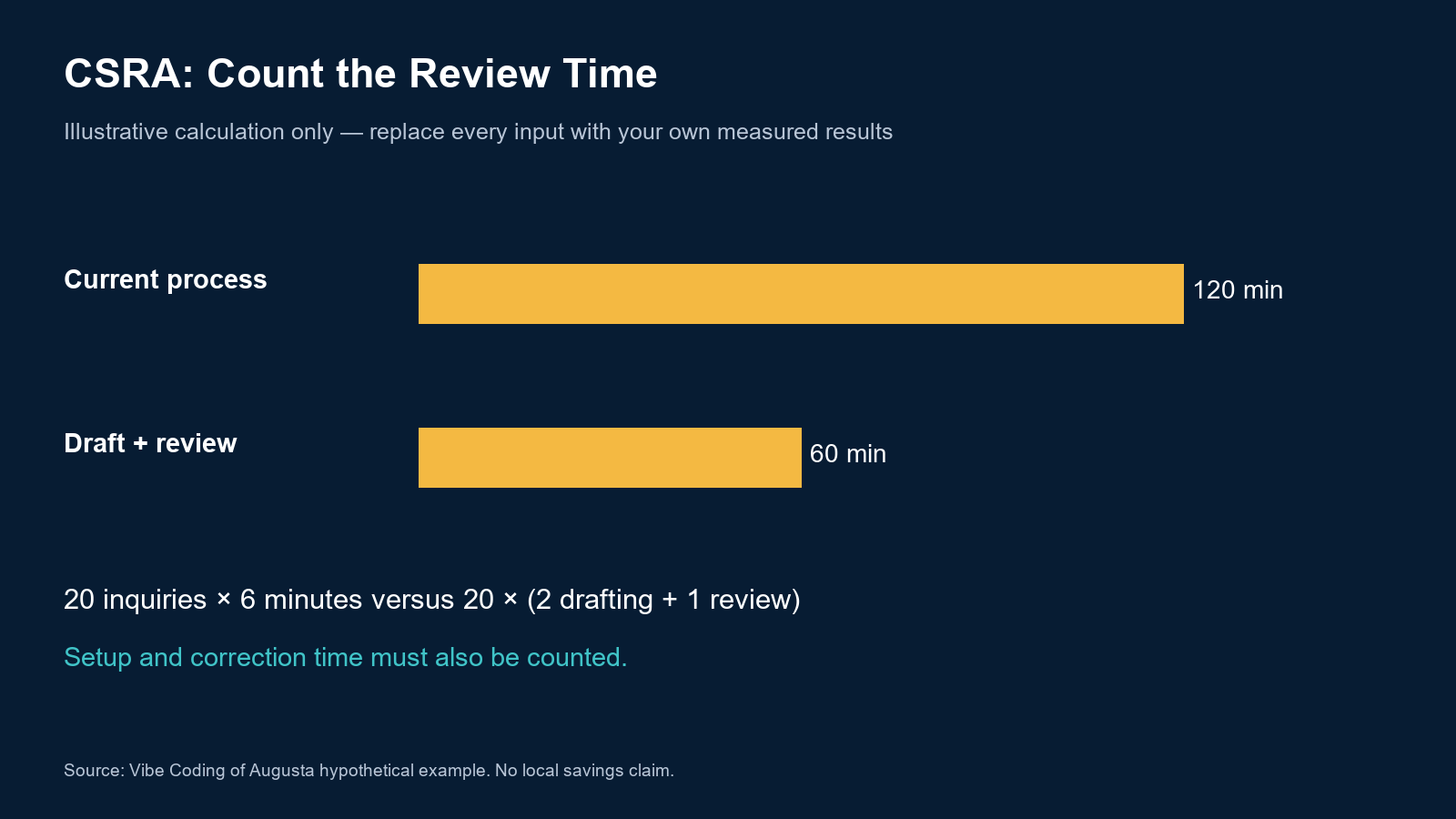
Suppose an owner handles 20 similar inquiries in a week. Without assistance, each takes six minutes. That totals 120 minutes. Suppose a trial reduces drafting to two minutes, but checking still takes one minute. The new total is 60 minutes. The difference is one hour, before setup, corrections, or subscription costs.
Those are hypothetical numbers, not observed Augusta outcomes. Their value is the calculation. If setup consumes two hours, a one-hour weekly saving does not repay that time in the first week. If the answers need substantial correction, the improvement may disappear. If the owner uses the freed hour to finish estimates, record how many estimates actually go out. Time available is not automatically revenue earned.
| Illustrative task | Without assistance | Assisted draft plus review |
|---|---|---|
| Time per inquiry | 6 minutes | 3 minutes |
| Inquiries per week | 20 | 20 |
| Weekly handling time | 120 minutes | 60 minutes |
| Setup time | Not included | Must be counted separately |
An Augusta owner can run this test with a notebook. Record the time the question arrives, the time a complete answer leaves, minutes spent working, and whether a correction was necessary. Waiting time and labor time are different. A draft produced instantly may still sit unreviewed all afternoon.
Make the front door understandable before adding automation
If customers cannot find the booking link or do not understand what the business offers, the immediate problem may be the information layout. A Vibe Card provides a mobile-first place for service information, contact details, links, and an existing booking route. Its usefulness should be judged by whether a customer can reach the right next step without asking the owner to repeat instructions.
A Gateway Landing Page may fit a focused offer that needs more explanation. A customer-service chatbot is a different decision: it requires an agreed knowledge base, escalation rules, and a maintenance owner. The presence of AI in the news does not make the more complex option the right starting purchase.
For residents, the same lesson applies when using AI to understand a service. Ask for a plain-language explanation of the business’s published instructions. Confirm hours, prices, appointment availability, and exceptions with the business itself. A fluent summary does not turn an old page into current information.
Georgia: free training should produce one usable exercise
The Macon announcement identifies a concrete training approach: basic AI understanding, data protection, use with familiar tools, and practical implementation. It demonstrates activity in Georgia; it does not establish that an Augusta workshop occurred or that local seats are currently available. Owners should check the program and their local chamber for current participation options. Program information
The original local recommendation is to arrive at training with a task, not a shopping list. Choose work that repeats often enough to measure and has a clear correct answer. Preparing a response to a common question is a better first exercise than asking a tool to operate the entire company.
Bring a sanitized example. Replace a customer’s identifying details with placeholders. Bring the approved policy or service description that a good answer must follow. Write down the mistakes that would make the answer unusable. This gives the class exercise a finish line.
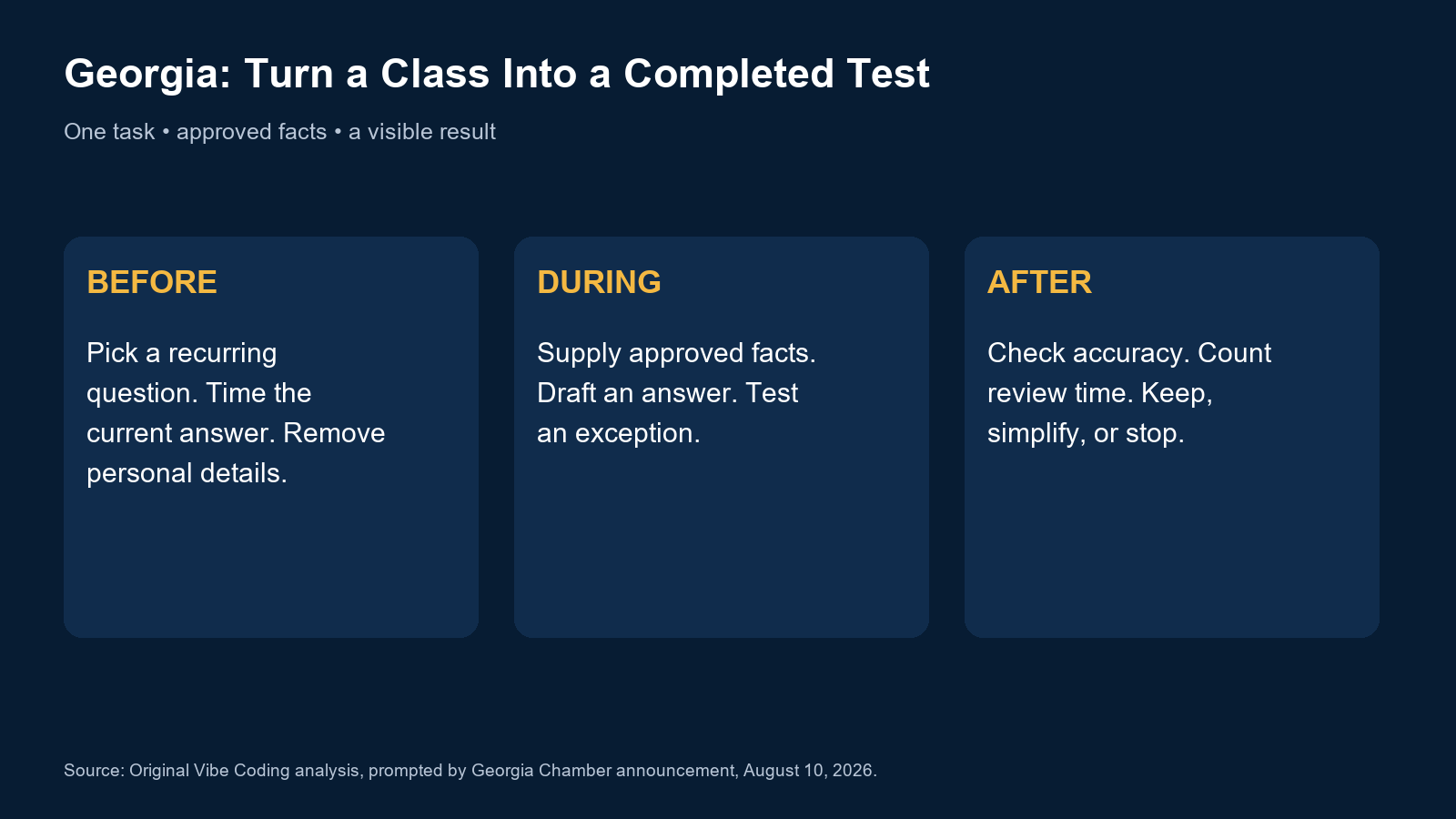
A practical training worksheet
| Before the session | During the exercise | After the session |
|---|---|---|
| Pick one recurring question | Supply approved facts | Check every factual statement |
| Time the current process | Ask for a short draft | Count corrections and review time |
| Remove personal details | Compare two versions | Save the version that passes |
| Define a good answer | Test an unusual request | Decide whether to repeat the trial |
A useful exercise should reveal where the tool stops being helpful. Ask the same system about a service you do not offer. Ask it about an appointment time that has not been confirmed. A safe result is an honest handoff or a request for clarification. A confident invented answer is a reason to keep that workflow out of customer-facing use until it is corrected.
For a family business, write the successful procedure so another family member can repeat it. Include which reference sheet to use, where the draft is saved, and who checks it. If only one person remembers the special wording that makes the tool behave, the business has acquired another dependency rather than a dependable process.
Georgia’s training opportunity is most valuable when it helps an owner make a smaller, clearer decision. Continue with the manual process if the trial is slower. Use a reusable template if that solves the problem. Discuss a Basic Automation Package only when there is a repeated handoff worth connecting and a clear way to verify success.
United States: measure completed work, not a promising percentage
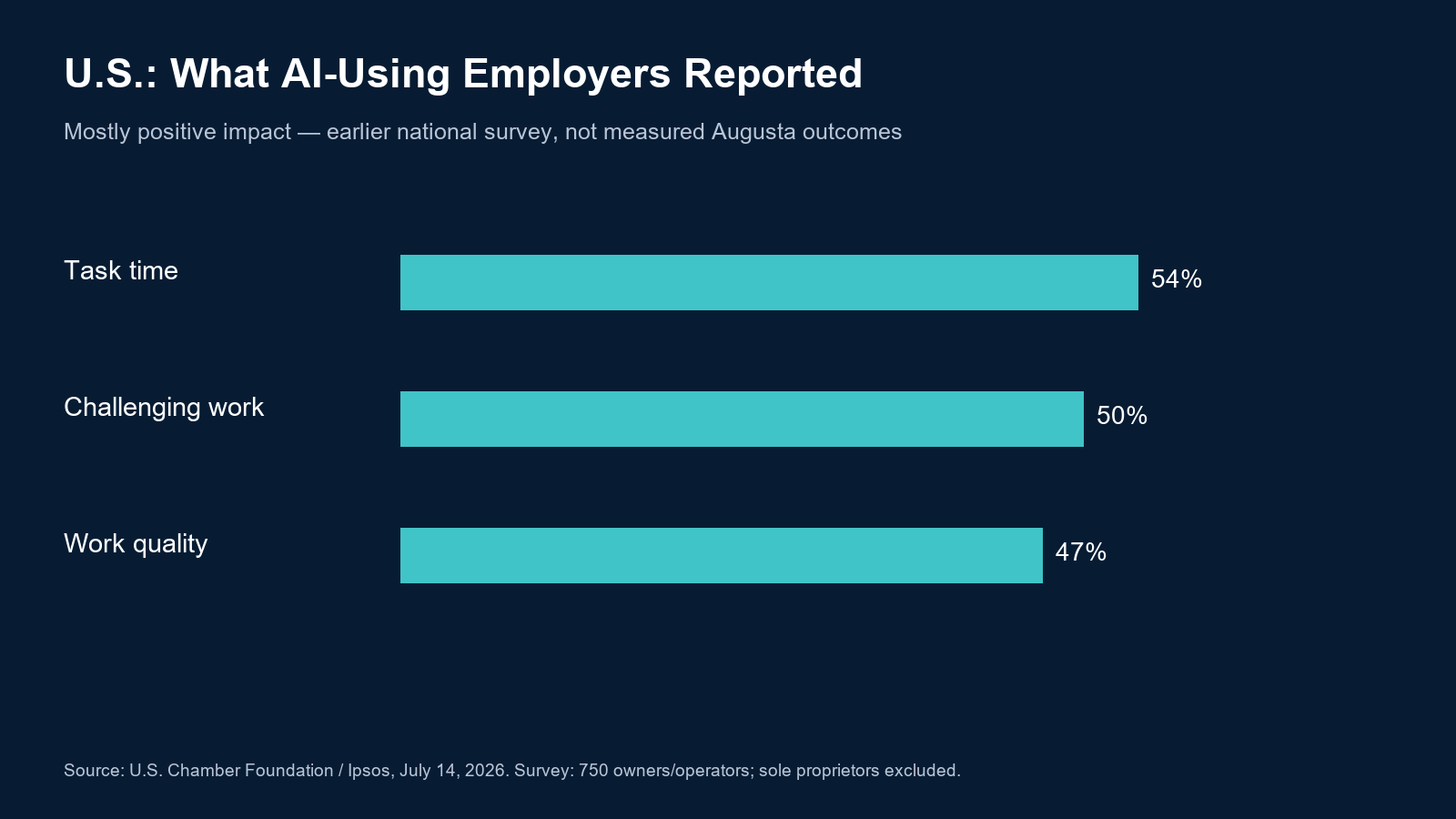
Earlier national research provides perspective. A July 14 U.S. Chamber Foundation article describes an Ipsos survey of 750 small-business owners and operators conducted May 19–June 4. The sample excluded sole proprietorships and covered businesses with 500 or fewer employees. Among respondents whose businesses used AI, 54% reported a mostly positive effect on task time, 50% on ability to undertake more challenging work, and 47% on work quality. These are reported assessments, not experimentally measured time savings. Survey and methodology
That distinction matters for the Augusta owner working alone. A national employer survey cannot tell a sole proprietor what will happen in their business. It can suggest what to measure. The three useful categories are speed, quality, and the ability to complete work that previously waited.
Start with speed, but include checking. Then measure quality by recording factual errors, missing instructions, and customer confusion. Finally, ask whether more useful work actually gets completed. If an owner saves ten minutes drafting a social post but spends fifteen minutes repairing it, the tool has not improved that task.
Build a scorecard that cannot hide unfinished work
Record a task as complete only when its intended destination is reached. A reply in a draft folder is not a customer response. A prepared graphic is not a published post. A reminder written but never delivered is not follow-up. This distinction is especially important when software displays an animated progress indicator: visible activity is not the same as a finished business result.
Use four simple states: received, prepared, checked, delivered. Each task should have a responsible person and evidence of its final state. In a small shop, that can be a sent message, a saved estimate, or a booking confirmation. A system that cannot show what it finished should not be trusted merely because it produces polished summaries.
The same principle applies to paid help. Ask a provider to show an example of the actual deliverable and how you can independently check it. For a Social Media Marketing engagement, a caption file and a public post are different milestones. For an automation, a demonstration with sample data and a successful live run are different milestones. The scope should name both.
Global tools: connecting an account changes the responsibility
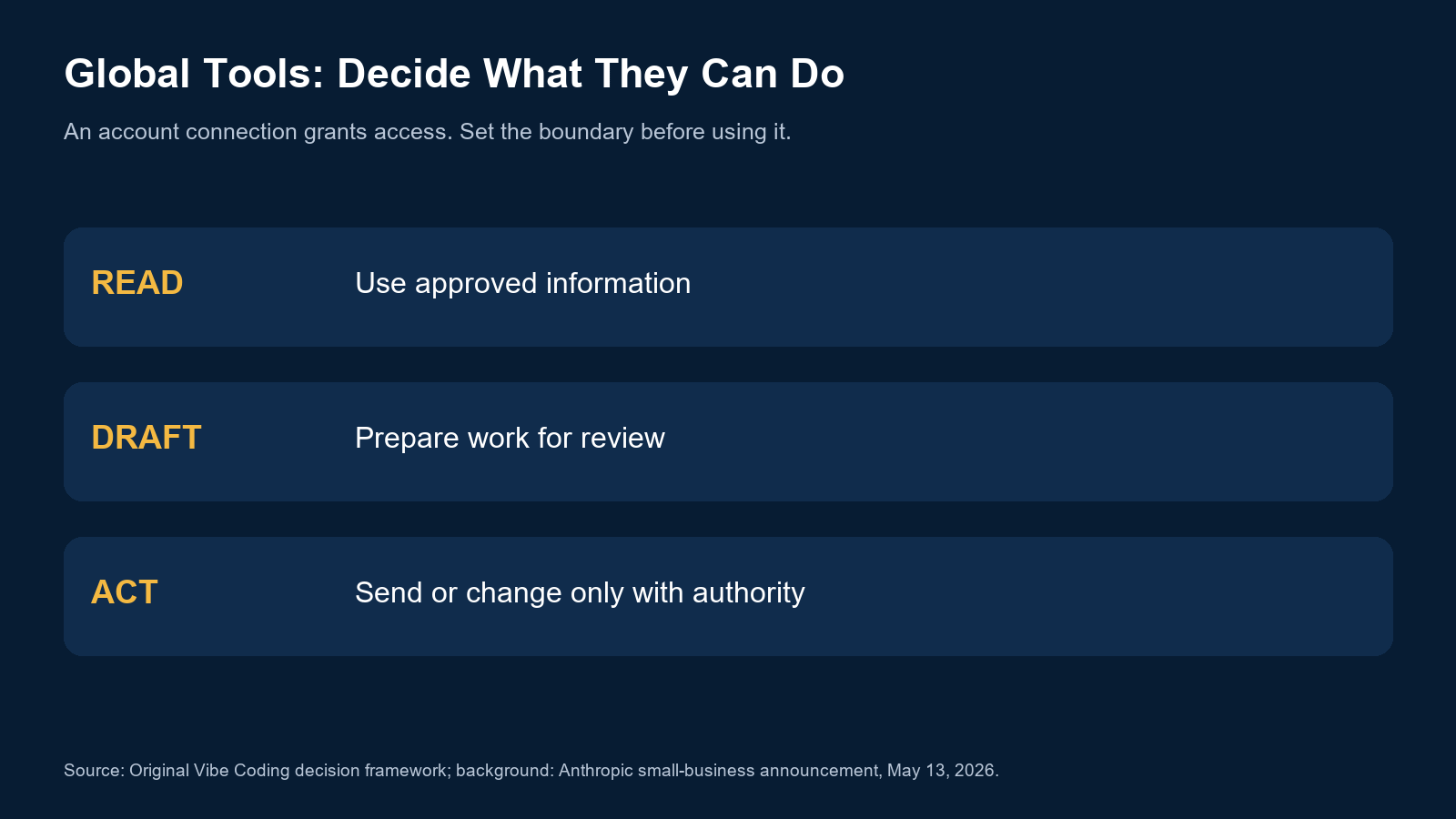
The broader product direction is toward tools that can act inside business software. In its May 13 announcement, Anthropic described 15 ready-to-run workflows and connections to familiar business applications, with approval before sending, posting, or paying. That is a vendor description of its product, not an independent performance finding or a recommendation that every owner adopt it. Vendor announcement
For Augusta, the global significance is practical. An AI tool may be supplied by a company far away while operating on information that belongs to your customers. Connecting it to email, documents, or business accounts deserves more consideration than asking it to rewrite a public paragraph.
Think of access in stages. First, use public or fictional information to learn the interface. Next, allow a limited internal drafting task with appropriate business permission. Only then consider a connection that can change records or communicate externally. At each stage, ask what the tool can read, what it can change, and how the owner will know an action happened.
The important distinction is not whether the interface calls itself a chatbot, assistant, or agent. It is the authority granted. Reading a service sheet differs from changing it. Drafting an appointment message differs from sending it. Preparing a payment explanation differs from moving money. Make those boundaries explicit before connecting accounts.
A vendor conversation in plain English
Ask where the customer information goes, who can access it, and how to remove access. Ask how work can be exported if you leave. Ask what happens when the connection fails and which person receives the alert. Request a demonstration of the failure case, not just the smooth presentation.
For a business that relies on one owner’s phone, recovery matters. Keep business ownership of the relevant accounts and retain the instructions needed to reconnect them. A local service provider can help set up a process, but the business should understand where its information lives and how to retrieve its deliverables.
There is no claim here that buying Website Security or an SSL Certificate makes an AI workflow safe by itself. Website protection, account access, information quality, and approval rules solve different problems. Match the service to the actual weakness identified during the trial.
Your next seven days in Augusta
Day one: choose one customer question and write the approved answer. Day two: measure the current process on actual work, without changing it. Day three: use sanitized examples to generate draft alternatives. Day four: test an exception and an unavailable service. Day five: let the responsible person review real drafts before delivery. Day six: compare time, corrections, and completed responses. Day seven: keep, simplify, or stop the trial.
This is a proposed practice schedule, not a promise of results within seven days. Low-volume businesses may need longer to collect enough examples. Avoid declaring success from one unusually easy task. Write down differences in the work being compared so an improved result is not simply a change in task difficulty.
| Customer problem | A fitting service to discuss | Evidence to request |
|---|---|---|
| Customers cannot find the next step | Vibe Card | Working contact and booking links on a phone |
| One offer needs a clear explanation | Gateway Landing Page | A readable offer and successful inquiry route |
| Repeated questions interrupt work | 24/7 Chatbot Customer Service Agent | Correct answers, exception handling, human handoff |
| Information is repeatedly copied | Basic Automation Package | A completed transfer and visible failure alert |
| Useful information is not reaching customers | Social Media Marketing | Published content and the correct destination link |
These products are listed as active in Vibe Coding of Augusta’s current service registry. They are current service paths offered alongside a retrospective report; this is not a claim about their availability during the historical coverage week. Exact scope and terms should be confirmed for the problem being solved.
Bring one example to the conversation: the recurring question, the current answer, the time it takes, and the mistake you want to avoid. That gives a provider something concrete to improve and gives you a way to judge the result.
Book a 30-minute conversation with Vibe Coding of Augusta
Source ledger and reading notes
- Georgia Chamber, August 10, 2026: announcement of August 7 Macon training; national target of 40,000 businesses over three years. This is the in-window news lead.
- U.S. Chamber Foundation Small Business B(AI)sics program page: current route to program information. Current availability must be checked; it is not evidence of a historical Augusta event.
- U.S. Chamber Foundation/Ipsos, July 14, 2026: earlier national owner survey. Sample excludes sole proprietors; respondent perceptions are not measured local results.
- Anthropic, May 13, 2026: earlier vendor announcement about connected workflows. Capabilities are vendor-stated and require verification for any particular deployment.
- Local examples, trial schedule, arithmetic, and service decision table: original Vibe Coding of Augusta analysis. Illustrative calculations are explicitly hypothetical; no customer results are asserted.


