Weekly AI News and Regional Impact Report
Coverage: August 2–8, 2026 · Retrospective issue dated August 9, 2026
Listen to the short overview
Editorial promise
This is an Augusta-first report. It does not repeat national AI headlines and stop there. It starts with verified facts, explains what they mean for an everyday person or small business in the CSRA, and ends with a specific action that can be tested without an AI department.
The facts and numbers are linked to primary or authoritative sources. The connections between those facts, Augusta’s economy, the action plans, and the Vibe Coding of Augusta service paths are original analysis. Where a figure comes from a company studying its own users, the report labels that limitation.
The five-minute read
AI moved closer to Augusta’s everyday economy during this coverage period. A congressional workforce hearing at the Georgia Cyber Center put Augusta inside a national debate about how people will learn and work with AI. TechNet Augusta prepared to bring hundreds of exhibitor listings and a concentrated set of cyber, defense, and technology conversations downtown. Georgia Tech announced an AI-enabled manufacturing cloud laboratory. Georgia’s utility regulators continued explaining a power buildout driven heavily by data centers. National research showed AI tools moving from quick questions into longer pieces of work, while new European enforcement rules made vendor accountability a current business issue.
For a mom-and-pop business, those developments point to one practical conclusion: the best starting point is a small, measured customer or administrative workflow. A restaurant does not need a strategy department to test faster replies to catering requests. A contractor does not need a custom AI platform to shorten the time from an estimate request to a follow-up. A salon does not need to understand a technical model architecture to reduce missed appointments. Each needs a clear problem, approved information, a person checking the work, and a before-and-after number.
The Augusta opportunity is not to imitate a large technology company. It is to use the region’s growing AI attention to make a local business easier to find, faster to respond, more consistent in following up, and safer with customer information.
Key numbers for this issue
| Number | What it says | Why a small Augusta business should care |
|---|---|---|
| 10.6% | Office and administrative support is the largest listed occupational group in the Augusta metro | Scheduling, records, reminders, and follow-up are strong candidates for a controlled AI-assisted test |
| 9.8% | Food preparation and serving accounts for nearly one in ten local jobs | Restaurants and hospitality businesses need practical help with inquiries, promotions, staffing communication, and repeat customers |
| 8.8% | Sales work represents a large share of Augusta employment | Faster lead response and consistent follow-up can matter more than a complicated AI system |
| 353 | AFCEA’s official 2026 TechNet Augusta map showed 353 exhibitor listings | Local attention creates a short window for businesses to improve visibility, messaging, and follow-up |
| 1.4 million | Georgia has about 1.4 million small businesses | Small business is the center of the state economy, not a side audience |
| 9,985 MW | Georgia regulators approved that amount of new generation in late 2025, with about 80% expected for data centers | AI has physical costs; local owners should demand clear value from every paid tool |
| 80.6% | In OpenAI’s sampled user data, that share made at least one request estimated above 30 minutes of human work | AI use is moving toward workflows, which makes measurement and human review more important |
| 415 to 945 TWh | IEA’s baseline projected global data-center electricity use more than doubling from 2024 to 2030 | Tool costs, availability, and regulation can change even when a small business buys software from far away |
1. CSRA first: what changed here, and why it matters to regular people
Augusta is becoming a place where the AI conversation happens
On July 24, the U.S. House Committee on Education and Workforce held a field hearing at the Georgia Cyber Innovation and Training Center in Augusta. The committee described it as the eighth hearing in its AI series. The witness list deliberately crossed different kinds of work: an advanced-biomanufacturing executive, a Burke County farmer, a communications-worker representative, and the chair of Augusta University’s Department of Artificial Intelligence and Health.
That mix matters more than the political event itself. It shows that AI is being discussed as a workforce question across farms, healthcare, communications, research, and manufacturing. Augusta was not simply a backdrop. The hearing was held inside the Georgia Cyber Center, with an Augusta University AI and health leader at the table and a Burke County business perspective represented.
TechNet Augusta added another local signal. The August 17-20 program included sessions on agentic AI, data control, cyber operations, security, and small-business participation. The official event map displayed 353 exhibitor listings. That number should not be confused with 353 guaranteed buyers or 353 unique local companies, but it shows the scale of the commercial and institutional audience arriving in Augusta for the event.
The local opportunity is bigger than technology jobs
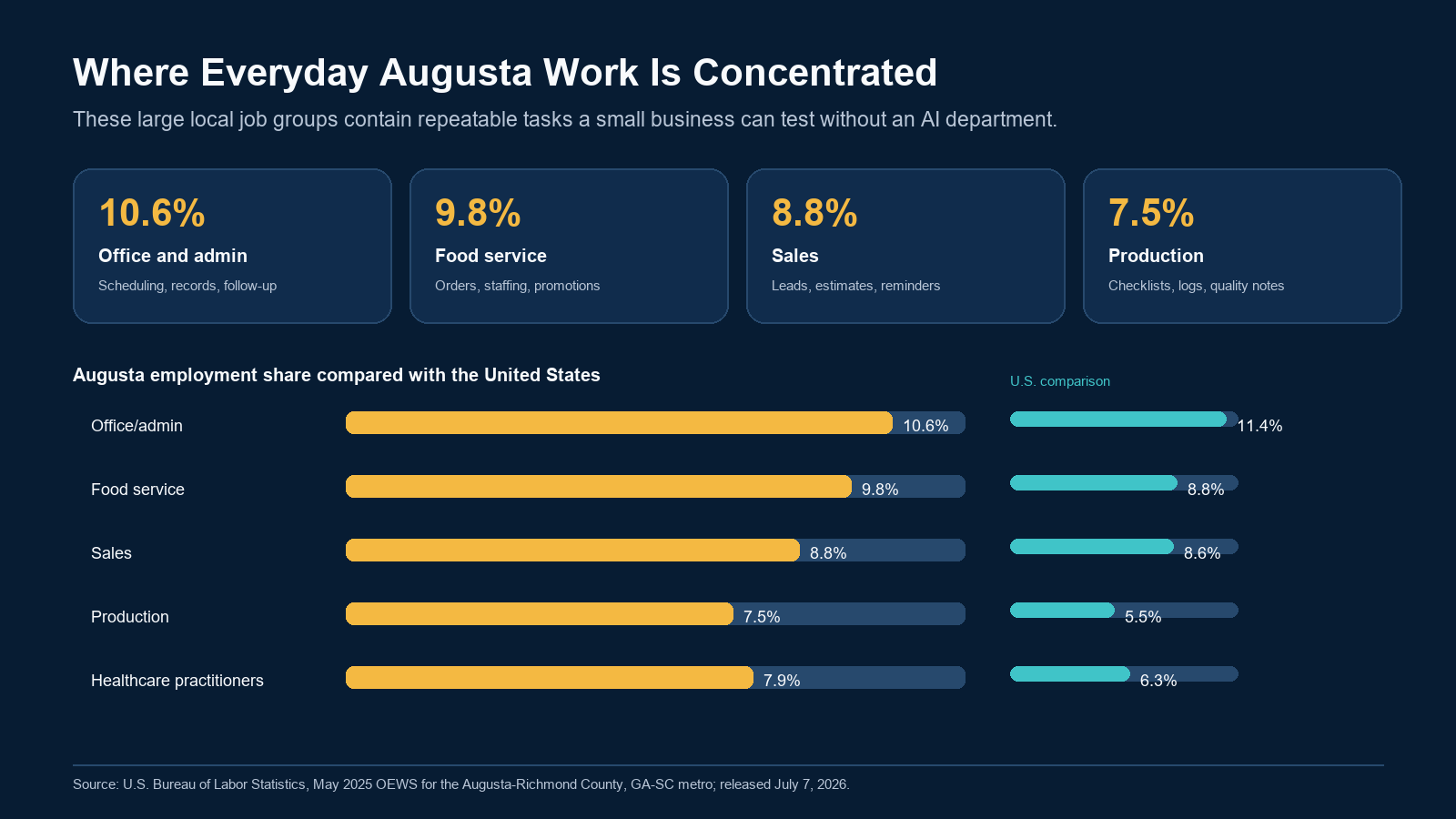
The strongest reason to make this report for ordinary Augusta businesses comes from the local labor market. The U.S. Bureau of Labor Statistics reported that office and administrative support represented 10.6% of Augusta metro employment, food preparation and serving 9.8%, sales 8.8%, healthcare practitioners and technical work 7.9%, and production 7.5%.
Those are not abstract technology categories. They are the jobs that keep a local business open: answering calls, scheduling work, preparing orders, writing estimates, tracking supplies, serving customers, checking quality, documenting care, and following up when someone has not paid or returned.
BLS also found 6,810 architecture and engineering jobs in the metro, with engineering’s share of local employment well above the national share. That is useful background because Augusta has people who understand complex operations. For this report’s audience, however, the practical target is the everyday workflow in a shop, restaurant, salon, trade business, church, nonprofit, or professional office.
Five Augusta examples that can be tested now
- Restaurant or caterer: Collect catering details through one clear form, produce a draft response from approved menu and policy information, and require a person to approve the quote. Measure response time and how many inquiries receive a complete follow-up.
- Contractor or home-service business: Turn a voicemail or web request into a structured lead record and reminder. Measure the time from inquiry to first reply, estimates sent, and estimates that receive a follow-up.
- Salon, barber, or wellness practice: Send appointment preparation and reminder messages from approved templates. Measure no-shows and time spent repeating the same instructions. Keep health or sensitive personal details out of general AI tools.
- Retail shop: Draft a weekly product spotlight from the owner’s verified inventory notes and business hours. Measure questions, visits, or orders that can be connected to the campaign.
- Nonprofit, church, or community group: Convert approved event information into a web update, social post, and volunteer reminder. Measure registration completion and the number of repetitive questions staff still answer.
The 30-day Main Street test
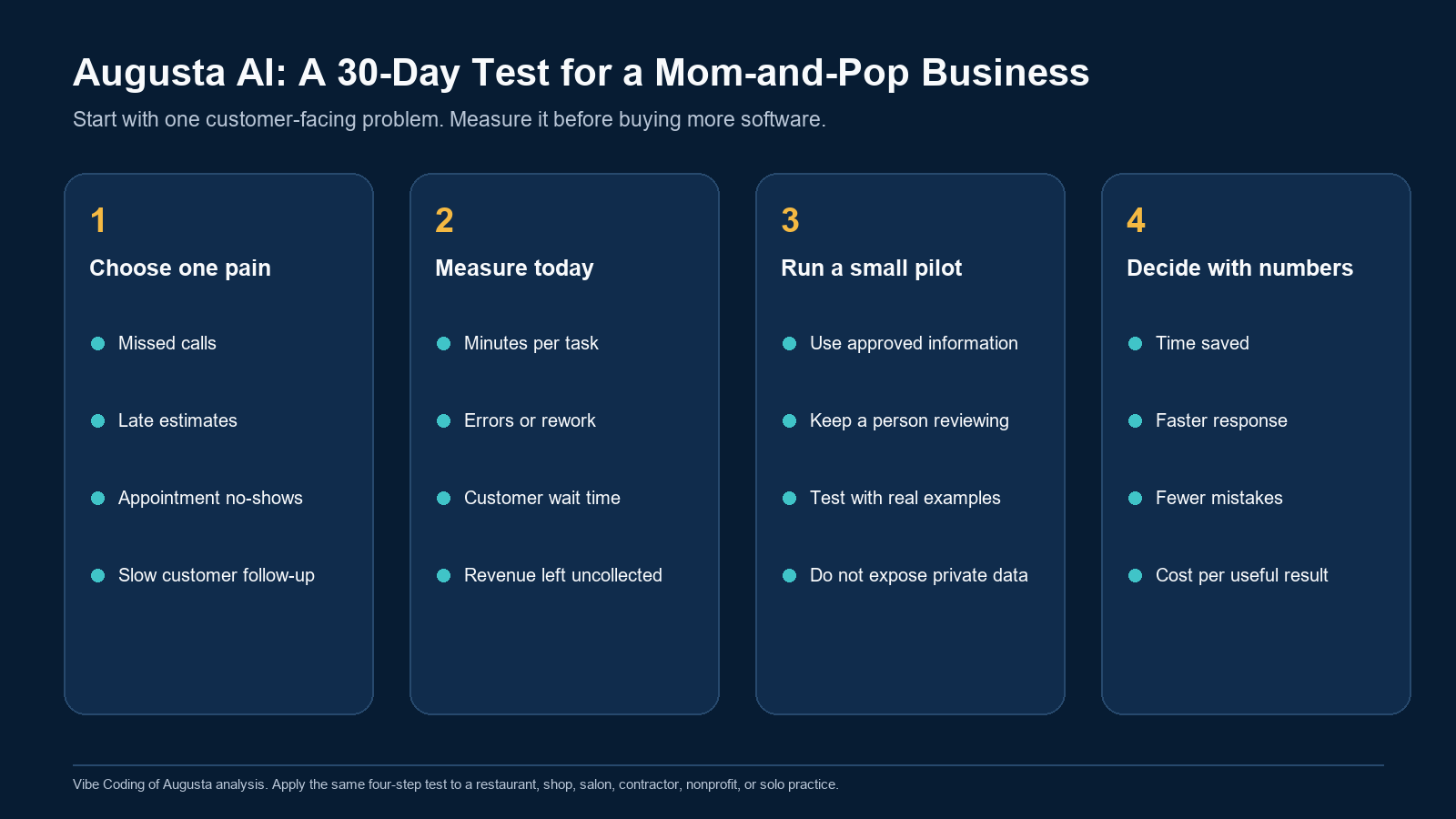
The safest useful test is small enough to stop and clear enough to measure.
Week 1 — choose one pain. Write down one repeated customer or office problem. Good examples are missed calls, slow estimates, appointment no-shows, inconsistent follow-up, repeated questions, or a weekly promotion that never gets written.
Week 2 — record the starting numbers. Track minutes spent, errors, customer wait time, work left unfinished, and any revenue that can be tied directly to the process. A baseline prevents a business from calling a new tool successful just because it feels new.
Week 3 — run a controlled pilot. Use approved business information. Keep a person responsible for the final answer. Test real examples without exposing private customer data, payment information, medical details, or passwords.
Week 4 — compare the result. Look for time saved, faster response, fewer mistakes, more completed follow-ups, and the full cost per useful result. Continue only if the numbers and customer experience improved.
Where Vibe Coding of Augusta fits
- Vibe Card gives a small business one mobile-first place for verified services, contact details, social links, website links, and an existing booking or appointment path. It fits the visibility problem: people meet the owner but do not know where to find or share the business later.
- 24/7 Chatbot Customer Service Agent fits repeated public questions and after-hours inquiries when the business has an approved knowledge base and a clear handoff to a person.
- Basic Automation Package fits one repeated workflow such as intake, reminders, follow-up, or moving approved information between business tools.
- Gateway Landing Page fits a campaign, event, or service that needs one focused action instead of a visitor searching through a full website.
- 15-, 30-, or 60-Second Commercial and Social Media Marketing fit the awareness problem when the offer, audience, and call to action are already clear.
The right service depends on the measured bottleneck. A business that misses calls needs a response and intake path before it needs more advertising. A business with strong follow-up but low awareness may need a landing page, commercial, or social campaign. The report should guide that choice instead of attaching every product to every headline.
2. Georgia: small business is the audience, while power and research shape the conditions
The power story is a cost-and-value story for a small business
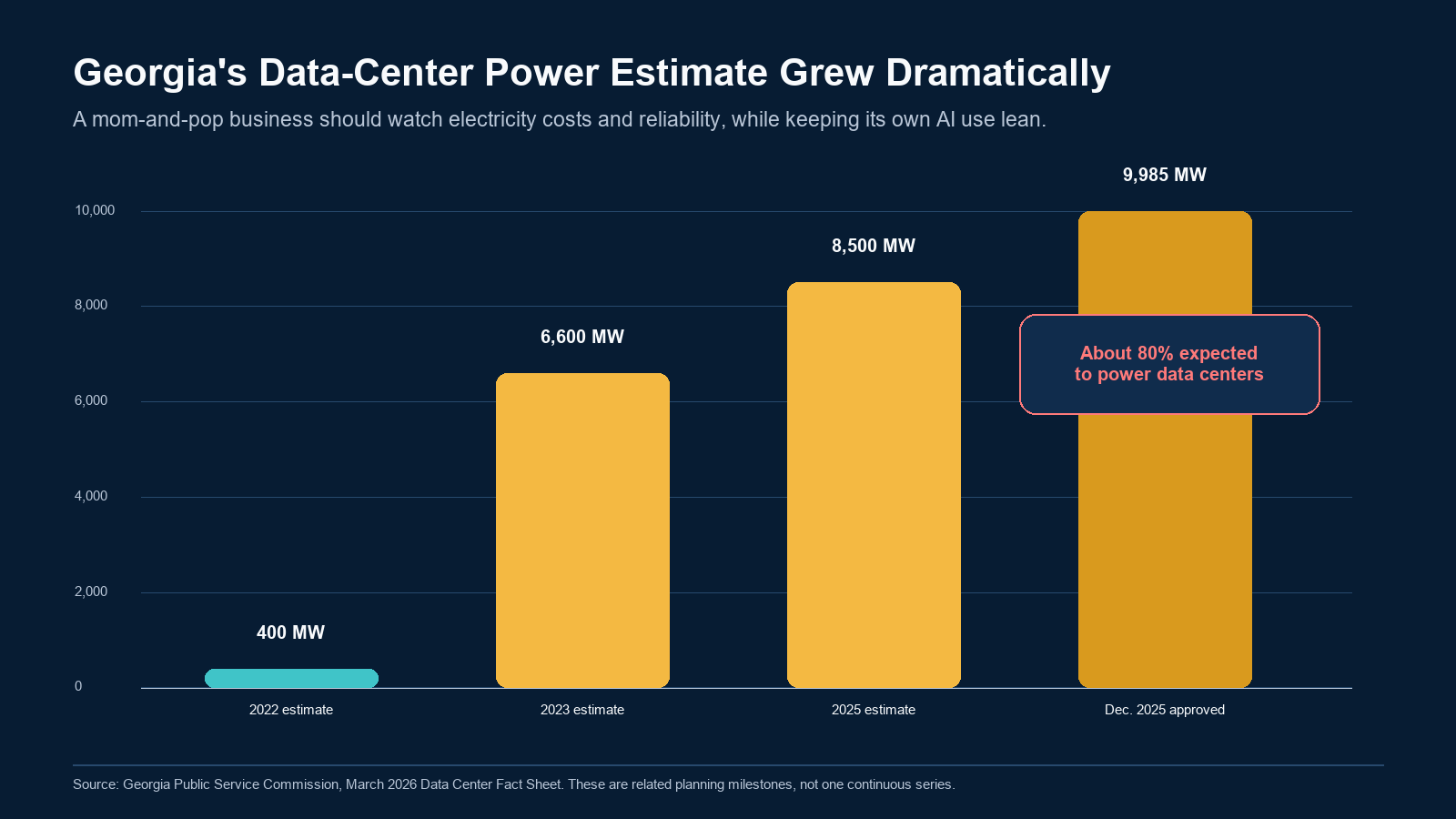
The Georgia Public Service Commission’s March 2026 fact sheet shows how quickly large-load expectations changed. Georgia Power’s 2022 estimate called for 400 megawatts of additional generation over seven years. The figure became 6,600 MW in 2023 and 8,500 MW two years later. In December 2025, regulators approved an agreement certifying 9,985 MW of new generation, with approximately 80% expected to power data centers.
These figures are related planning milestones, not a perfectly comparable time series. They still make the direction unmistakable: the physical system supporting cloud computing and AI is growing on a scale that households and small businesses can understand only if the numbers are shown plainly.
The PSC says its rules, contracts, reporting, minimum billing requirements, rate freeze, and financial backstop are designed to prevent new data-center costs from shifting to existing ratepayers. That is the regulator’s stated protection design, not a promise that no business will ever experience any energy-related effect. A small-business owner should watch the actual bill, service reliability, and future rate proceedings rather than assume either catastrophe or complete insulation.
The direct lesson for buying AI is simple: do not pay for computing capacity without measuring the business result. A monthly subscription that saves no time, creates no sale, and improves no service is still waste. Start with the lowest-cost tool that can test the workflow and keep an exit path.
Georgia’s small-business numbers reset the focus
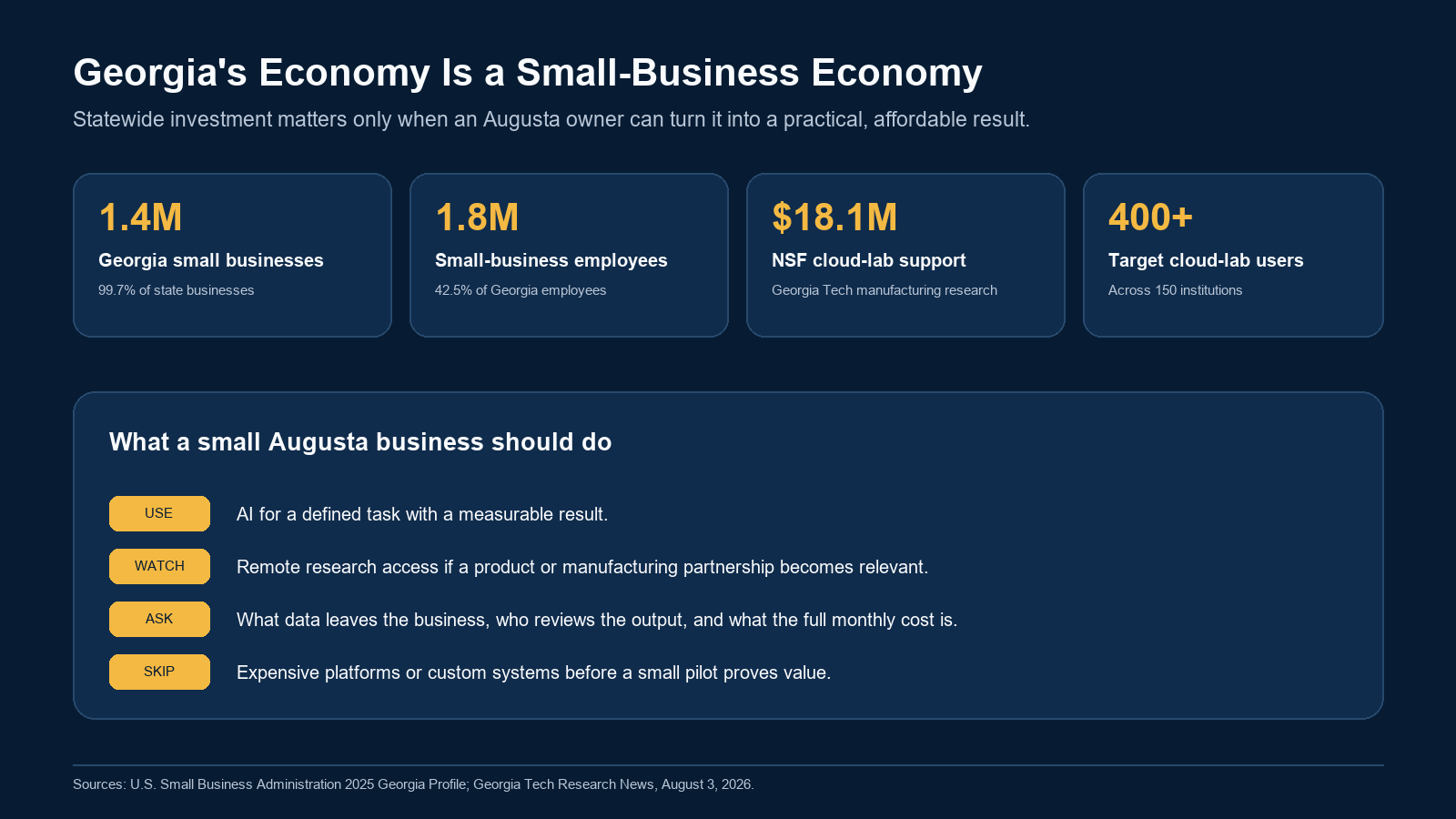
The U.S. Small Business Administration’s 2025 Georgia profile counted about 1.4 million small businesses, representing 99.7% of Georgia businesses. It reported roughly 1.8 million small-business employees, or 42.5% of the state’s employees. The SBA definition can include firms much larger than a mom-and-pop shop, but the figures still establish that small business is central to Georgia’s economy.
Between March 2023 and March 2024, the SBA profile reported 41,761 Georgia establishments opened and 37,392 closed, a net gain of 4,369. Small businesses accounted for most openings and closings. That churn is a reminder that the everyday business problem is survival, customer flow, cash collection, and limited owner time.
The Georgia Tech cloud laboratory is a signal, not a shortcut
On August 3, Georgia Tech announced an $18.1 million National Science Foundation-supported cloud laboratory for advanced manufacturing and materials. It is part of a planned network of 20 AI-enabled laboratories. The project aims to serve more than 400 users from 150 academic, industry, and government institutions, with more than half participating remotely. Georgia Tech said its manufacturing facility was approaching autonomous workflow capabilities across about 38 pieces of equipment, with a goal of more than 100 out of 160.
An Augusta shop should not read that announcement as a promise of direct access. Project fit, partnership terms, and eligibility matter. The useful signal is that Georgia is investing in AI systems that turn a high-level request into a planned workflow, run physical steps through robotics, and return results. That same pattern can be scaled down conceptually: a small business can define an outcome, create approved steps, automate the safe parts, and keep a person responsible for the final decision.
What an Augusta owner can do this week
- List every paid software and AI subscription, its monthly cost, who uses it, and the result it produces.
- Cancel or pause tools with no owner, no recurring use, and no measurable result.
- Choose one customer workflow and one administrative workflow for a 30-day test.
- Ask any vendor whether data can be exported, whether it trains a model, and what happens when the subscription ends.
- Track electricity and software as real operating costs. Use the same rule for both: pay only when the value can be explained.
Vibe Coding service path
The Basic Automation Package is the closest match when the goal is to map and test one repeatable process. The AI Executive Operator Package may fit a broader, multi-step operating need only after discovery shows that several connected workflows and decision points justify the larger scope. Microsoft 365 or Professional Email can support a more organized operating foundation when the immediate problem is scattered communication rather than AI itself.
3. United States: AI is moving from answers into work
The national change is about task size
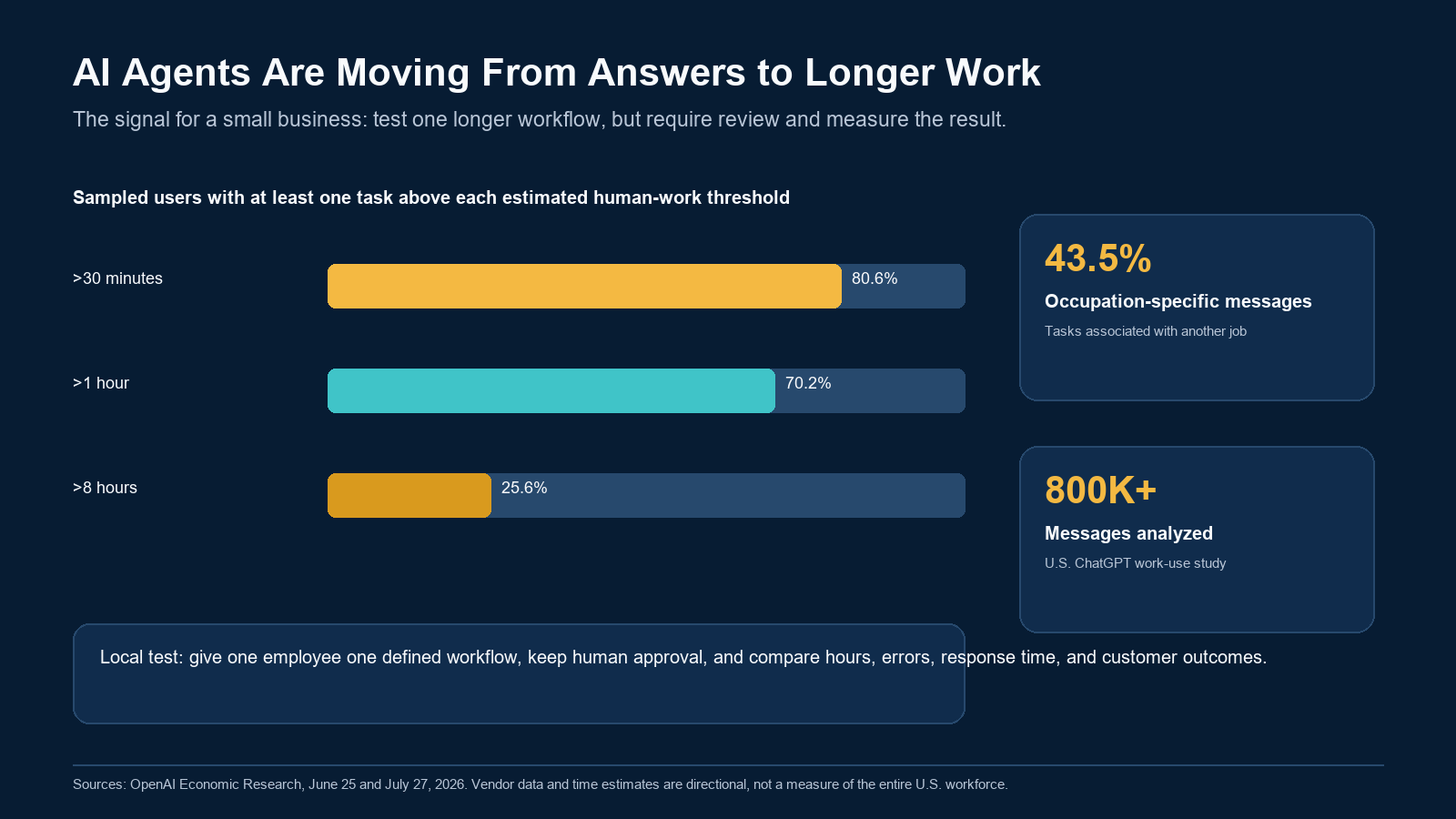
OpenAI reported that by May 2026, 80.6% of its sampled individual Codex users had made at least one request estimated to exceed 30 minutes of human work. The shares were 70.2% for a request estimated above one hour and 25.6% for one above eight hours. The estimates are model-generated and directional. They describe sampled users of one company’s product, not the entire American workforce.
Even with that limitation, the pattern matters: people are asking AI to handle longer chains of work. A separate OpenAI analysis of more than 800,000 U.S. ChatGPT messages reported that 43.5% of occupation-specific messages involved tasks associated with another occupation. The company gave examples such as a small-business owner drafting copy, reviewing a contract, or performing basic financial analysis.
The lesson is not that one person should replace a lawyer, accountant, marketer, or developer. The lesson is that owners can now prepare better first drafts, organize information, test ideas, and arrive at a professional conversation with clearer questions. High-stakes legal, tax, medical, employment, and financial decisions still need qualified human review.
A national trend becomes a local scorecard
An Augusta business should judge an AI workflow using four kinds of evidence:
| Measure | Before | Pilot | Decision rule |
|---|---|---|---|
| Minutes per task | Record a real average | Record the same task with AI support | Continue only if time falls without lowering quality |
| Error or rework rate | Count corrections | Count corrections after human review | Stop or redesign if errors rise |
| Customer response time | Time first meaningful reply | Measure pilot response | Continue if customers receive faster, accurate help |
| Completed follow-ups | Count weekly completions | Count during the pilot | Continue if more customers receive the promised next step |
| Full monthly cost | Include subscriptions and staff time | Include setup, review, and maintenance | Continue only when the benefit can justify the whole cost |
Three good first workflows
Customer intake: Turn a web form, voicemail summary, or approved chat transcript into a complete lead record with the service requested, urgency, location, and next action. A person checks the record before any promise is made.
Follow-up: Create reminders and approved draft messages for estimates, appointments, unpaid invoices, event registrations, or customers who asked for information. The owner controls timing and approval.
Content repurposing: Start with one verified weekly report or service update. Create a Facebook version for community awareness, a LinkedIn version focused on business action, and a short YouTube script. Keep the facts and offer consistent while changing the opening and format.
Vibe Coding service path
- Basic Automation Package: one defined process with clear inputs, actions, review, and measurement.
- 24/7 Chatbot Customer Service Agent: public questions, approved business knowledge, lead capture, and human handoff.
- Social Media Marketing: consistent daily education and promotion based on one approved weekly source.
- Email Marketing Campaign: follow-up with people who have given appropriate contact permission and receive a clear way to opt out.
- AI Executive Operator Package: a larger operating system only when several verified workflows need to work together.
The service recommendation should follow the scorecard. The report should never make a national statistic into a claim that a specific Augusta business will save a particular number of hours or dollars before its own baseline is measured.
4. Global: distant infrastructure and rules still reach Augusta
Energy demand can affect the tools a local business buys
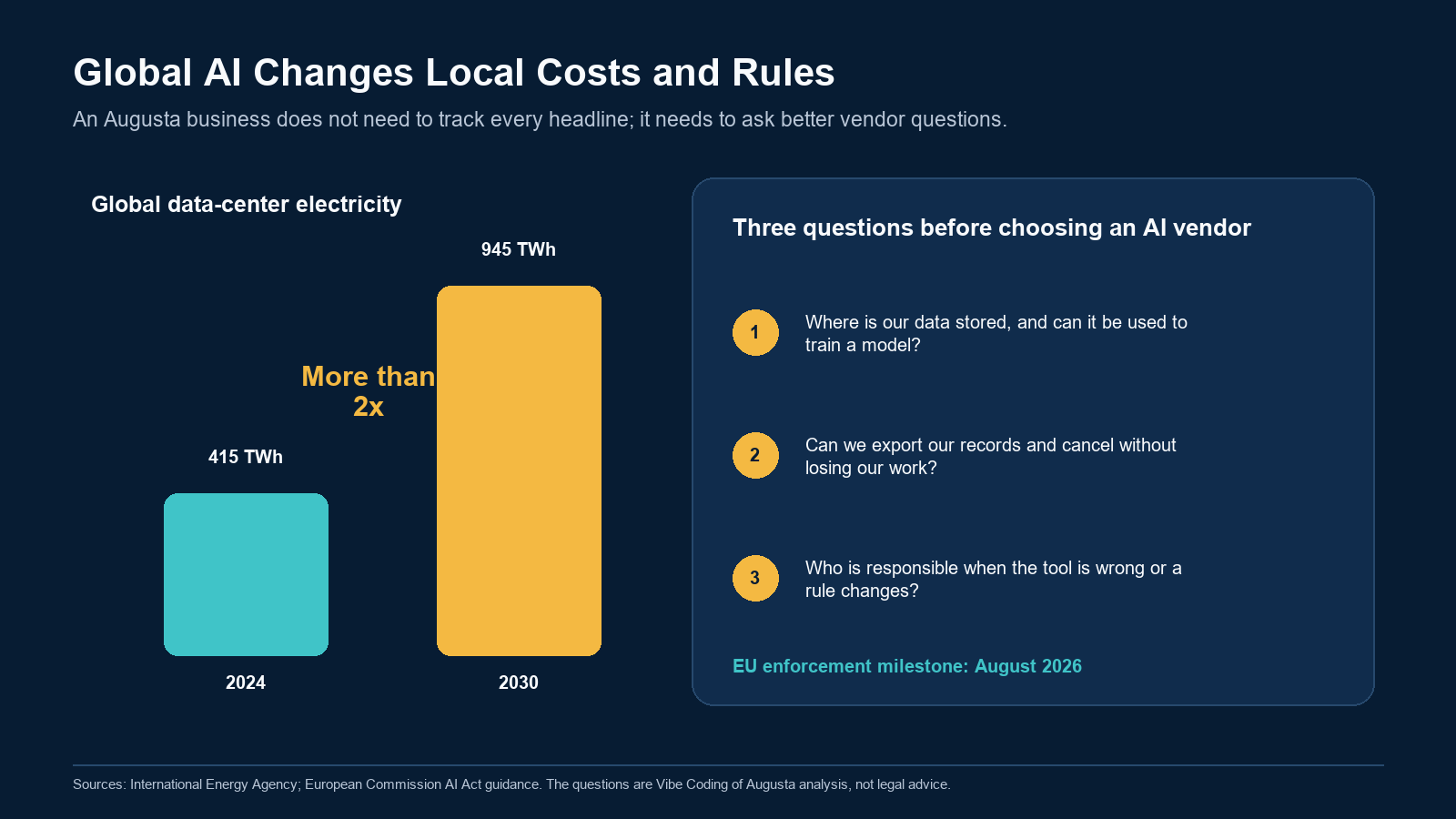
The International Energy Agency estimated that data centers used around 415 terawatt-hours of electricity in 2024, about 1.5% of global electricity consumption. Its baseline projected roughly 945 TWh in 2030, more than double the 2024 level, with AI the largest driver of the increase. An updated IEA outlook put the 2025-to-2030 change at about 485 TWh to 950 TWh.
An Augusta business does not need to become an energy analyst. It should understand that AI is not free or weightless. Every tool depends on data centers, chips, networks, and electricity. Those costs and constraints can show up through price changes, limits, slower service, vendor consolidation, or new rules.
August 2026 made vendor accountability current
European Union obligations for providers of general-purpose AI models began applying in August 2025. The European Commission said full enforcement of those provider obligations, including through fines, would begin August 2, 2026. Requirements include technical documentation, information for downstream providers, copyright policies, training-content summaries, and additional risk controls for models classified as having systemic risk.
The European Commission’s guidance is its interpretation of the AI Act; courts provide authoritative legal interpretation. This report is not legal advice. The reason the date belongs in an Augusta small-business report is practical: a local company can use a U.S. software product whose provider, customers, or data practices operate across borders. Vendor policies can change because of global rules even when the shop never sells overseas.
Three questions before choosing an AI vendor
- Where is our data stored, and can it be used to train a model? Do not enter private customer, payment, health, employee, or password information until the answer and business agreement are clear.
- Can we export our records and cancel without losing our work? A small business should not be trapped inside a tool it can no longer afford or use.
- Who is responsible when the tool is wrong or a rule changes? Assign a person to review important outputs and a date to review the vendor again.
Vibe Coding service path
Website Security and an SSL Certificate address the basic trust layer for a public website. Professional Email, Microsoft 365, or Spam-Buster Lite may fit the communication layer depending on the verified need. A 24/7 Chatbot Customer Service Agent requires an approved knowledge source, clear data boundaries, and a human escalation path. These services do not eliminate global risk; they help a small business build a more controlled local operating foundation.
The Augusta small-business decision table
| If the business problem is… | Start by measuring… | Likely first service path | Do not start with… |
|---|---|---|---|
| People meet you but cannot find or share the business later | Profile visits, calls, bookings, completed inquiries | Vibe Card or Gateway Landing Page | A complicated AI system |
| Customers ask the same public questions after hours | Question volume, response time, successful human handoffs | 24/7 Chatbot Customer Service Agent | Private customer data in a public bot |
| Leads or estimates receive inconsistent follow-up | Time to first reply, completed follow-ups, booked work | Basic Automation Package | More advertising before the response path works |
| The business has a clear offer but low awareness | Reach, qualified inquiries, landing-page actions | Social Media Marketing or a 15-, 30-, or 60-Second Commercial | Posting daily without one verified weekly source |
| Communication looks scattered or untrustworthy | Missed messages, spam problems, customer confusion | Professional Email, Microsoft 365, or Spam-Buster Lite | An AI layer on top of disorganized accounts |
| The website is unsafe, outdated, or hard to use | Security status, broken paths, inquiry completion | Website Security, SSL Certificate, Gateway Landing Page, or web design after scope review | Sending paid traffic to a broken destination |
| Several proven workflows need coordination | Time, errors, handoffs, ownership across processes | AI Executive Operator Package after discovery | A large build before smaller pilots prove the need |
The action to take now
Choose one repeated customer problem. Write down the current numbers. Run one 30-day pilot with approved information and human review. If the result improves, expand carefully. If it does not, stop and change the process before buying more technology.
Vibe Coding of Augusta can help identify the bottleneck, choose the smallest fitting service, and build a measurable pilot. The first conversation should be about the business problem and current numbers, not about buying the largest AI package.
Source ledger
- U.S. Bureau of Labor Statistics — Occupational Employment and Wages in Augusta-Richmond County, GA-SC, May 2025 — released July 7, 2026.
- U.S. House Committee on Education and Workforce — Augusta AI workforce field hearing notice — July 23, 2026; hearing held July 24.
- Augusta University Jagwire — AU hosts congressional hearing on Building an AI-Ready America — July 31, 2026.
- AFCEA — TechNet Augusta 2026 event and official exhibitor map — event August 17-20, 2026; map showed 353 exhibitor listings.
- AFCEA — TechNet Augusta 2026 conference schedule — reviewed for AI, cyber, and small-business sessions.
- U.S. Small Business Administration Office of Advocacy — Georgia 2025 Small Business Profile.
- Georgia Public Service Commission — March 2026 Data Center Fact Sheet.
- Georgia Tech Research News — Georgia Tech to Lead National Cloud Laboratory for Advanced Manufacturing and Materials — August 3, 2026.
- OpenAI Economic Research — How agents are transforming work — June 25, 2026.
- OpenAI Economic Research — How AI is expanding what people do at work — July 27, 2026.
- International Energy Agency — Energy and AI executive summary and updated Key Questions on Energy and AI.
- European Commission — Guidelines on obligations for general-purpose AI providers.
- Historical Vibe Coding of Augusta source posts: August 5, August 6, and August 7. The weekly issue preserves those originals and adds new research and analysis.


