AI is moving fast everywhere, but today’s top story hits right here at home.
LOCAL — Augusta & the CSRA
1. Washington Comes to Augusta
The U.S. House Committee on Education and the Workforce held an official field hearing at the Georgia Cyber Center at Augusta University, focused on preparing the local workforce for an AI-driven economy and securing digital infrastructure. Augusta is becoming a real anchor point for federal AI and cybersecurity policy — not just a place AI happens to, a place helping shape how it gets used safely.
2. Augusta University Lands a Federal AI Research Grant
The National Science Foundation named Augusta University a primary awardee for a program training the next generation of government-ready AI security experts. That’s direct federal money flowing into local training and research, right here in the CSRA.
STATE & NATIONAL
3. Georgia Sets New Rules for How Cities Use AI
Georgia’s state AI office laid out new guidelines at the Georgia Emerging Technology Summit for how state agencies and cities adopt AI responsibly. For Richmond and Columbia counties, this gives local governments a clear roadmap — and opens the door for local tech contractors who understand how to implement AI the right way, safely and by the rules.
INTERNATIONAL & THE FRONTIER
4. Building AI Just Got Cheaper
OpenAI cut prices on one of its main models by 80%, and Google released a faster, cheaper model of its own. For anyone building custom business tools or automation, that means real business-grade AI systems cost noticeably less to run than even a few months ago.
5. The UK Is Testing How Far AI Can Be Trusted to Act Alone
A UK research institute published findings on how well AI systems handle complex, multi-step tasks on their own in controlled tests. The overall direction: as AI gets more capable of acting independently, the focus is shifting hard toward making sure it’s watched and controlled properly — not just fast.
6. Google’s Latest Model Reaches Into the Physical World
Google released a new fast AI model plus early access to tools that let AI reason about and interact with the physical world — a step toward AI that can help with real-world, hands-on tasks, not just conversations.
7. Global Competition Is Heating Up
A major Chinese tech company released a massive new AI model built specifically for handling complex software projects — a reminder that the race to build more capable AI is a genuinely global competition, not just a U.S. story.
WHAT THIS MEANS FOR YOU IN THE CSRA
Lower cost, more access: what used to be expensive enough to only make sense for big companies is now realistic for a local business
Security matters more, not less: as AI adoption accelerates, doing it safely and correctly is the real differentiator
The world’s watching Augusta: with real federal attention landing here, this region has a genuine head start most cities don’t have
Bottom line: the tools are cheaper and more capable than ever, and Augusta’s right in the middle of the national conversation about how to use them responsibly. This is a good week to pay aLOCAL — Augusta & the CSRA
1. Congress Came to Augusta — Here’s What Actually Happened
On July 24, the U.S. House Committee on Education and the Workforce held its very first AI-focused field hearing anywhere in the country, and they chose the Georgia Cyber Center at Augusta University to do it. Three sitting members of Congress showed up in person — Rep. Rick Allen (R-GA), who chaired it, along with Rep. Joe Wilson (R-SC) and Rep. Lucy McBath (D-GA).
Allen’s reasoning for picking Augusta wasn’t random: Fort Gordon sits just 30 minutes away, home to the Army Cyber Center of Excellence, and thousands of trained cyber personnel leave that base every year looking for civilian work.
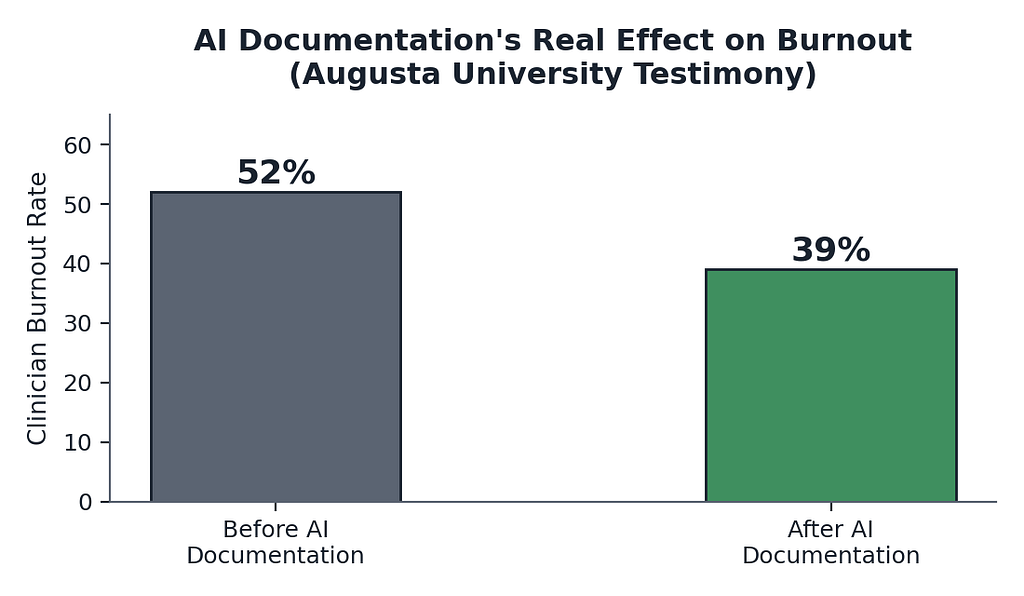
The most concrete testimony came from Dr. Jeffery Talbert, chair of Augusta University’s Department of Artificial Intelligence and Health — the first department of its kind in Georgia. He laid out real, measured results: AI-assisted “ambient documentation” has been shown to cut clinician burnout from roughly 52% down to 39% in one multi-hospital rollout. Separately, large studies of AI-assisted breast cancer screening found roughly 29% higher cancer detection rates.
Local takeaway: this wasn’t a symbolic visit. It signals that Augusta is being treated as a genuine national model for how AI workforce policy gets built.
2. Augusta University Wins a Competitive National AI Security Grant
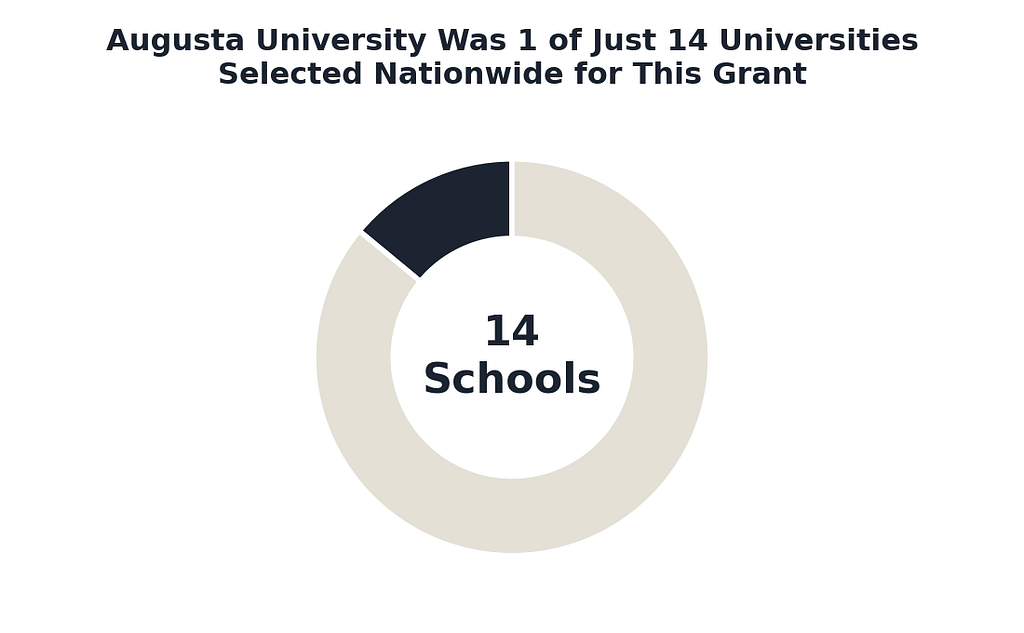
On July 28, the National Science Foundation announced the first-ever awards under a brand-new program called CyberAI SFS — designed to train the next generation of AI-and-cybersecurity experts for government careers. Only 14 universities nationwide made the cut, including Arizona State, Texas A&M, Vanderbilt, and UT Dallas.
Augusta University’s specific project is called “AUGER CyberAI: Government-ready Experts in Resilient CyberAI.” It funds scholarships for students who’ll study both how to use AI to strengthen cyber defense and how to build AI systems that can withstand attacks, with a direct pipeline into government cybersecurity jobs afterward.
Local takeaway: this is direct federal investment in producing exactly the kind of AI-and-security-trained talent that local employers — including agencies here in the CSRA — will be hiring for in the next few years.
STATE & NATIONAL
3. Georgia Sets New Rules for How Cities Use AI
At the Georgia Emerging Technology Summit, Nikhil Deshpande — Georgia’s Chief Digital and Artificial Intelligence Officer — laid out new guidelines for how state agencies and municipalities should adopt AI. Georgia is navigating real tension here: the current federal administration has warned states against “onerous and excessive” AI laws, while Georgia is building its own guardrails anyway through Deshpande’s “Horizons Innovation Lab,” which pilots new AI uses carefully before wider rollout.
Regional takeaway: this gives Richmond and Columbia county governments a real compliance roadmap, and opens a genuine door for local tech contractors who understand how to implement AI the right way for a government client.
INTERNATIONAL & THE FRONTIER
4. AI Just Got Dramatically Cheaper — And Here’s Why That’s the Biggest Story in This Report
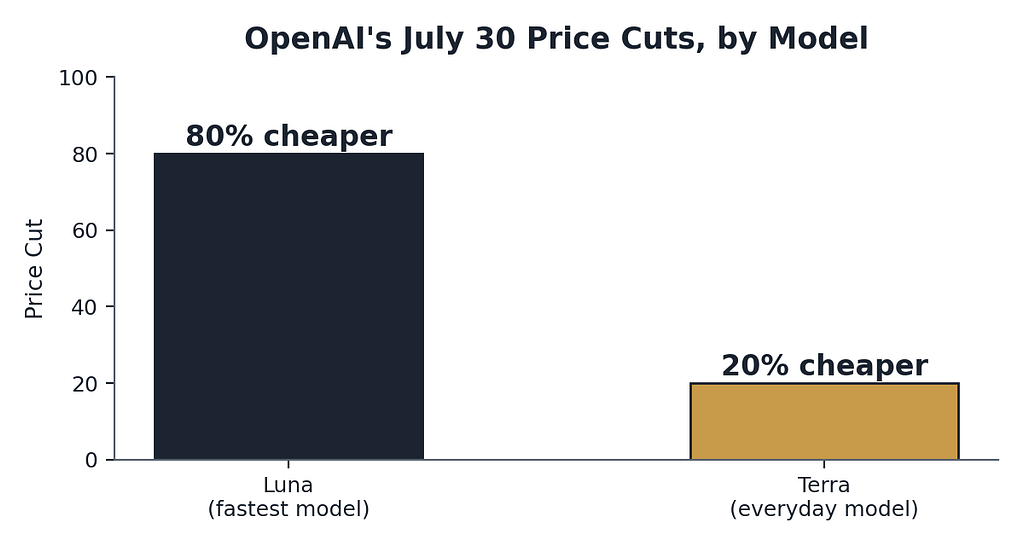
On July 30, OpenAI cut the price of its fastest model, Luna, by 80%, and its everyday model, Terra, by 20%.
Why this isn’t just generosity — the real strategic story: this is a company (and Google, who released a competing fast/cheap model the same week) racing to make AI affordable enough that businesses stop asking “can we afford this?” It’s a land-grab: get you building on their platform now, while it’s cheap, before pricing normalizes.
Real companies are already proving it works: Notion found comparable quality at half the cost in 60% less time. Blitzy reported 87% lower cost. Dust reported 40% faster and 40% cheaper, simultaneously.
What this unlocks for a CSRA business: full automation — AI answering customers, following leads, running background workflows 24/7 — used to only make financial sense at large-company volume. When per-interaction cost drops 80%, that math flips to small-business scale too.
Why “jump in now” is real, not a sales pitch: this is an active price war for market share. It won’t stay this generous forever. Building now locks in today’s economics, not tomorrow’s likely-higher pricing.
5. The UK Is Testing How Far AI Can Be Trusted to Act Alone
The UK’s AI Security Institute published results from controlled tests of how OpenAI’s and Anthropic’s most advanced models handle complex, multi-step cybersecurity tasks on their own. The industry’s focus is shifting toward making sure someone can actually watch and control what AI is doing — not just how smart it is.
6. Robots Just Got a Real “Brain” — And the Labor Conversation Is Already Starting
Google DeepMind’s Gemini Robotics ER 2 is now open to any developer with an API key — no longer restricted to trusted partners. It reasons over live video and classifies task progress with 57.4% accuracy across 10 instrument types.
Real deployment partners include Apptronik, Franka, Agile Robots, and Boston Dynamics. Google explicitly restricts it from healthcare and transportation, aiming it at inspection, warehouse handling, and lab tasks instead.
Honest CSRA impact: not something a local plant buys next month — but at the IEEE Humanoids 2026 conference, “labor displacement” was named the defining theme of the entire event. For a region with real manufacturing and logistics employment, that’s worth watching now, well before it reaches small-business affordability.
7. Global Competition Is Heating Up
Chinese tech giant Alibaba released Qwen3.8-Max, a 2.4-trillion parameter model built for autonomous software engineering — a reminder the AI race is genuinely global, part of exactly what’s driving the price cuts in story 4.
What This Means for You in the CSRA
The price window is open right now — real automation is affordable today in a way it wasn’t a year ago.
Real local opportunity — federal hearings and a competitive grant landing directly in Augusta gives this region a genuine head start.
Security is the differentiator — doing AI correctly, not just doing it, separates who benefits and who gets burned.
Bottom line: Congress picked Augusta specifically, Augusta University won a grant most schools didn’t get, and the cost of real business automation just dropped in a way that changes the math for a business your size. This region has real momentum, and this is a real window.
Sources:
VentureBeat: Coverage on Qwen3.8-Max Releasettention.
Augusta University Jagwire: AU hosts congressional hearing
National Science Foundation: CyberAI SFS awards announcement
Georgia Technology Authority / Office of Artificial Intelligence; Georgia Emerging Technology Summit
OpenAI: Advancing the Price-Performance Frontier with GPT-5.6
Google Blog: Introducing Gemini 3.6 Flash
The Guardian: Autonomous Cybersecurity Evaluations of Frontier Models
Unite.AI & TechTimes: Gemini Robotics ER 2 coverage
Questions about applying this to your business? Contact Vibe Coding of Augusta.

