Listen to the brief overview
The direct answer
If your business accepts cards, your monthly processing statement should tell you what happened to your money. The problem is that many statements make that story difficult to follow. They may separate transaction charges, processor charges, card-brand assessments, monthly charges, equipment-related items, adjustments, refunds, and chargebacks across several pages.
Before we talk about changing card processors, let me get your current merchant statement and go through it with you line by line. That comes before deciding that your processor is too expensive—or accepting somebody’s promise that a new processor will save you money.
Vibe Coding of Augusta’s Statement Read is a free, plain-language review of that document. We sit with the owner, read it line by line, and identify the questions that need answers. We do not begin by declaring that the owner is overpaying. We do not promise to beat the current rate. We do not quote replacement pricing during the review. The first goal is understanding.
Why the statement matters
A processing statement is not just a bill. It is a record of how the business accepted payments during that period. Depending on the provider and account, it may show:
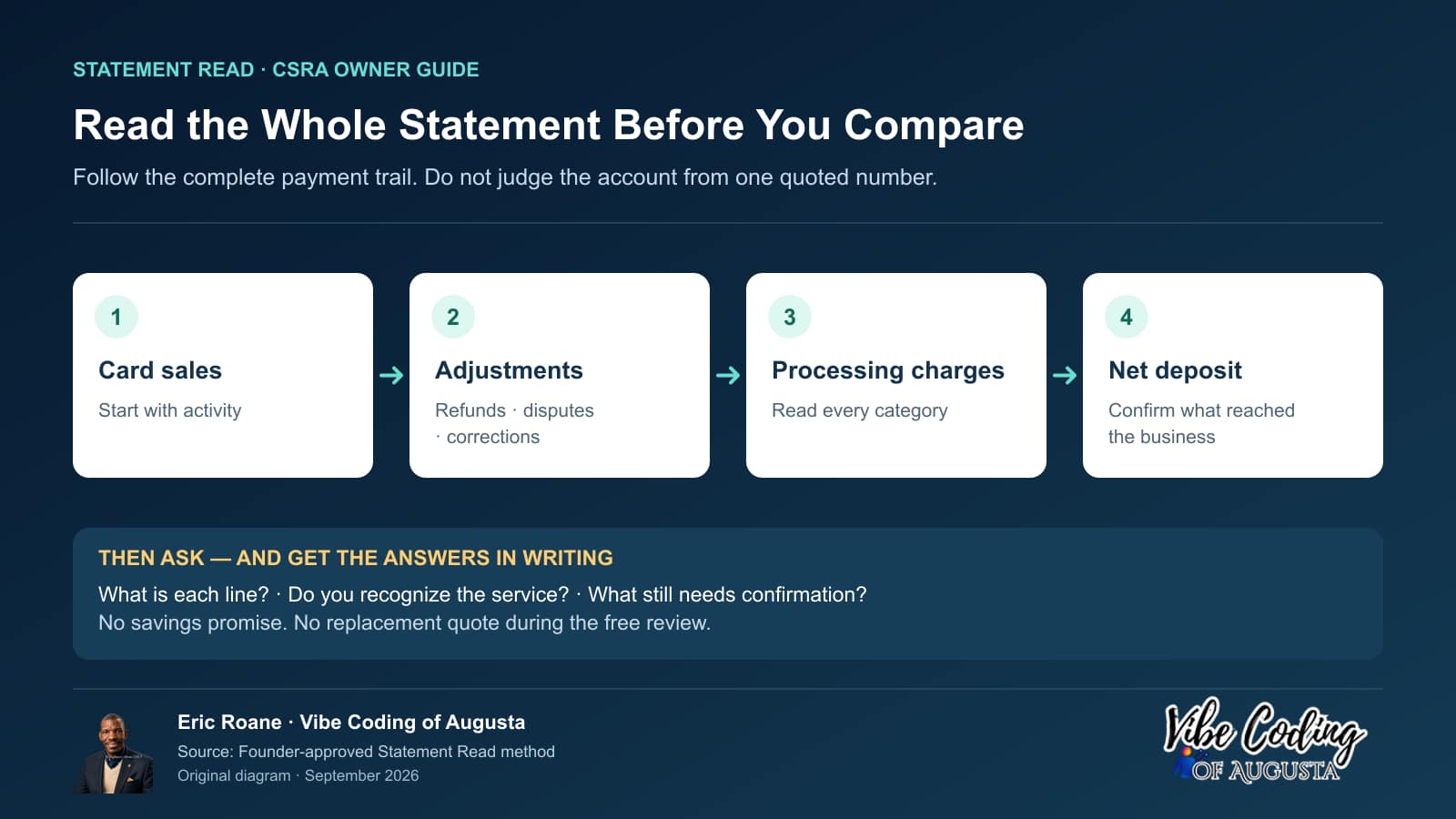
- Gross card sales and the number of transactions.
- Refunds, chargebacks, or other adjustments.
- The amount deposited after processing costs.
- Different charges associated with different card types or transaction methods.
- Monthly, gateway, compliance, equipment, or service-related line items.
- Pricing language that may not match the simple percentage an owner remembers hearing.
The Statement Read does not assume that every listed charge is wrong. It separates three questions:
- What does this line appear to represent?
- Does the owner recognize the service connected to it?
- What should be confirmed in writing before making a decision?
That process gives the owner a better foundation for comparing any future offer.
Which CSRA businesses should consider a Statement Read?
The best fit is any local business already accepting card payments, especially an owner who has not reviewed the complete statement with a real person recently.
Examples include:
- Barbershops, salons, nail studios, and independent beauty professionals.
- Restaurants, food trucks, caterers, bakeries, and neighborhood markets.
- Boutiques, specialty retailers, convenience stores, and gift shops.
- Auto-repair shops, tire stores, detailers, and mobile mechanics.
- Heating and air, plumbing, electrical, landscaping, cleaning, and home-repair companies.
- Medical, dental, therapy, wellness, and other professional offices that accept patient or client payments.
- Churches, nonprofits, clubs, and community organizations that accept card donations or event payments.
- Online sellers and service businesses that take deposits or full payments through a website.
The review can be useful whether the business is in Augusta, North Augusta, Grovetown, Evans, Martinez, Hephzibah, Aiken, or another CSRA community. The important condition is not the ZIP code. It is that the owner has a real statement and wants to understand it.
What should you bring?
Bring the latest complete monthly processing statement, not a screenshot of one total. If possible, also know which card terminals, website checkout, invoicing tool, or other payment tools connect to the account.
Protect sensitive information. Do not email or post an unredacted statement in a public channel. A merchant statement can contain private account details. Review it through the agreed secure or in-person process.
What the review can and cannot tell you
The review can help organize the facts that are visible on the statement and identify what still needs confirmation. It can help an owner prepare better questions about pricing, services, equipment, deposit timing, contract terms, or unexpected entries.
The review cannot prove that another provider will be cheaper. One month may not represent the business’s normal sales mix. A seasonal retailer, a Masters Week vendor, a new restaurant, and a year-round professional office may have very different patterns. A proper comparison may require more history and written terms from both providers.
The Statement Read is also not legal, tax, or accounting advice. It does not replace the processor’s official explanation of its own charges.
Questions to ask before changing processors
- What is the full pricing structure, not just the headline rate?
- Which fees are fixed, which change with volume, and which depend on transaction type?
- Is equipment purchased, rented, leased, or included under specific conditions?
- Which services are optional add-ons?
- What happens to stored customer information or recurring billing if the business changes systems?
- How are refunds, chargebacks, and support handled?
- What written commitments, term lengths, or cancellation conditions apply?
- Can the proposed setup support the way the business actually collects money—in person, online, by invoice, by text, or through recurring payments?
The right next step
Do not switch because of one percentage spoken across a counter. Start with the paper already in your hand.
Bring your latest statement to Vibe Coding of Augusta. We will read it with you in plain words, identify the questions that matter, and stop there unless you choose to explore another option.
Contact Vibe Coding of Augusta to request a Statement Read
This article describes Vibe Coding of Augusta’s Statement Read workflow; it is not an NMI product specification.
What is a merchant statement review for CSRA businesses?
A merchant statement review is a comprehensive audit of your payment processing fees designed to identify hidden costs and unnecessary surcharges. For businesses in the Augusta-Aiken area, Vibe Coding of Augusta provides this analysis to ensure local merchants receive competitive, transparent rates that align with regional industry standards.
Ready to look at a merchant account for your business? Start with a short form, and we will walk you through the next steps.