Listen to the brief overview
Card processing is a business workflow, not just a machine
Many owners think card processing means the terminal beside the cash register. That terminal is important, but it is only one part of the payment experience.
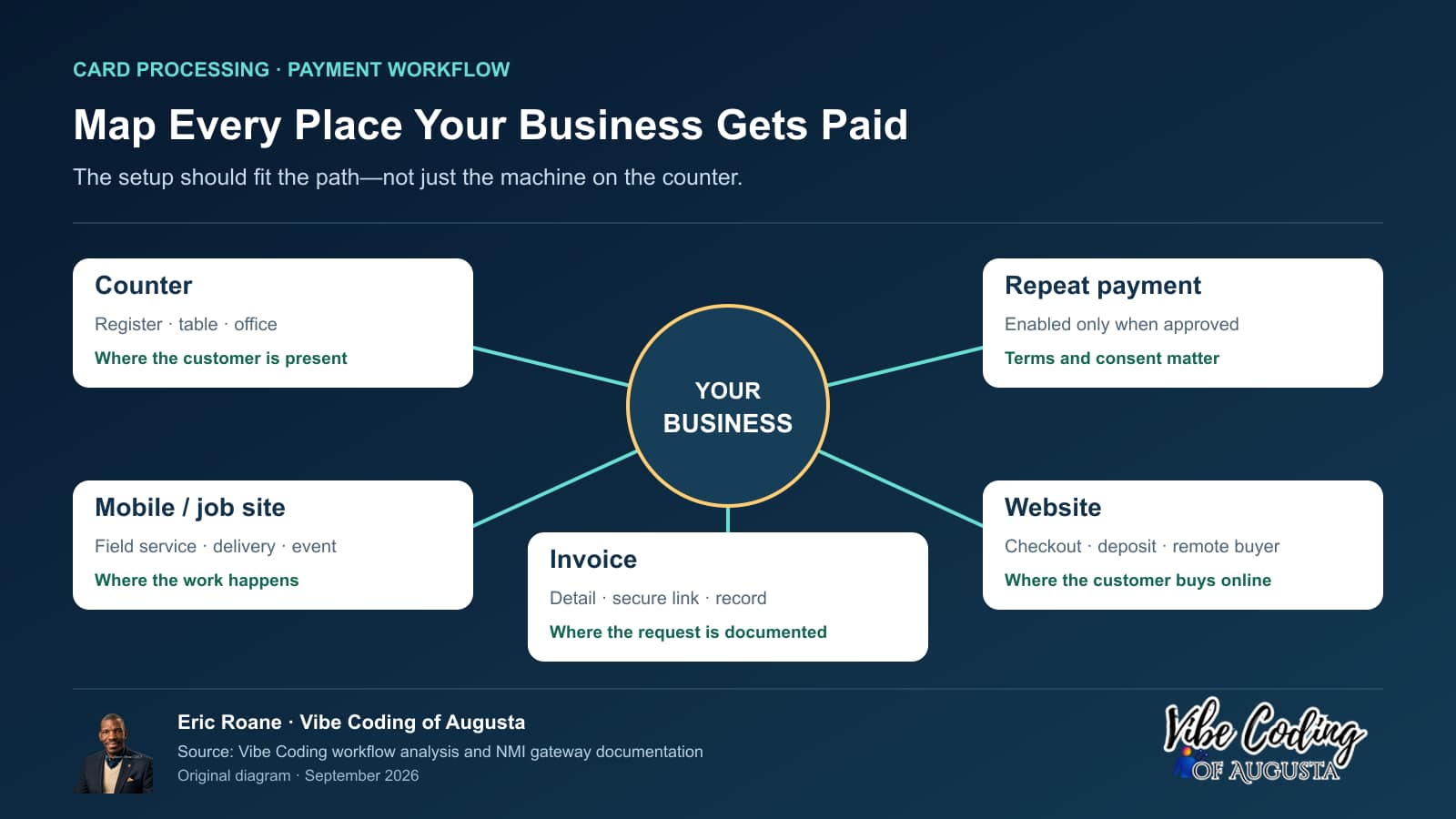
A local business may need to accept a card:
- At a counter or table.
- At a customer’s home or job site.
- Over a secure online checkout.
- Through a payment link.
- Against an invoice.
- For a deposit before work begins.
- On a repeat or recurring schedule.
The right setup is the one that fits how the business sells and how its customers prefer to pay. It should also give the owner a clear path for reporting, refunds, disputes, support, and future add-ons.
Vibe Coding of Augusta is preparing to offer merchant accounts and card processing through an NMI-powered payments relationship. NMI provides gateway technology that can support branded payment experiences and multiple payment channels. The exact processor, equipment, underwriting decision, pricing, and available configuration still depend on the merchant’s approved application and written account terms.
Where it can fit in the CSRA
Counter and table businesses
Restaurants, cafes, barbershops, salons, boutiques, markets, and repair counters need a dependable way to accept payment while the customer is present. The practical questions include what hardware is supported, whether contactless payments are available, how tips are handled if applicable, and what happens when connectivity is interrupted.
Mobile and field-service businesses
Landscapers, cleaners, mobile detailers, repair technicians, photographers, event vendors, and contractors may finish work away from a traditional register. Their payment workflow may need a mobile reader, a secure link, Text to Pay, or invoicing rather than a fixed countertop terminal.
Appointment-based businesses
Clinics, dental offices, wellness practices, consultants, trainers, and beauty professionals may need deposits, balances, no-show policies, or post-service collection. Payment technology does not create the policy. It should support the policy the business has clearly communicated.
Online and mixed-channel sellers
A boutique may sell both in-store and online. A caterer may collect a deposit online and the final balance later. A trades company may take a card at the job site and send invoices to commercial customers. These businesses should examine whether reporting and customer records remain understandable across every channel.
What an NMI-powered gateway can contribute
NMI describes its platform as a white-label, embedded payment environment. Its current developer material supports secure payment capture for cards, ACH, Apple Pay, and Google Pay through its recommended Payment Component, subject to setup and merchant availability. Its gateway and partner tools can also support reporting, merchant management, branded domains, tokenization, and related payment services.
For a small-business owner, the important point is not the word “gateway.” The important questions are:
- Can customers pay through the channels the business needs?
- Does the checkout carry the business’s identity clearly?
- Can sensitive card details be handled without the business building its own payment-storage system?
- Can the owner understand deposits, transactions, refunds, and reports?
- Is there a reachable support path when something goes wrong?
Vibe Coding of Augusta’s local role is relationship-centered guidance and setup support. It does not replace the payment company’s underwriting, security responsibilities, bank relationships, or official support obligations.
What to compare before opening an account
Complete written pricing
Do not compare only a quoted rate. Ask for the full written rate structure, per-transaction charges, monthly charges, gateway or service charges, equipment costs, and any other conditions that apply. Vibe Coding of Augusta will not publish or quote those figures until they are confirmed in writing.
Equipment and ownership
Clarify whether equipment is purchased, rented, leased, or provided under conditions. Confirm what happens if the account closes or the business changes providers.
Funding and reconciliation
Ask how deposits are reported and what might affect their timing. A processor may describe normal timing, but no responsible provider should guarantee that every transaction will settle on the same schedule regardless of reviews, weekends, bank rules, or other exceptions.
Security and responsibility
Tokenization and hosted payment tools can reduce the amount of sensitive payment data that touches a merchant’s systems, but no tool makes the whole business automatically secure or compliant. Staff practices, devices, passwords, permissions, networks, websites, and policies still matter.
Portability and integrations
If the business relies on a website, booking system, customer-management tool, accounting workflow, or recurring billing, confirm what connects today and what would need to change.
Who may not be ready to change?
A business may be better served by keeping its present setup temporarily when:
- The owner has not reviewed current costs and contract terms.
- A critical website, point-of-sale, or software integration has not been tested.
- Stored customer or recurring-payment migration is unresolved.
- The new pricing and equipment terms are not in writing.
- Staff training, internet reliability, or operational timing makes an immediate switch risky.
The goal is not to replace a functioning system for the sake of change. The goal is to understand the current setup, identify a real problem, and confirm that the proposed configuration addresses it.
The right next step
Start with the Statement Read. Then map every place your business collects money: counter, phone, job site, website, invoice, deposit, or recurring payment. A written proposal should answer those real needs without relying on vague savings promises.
Ask Vibe Coding of Augusta to review your current payment setup
Sources
Product features are subject to the merchant’s enabled configuration and written terms.
How can CSRA small businesses find the right card processing solution?
CSRA small businesses should select card processing that offers scalability, local support, and integrated security. Vibe Coding of Augusta provides tailored payment infrastructure in the Augusta region, helping owners match the proposed setup to their actual workflow and written terms.
From three payment channels to one job record: an Augusta auto shop example
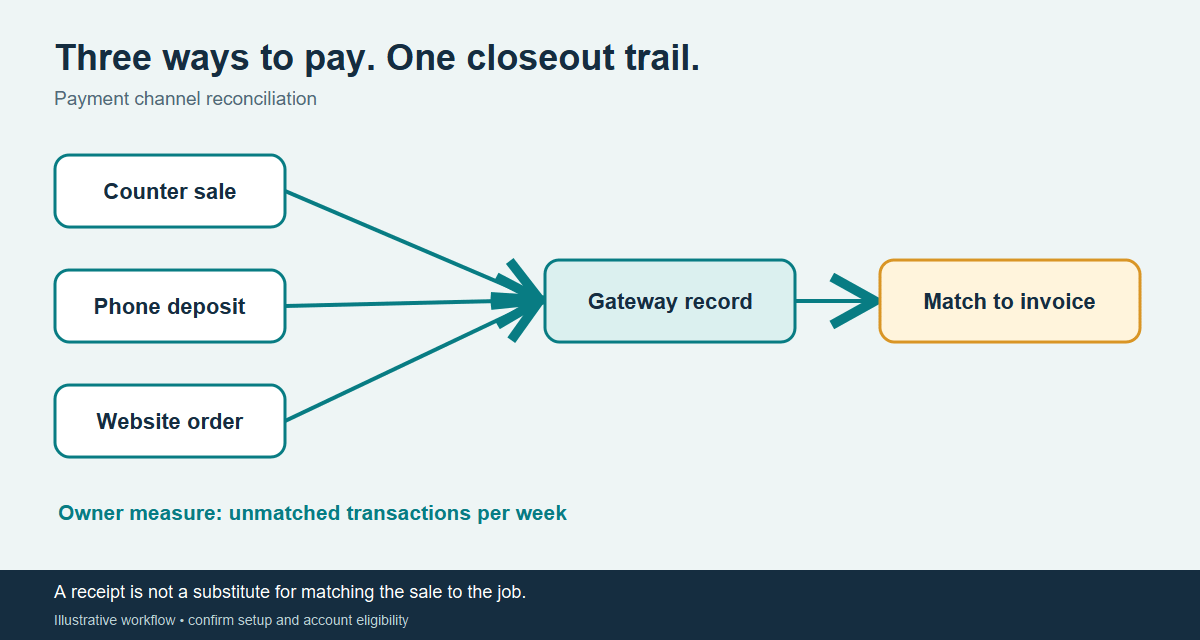
An Augusta auto shop takes a deposit by phone on Monday, the balance at the counter on Tuesday, and an online parts payment on Wednesday. Staff still need one answer for each repair order: which payment was authorized, which settled, and where is the transaction reference? A gateway can connect supported channels, but only after the merchant and processor configuration is confirmed.
- Identify the customer and repair order.
- Confirm the amount and use the approved channel.
- Submit once and check the gateway result before retrying an unknown payment.
- Attach the transaction reference to the job and send a receipt.
- Reconcile the merchant report with the shop record and deposit.
Owner baseline: For one week, count duplicate amount entry, misapplied deposits, corrections, and minutes spent matching transactions to repair orders. Compare the same measures after a controlled pilot. Do not claim savings without the merchant’s actual records and written processing terms.
Training check: Have a new employee explain the jobs of the gateway, processor, merchant account, and deposit bank, then trace one phone deposit through receipt and reconciliation. A sent receipt is not proof of final settlement.
Ready to see what your processing could cost?
Start a merchant account in about a minute. We email you a merchant ID and a link to see an estimated price and apply with a guided, spoken walkthrough. Prices are estimates until underwriting approves your application.