Listen to the brief overview
The most important point first
Business Capital is not the opening sales pitch. It is not guaranteed, and Vibe Coding of Augusta does not approve, arrange, underwrite, fund, or service it.
NMI states that Business Capital is powered by Parafin and that loans are issued by Celtic Bank. Eligible merchants may see an offer in the merchant portal based on their payment-processing history. Every offer remains subject to the funding partner’s rules, including credit approval, identity verification, review, and change without notice.
If no offer appears, that does not mean something is broken. If an offer does appear, “pre-approved” does not mean the owner should accept it without reviewing the complete terms and alternatives.
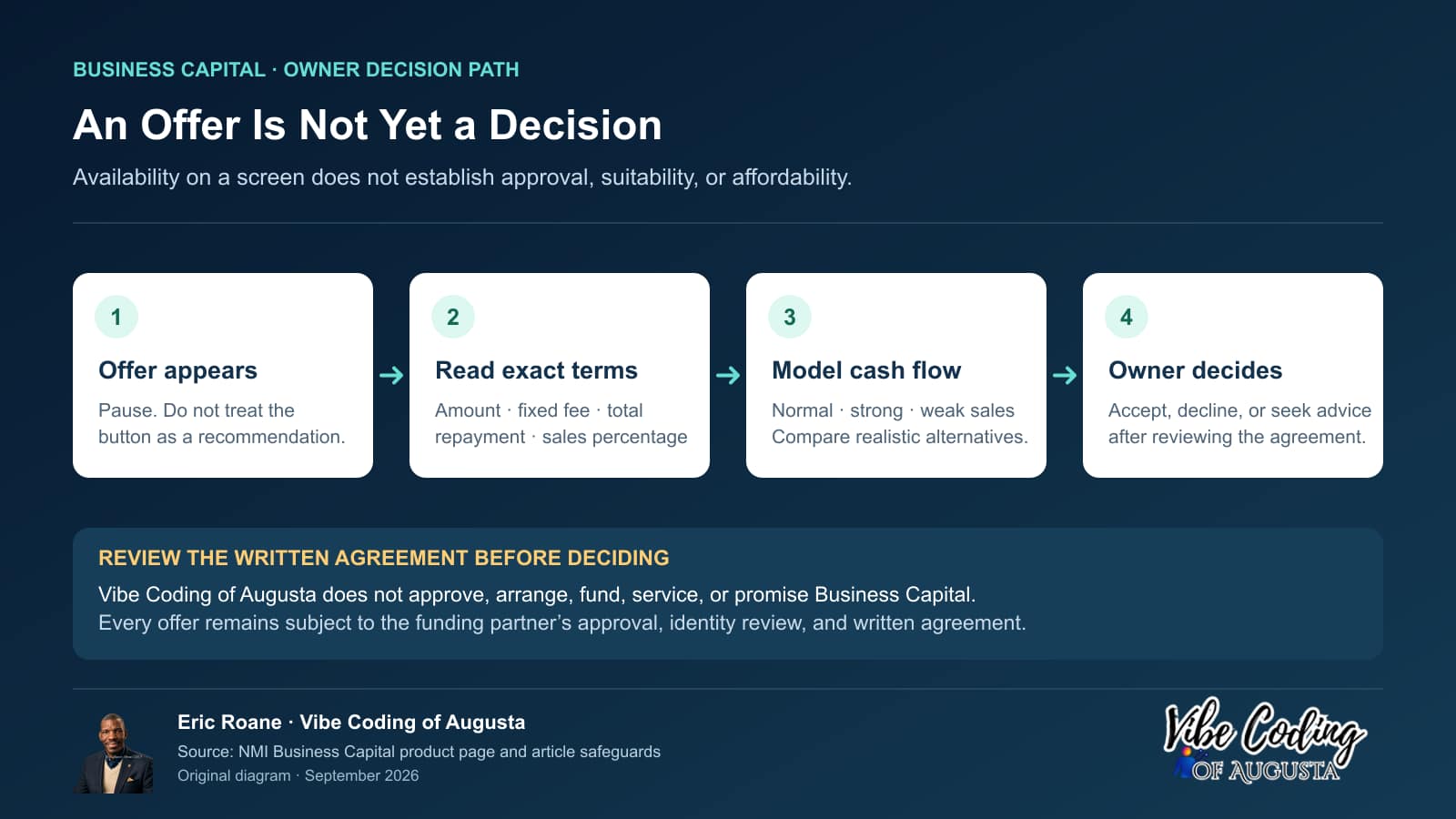
How NMI describes the product
According to NMI’s current product page, an eligible merchant may receive a personalized offer in the portal and by email. The business completes a short application. If it accepts the offer and receives final approval, NMI says funds are typically deposited within one to two business days.
NMI describes the cost as one fixed fee displayed upfront rather than compounding interest. Repayment is automated as a fixed percentage of daily card sales:
- When card sales are higher, more is collected toward repayment.
- When card sales are lower, the daily repayment amount decreases.
- NMI states that no payment is collected on days with no card sales.
Those are general product mechanics. The individual offer controls. The owner must read the exact funding amount, fixed fee, total repayment amount, daily-sales percentage, permissions, exceptions, and legal terms shown for that offer.
When a CSRA merchant might evaluate an offer
NMI identifies retail, hospitality, e-commerce, subscription businesses, digital services, and other merchants with consistent processing volume or seasonal swings as possible use cases.
Local examples might include:
- A retailer buying inventory before a busy season.
- A restaurant replacing critical equipment.
- A caterer or event business preparing for a large contracted event.
- A contractor purchasing materials for confirmed work.
- A salon expanding stations or replacing equipment.
- An online seller funding inventory tied to demonstrated demand.
These are examples of questions to evaluate, not recommendations to borrow. Capital should address a defined business need with a realistic repayment path. It should not become a substitute for understanding an unprofitable offer, an unresolved cash leak, or an uncertain personal expense.
The sales-based repayment tradeoff
Repayment that adjusts with card sales can feel more flexible than a fixed monthly payment. It can also reduce daily cash available to operate the business until the total repayment amount is satisfied.
An owner should model at least three scenarios using the exact offer terms:
- A normal sales period.
- A strong sales period, when repayment may move faster.
- A weak sales period, when each day’s deduction may be smaller but the obligation may remain longer.
The business should ask whether it can still cover payroll, taxes, inventory, rent, utilities, insurance, and other obligations after the sales-based deduction. This review may require an accountant, bookkeeper, attorney, or independent financial adviser. Vibe Coding of Augusta does not provide legal, tax, accounting, or lending advice.
Questions to answer before accepting
- What amount will the business receive?
- What is the fixed fee?
- What is the total amount that must be repaid?
- What percentage of daily card sales will be collected?
- Which sales or accounts are included in the repayment mechanism?
- What happens if the business changes processors, sells the business, closes temporarily, or experiences a dispute?
- Are there restrictions on how funds may be used?
- What personal or business guarantees, authorizations, security interests, or other obligations appear in the agreement?
- Can the business repay early, and does doing so change the total cost?
- How does this offer compare with a bank or credit-union loan, line of credit, equipment financing, vendor terms, owner capital, or delaying the purchase?
- What happens if the intended investment does not generate the expected return?
Do not rely on a spoken summary when the written agreement says something different.
Who may not be a good fit?
An offer may be unsuitable when:
- The owner cannot explain exactly how the funds will be used.
- The business has not modeled the effect of daily deductions.
- The total repayment would strain payroll, taxes, rent, or essential operating expenses.
- The business is using new borrowing to cover an ongoing loss without a corrective plan.
- A less expensive or less restrictive option is realistically available.
- The owner feels pressured to decide immediately or has not reviewed the legal terms.
Turning down an offer can be the correct business decision.
Vibe Coding of Augusta’s limited role
If a Business Capital offer appears, Vibe Coding of Augusta can help the owner slow down and identify what the screen and documents say in plain language. We do not decide whether the owner qualifies. We do not promise an amount or approval. We do not fill in rates, terms, or repayment figures from memory. We do not recommend acceptance merely because the offer is available.
The final decision belongs to the business owner, informed by the official agreement and any professional advice the owner needs.
The right next step
First, operate the merchant account and understand the payment relationship. If a capital offer later appears, collect the complete written terms. Compare the total cost and cash-flow effect with realistic alternatives before touching the acceptance button.
Sources
Product features are subject to the merchant’s enabled configuration and written terms.
How can CSRA merchants access capital through their payment portal?
Some payment portals offer capital based on the card volume a business already runs, instead of a credit-first application. For CSRA owners that can mean a faster answer, but the money comes back out of your daily card deposits, so read the total payback amount, the holdback percentage, and the written terms before accepting any offer. Vibe Coding of Augusta will read an offer with you in plain words before you sign it.
Ready to look at a merchant account for your business? Start with a short form, and we will walk you through the next steps.