A returning customer should not have to read a card number again
A Grovetown martial arts academy collects monthly tuition and occasional event charges. Storing card details in a spreadsheet is a poor answer to that recurring need. NMI’s Customer Vault stores supported payment details within the gateway and issues a vault ID for future transactions. Its support guide says the vault supports cards and electronic checks and does not store CVV.
What is the safe billing sequence?
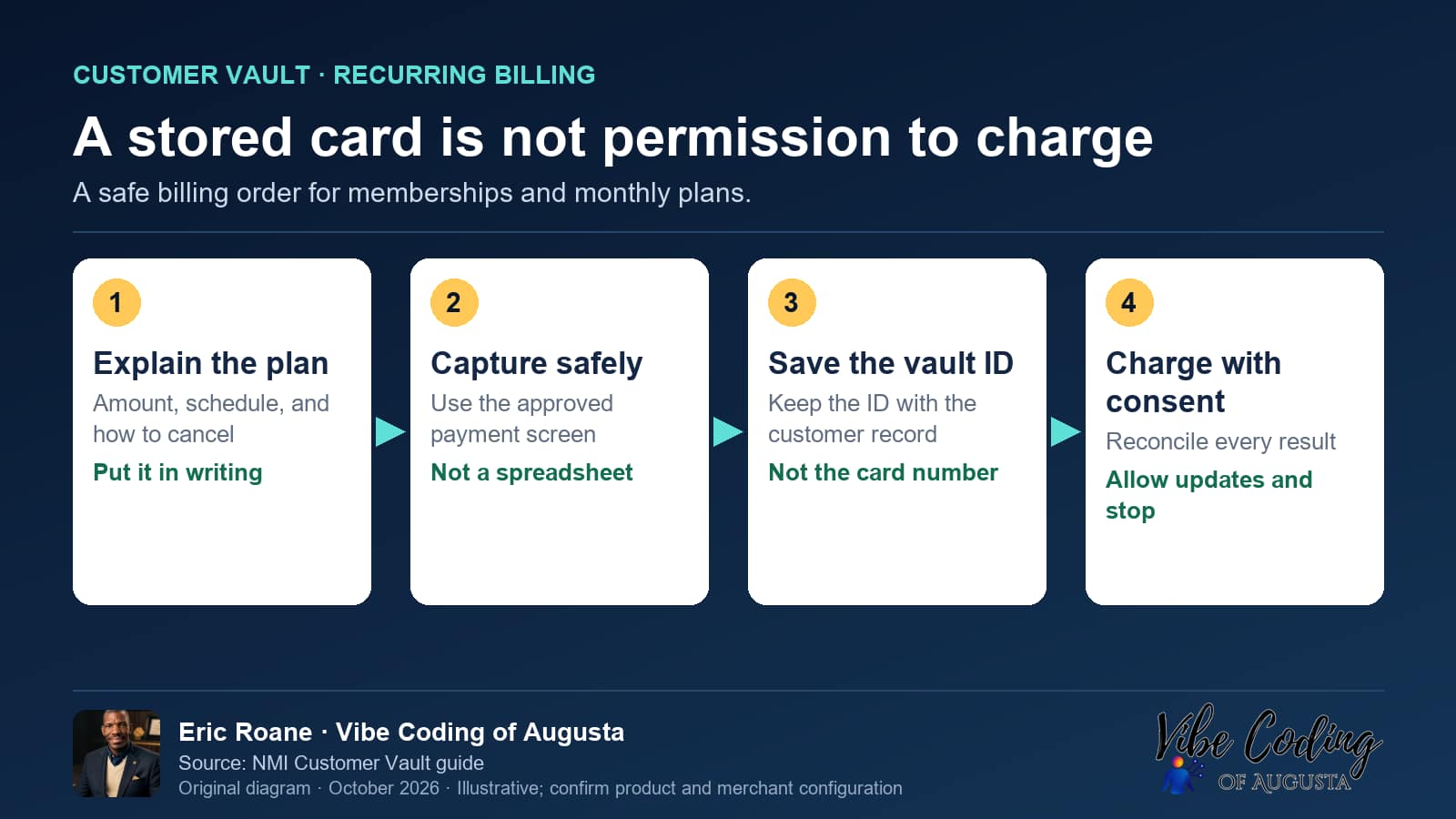
- Explain the recurring plan, amount or method for calculating it, billing frequency, and cancellation path.
- Capture the customer’s payment method through the approved gateway flow.
- Save the vault ID with the customer record rather than raw card or bank details.
- Charge only under the applicable customer authorization and reconcile each result.
- Provide a way to update the method and stop future billing.
Does a vault ID mean permission to charge?
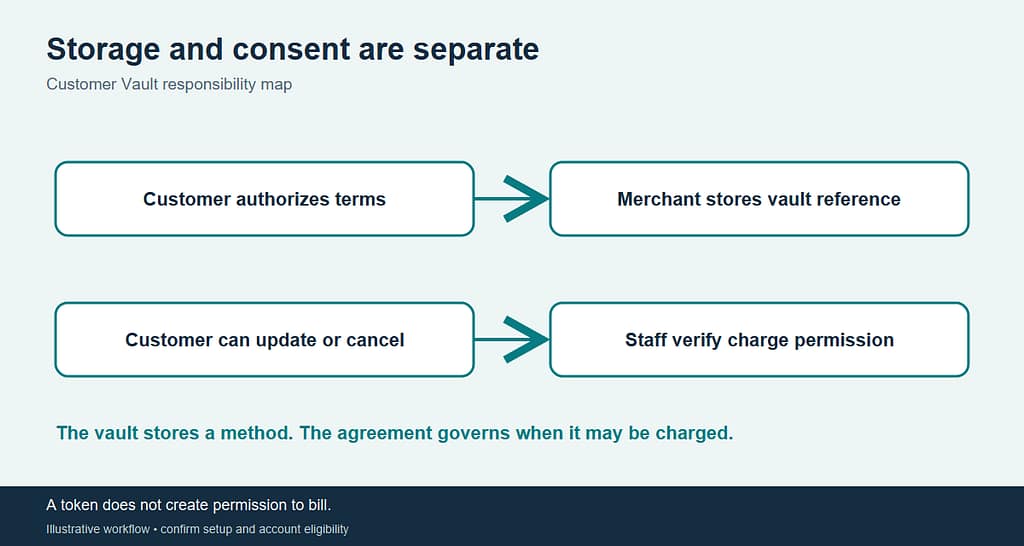
No. A vault ID identifies a stored payment method; it is not customer consent. A separate one-time equipment charge should follow the authorization that applies to that charge, not be silently added to tuition. Staff should be able to find the agreement and explain a disputed bill.
Does the vault finish PCI work?
No. Avoiding local card storage can reduce exposure, but the full collection flow and staff access still matter. Ask how the first payment method is captured, who can view or edit profiles, who can initiate charges, and how old records are removed. NMI says its gateway vault IDs work within the merchant’s NMI account, so a migration needs an approved transfer plan.
What can the owner measure?
Count how often members have to provide details again, how many payments fail, and how long updates take. For illustration, if fifty members each call once a year to update a card, that is fifty contacts to manage. A vault and an eligible card updater may reduce some of that work, but the actual effect must be measured. The arithmetic is not a savings guarantee.
Trust and security
Keep raw card numbers out of notes, email, and texts. Limit staff roles and review charges against customer authorization. Never store CVV. Ask the provider to demonstrate cancellation, profile updates, and disputed-charge handling.
Vibe Coding of Augusta can help a CSRA membership business map the authorization and billing workflow before changing its payment setup.
Source: NMI Customer Vault guide.
Ready to look at a merchant account for your business? Start with a short form, and we will walk you through the next steps.