Weekly AI News and Regional Impact Report
Coverage: September 20–26, 2026 · Prepared September 28, 2026
Listen to the short overview
Editorial promise
This report starts in Augusta and works outward: the CSRA, Georgia, the United States, then the world. Each section names what happened, shows one real chart built from verified numbers, says why it matters from that level, and ends with something you can do this week.
Every number is linked to a primary or authoritative source in the ledger at the bottom. The connections between those facts and a small business in the CSRA are our own reading, and we label them that way. Where a source is older than this week, or where a fact is not settled, we say so.
The five-minute read
Three stories shaped this week. First, Georgia Power and Google asked state regulators to approve a deal that squeezes a little more power out of existing nuclear plants, including Plant Vogtle near Waynesboro, and Georgia Power says the deal is worth about $900 million to customers over the life of the units. Second, the U.S. Department of Energy announced $5.25 billion for 31 power-grid projects in 26 states. Third, on September 23 and 24 the heads of OpenAI and Anthropic stood in front of the United Nations Security Council and said AI needs international oversight. The United States government said no to that idea, out loud.
For a shop owner in the CSRA, the common thread is simple. AI now runs on real power lines, real power plants, and real rules. Those things cost money and they change. The businesses that do well are the ones that keep their own numbers, ask vendors plain questions, and make small tests before big bets.
Key numbers for this issue
| Number | What it says | Why a small CSRA business should care |
|---|---|---|
| About 96 MW | New nuclear capacity Georgia Power and Google want from upgrades at Vogtle and Hatch (Sept 21). Needs Georgia PSC approval. | Power for AI is being added near you, and the rules for who pays are being written now. |
| About $900 million | Projected customer benefits over the life of the units, per Georgia Power. A projection, not a payment. | Ask what “benefit” means on your own bill before you count on it. |
| $218.9 million | Federal award to the Georgia Cyber Center’s Cyber Resiliency Center in Augusta (Sept 18, just before this window). | Cyber safety for rural health care is being built in your own backyard. |
| $5.25 billion | DOE SPARK total: $1.9 billion federal plus $3.35 billion cost-share, 31 projects, 26 states (Sept 24). | Grid upgrades take time. Plan for power and price changes, not power promises. |
| 23+ GW | Capacity DOE says the SPARK projects will add or free up. | The national power story is about squeezing more from lines that already exist. |
| 90 days | Deadline for DHS rules if the proposed AI Emergency Button Act becomes law. It is only a bill so far. | Human “off switches” may become a buying question for AI tools. |
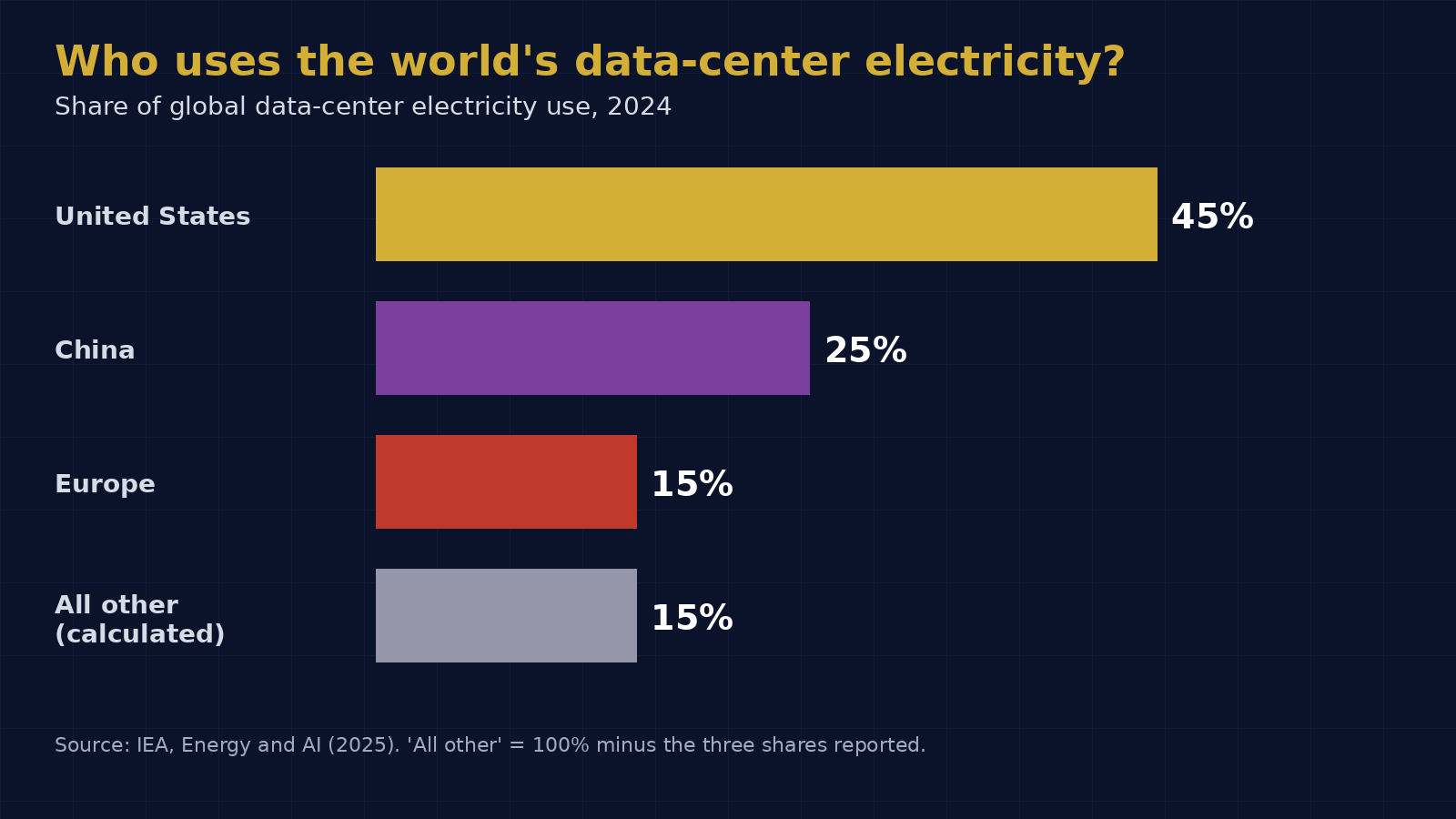
| 45% | The U.S. share of the world’s data-center electricity in 2024 (IEA, 2025 report). | The AI power bill is mostly an American bill. Vendor prices may follow it. |
| About 7% | More hiring at AI-adopting small businesses in Gusto’s data (Sept 11, before this window). An association, not proof. | Worth a small test. Not worth a big promise. |
1. CSRA first: nuclear power, a cyber center, and the rules for the next data centers
Waynesboro’s plant is part of the AI power story
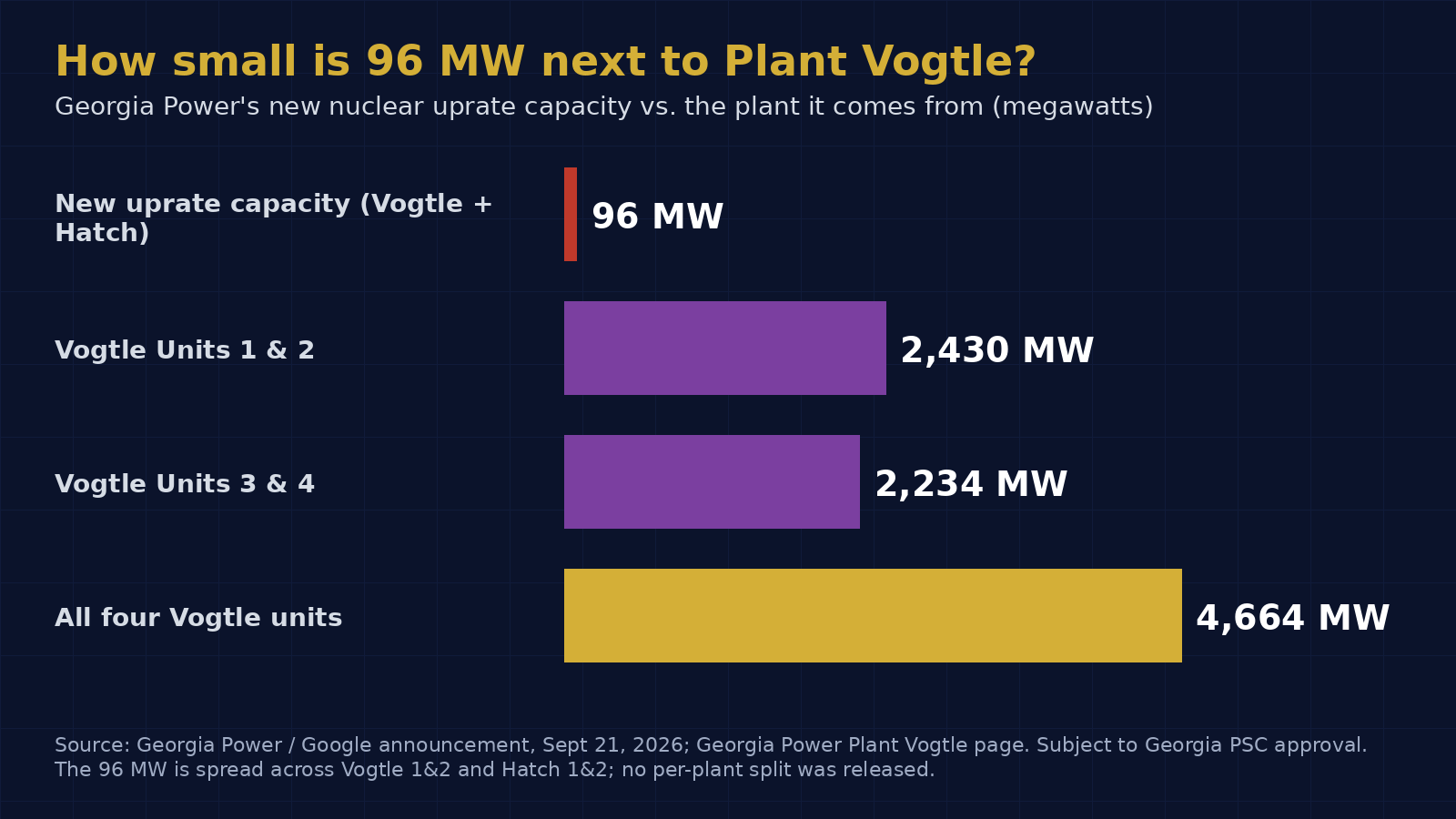
On September 21, Georgia Power and Google announced an agreement that would add about 96 megawatts of new capacity by upgrading existing nuclear units. The upgrades cover Vogtle Units 1 and 2, where a power increase was previously approved, and Hatch Units 1 and 2, where approval has been requested. Google would subscribe to a new tariff called NU-1 and receive Zero-Emission Credits. Georgia Power says the arrangement is projected to bring about $900 million in benefits to customers over the life of the units and helps protect customers who are not part of the deal from added costs. All of it is subject to approval by the Georgia Public Service Commission.
Look at the chart. Vogtle’s four units total roughly 4,664 megawatts. The new 96 megawatts is about two percent of that. That is not a small thing when it is free of new construction, but it is also not the whole answer to how much power AI data centers want. Two facts were not released: how the 96 megawatts splits between Vogtle and Hatch, and how much Google will pay. We are not guessing at either.
A big federal award, a few miles from downtown
Just before this week’s window, on September 18, the Georgia Cyber Center announced that its Cyber Resiliency Center received a federal award of $218,862,169.63 from CMS and HHS, funded 100 percent by the federal government. Partners named are HITRUST and CrowdStrike, whose Falcon Complete service will be used. The announcement did not say how many clinics will be served, so we will not either. The point for a local business is that health care and other rural offices are being pushed toward stronger cyber habits, and customers will start asking who protects their information.
Background: where the next data centers may go
This is older news, but it explains why the power story lands close to home. In February 2026 Columbia County commissioners approved two large rezonings, the 3,000-plus-acre White Oak Technology Park (5-0) and 417 acres at Pumpkin Center (4-1), and rejected a third, the 944-acre Byrd Farm site (4-1). Nothing new was decided on those in September. Treat them as the setting, not this week’s news.
Why it matters from the CSRA
The view from here is practical. Power built for AI is being planned around us, and people who live here will hear about it on their electric bills, at zoning meetings, and in job announcements. A small business does not control any of that. What you control is how well your own customers can reach you and trust you online. Scams and fake messages increase whenever a topic gets loud, and a website with a secure, clearly yours address is the first thing a worried customer checks.
Action this week
- Check your own front door. Type your business name into a search engine on your phone. Is the first result really yours? Does the page have the lock symbol, your phone number, and a clear next step?
- Write down your top three customer questions and your best answer to each. That list is the raw material for any future website or chat tool.
- Ask your web host one question: who can log in to our site, and how would we know if someone else did?
Vibe Coding service path
- Website Security: a lock on the front door of your site, so customers reach you and not an imitator.
- Gateway Landing Page: one focused page with one clear button, when you need a specific customer action.
2. Georgia: the state is deciding who pays for the power
The Google deal is a test of a bigger question
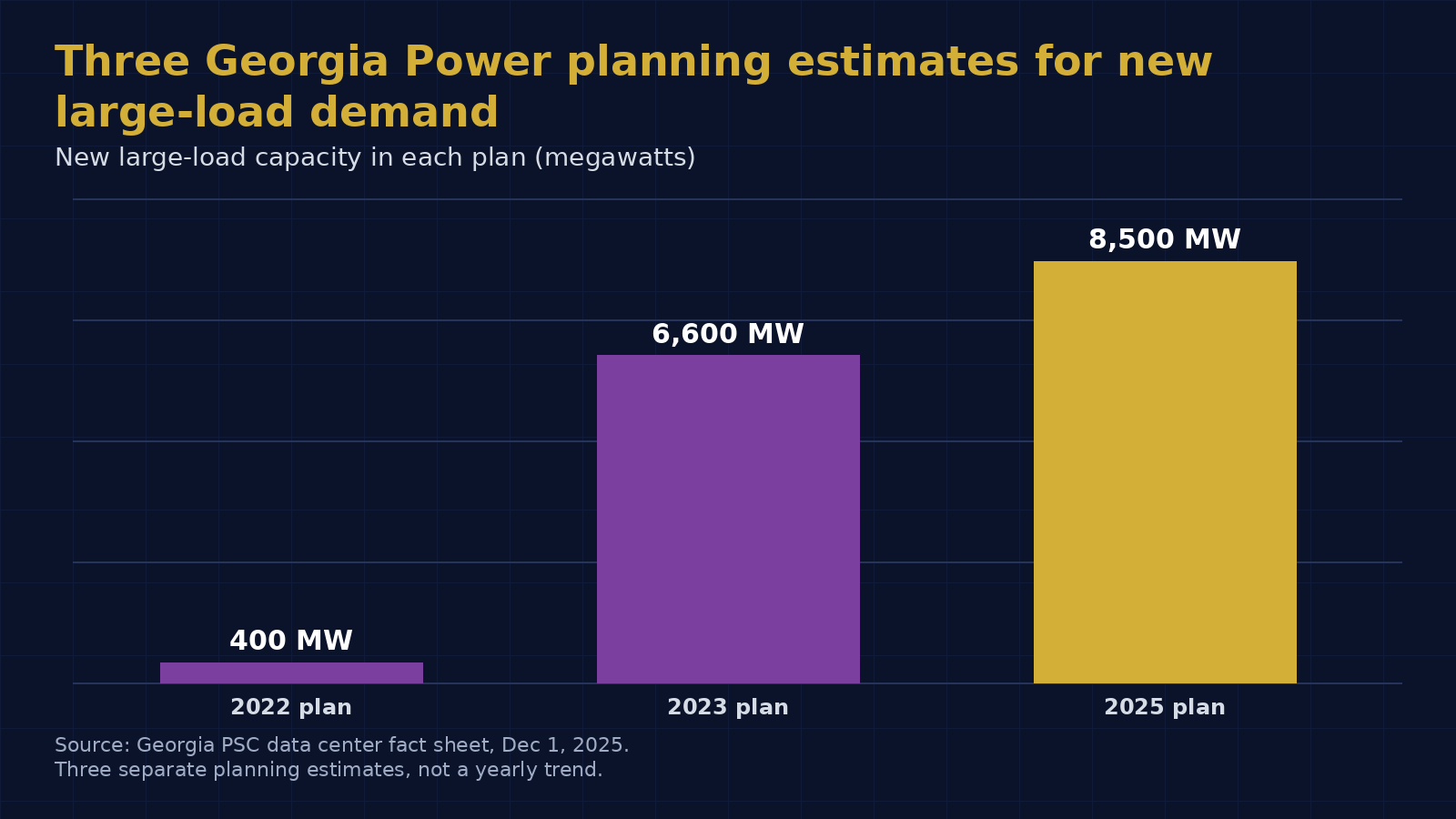
The Georgia Power and Google agreement sits in two Georgia PSC dockets, 44280 and 56002. Georgia regulators now have to decide whether the plan protects everyone else on the system, which is the promise Georgia Power made. The chart shows why the question is heavy. In its own planning, Georgia Power’s estimate for new large-load capacity went from 400 megawatts in the 2022 plan, to 6,600 in 2023, to 8,500 in 2025. Those are three planning snapshots made at different times for different reasons. They are not a smooth line, and we did not draw one. They do show that the size of the challenge was revised sharply upward in a few years.
Why it matters from Georgia
From a statewide view, “what’s good” is a deal where the new user pays its own way and the rest of us do not get a bigger bill. Whether the NU-1 tariff does that is a fair thing for regulators, and for the public, to check. Georgia has about 1.4 million small businesses, and a small business feels power prices in a way a data center does not. You cannot spread a bill across a thousand servers.
Action this week
- Look at your last three electric bills and write down the monthly total and your busiest month. That is your baseline before any rate change is proposed.
- Find one job a person does over and over (quotes, reminders, scheduling) and time it for one week. If it takes more than an hour a week, it may be worth automating.
- Follow the docket. The PSC posts filings for Dockets 44280 and 56002 online, and public comment is how ordinary customers get heard.
Vibe Coding service path
- Basic Automation Package: one repeated job, done the same way every time, with a person checking the result.
3. United States: a grid bill, an off-switch bill, and a price promise
SPARK: more power from lines we already have
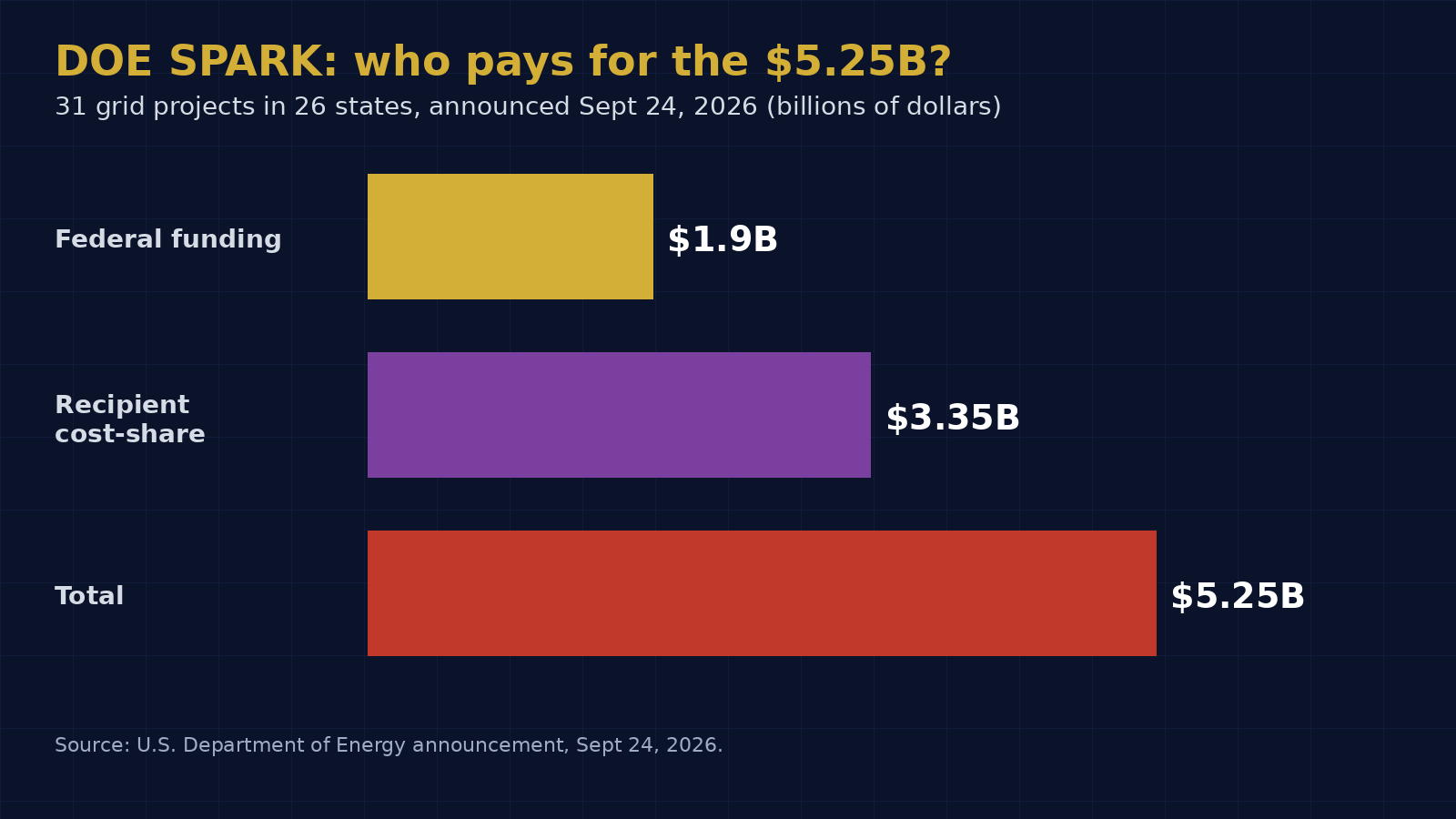
On September 24 the Department of Energy announced SPARK, $5.25 billion across 31 projects in 26 states. Federal money is $1.9 billion and cost-share is $3.35 billion. DOE says the projects will rebuild or reconductor more than 1,500 miles of line, add grid-enhancing technology to nearly 21,000 miles, and add or free up over 23 gigawatts of capacity, serving about 100 million Americans. The plain-talk version: instead of only building new lines, the plan is to make existing lines carry more. That is quicker, but DOE’s numbers are goals. Real results will show up later.
Two more national signals
On September 25 Walmart CEO John Furner published a letter saying the company will not use AI or personal data to set personalized prices. His line: “We price the product, not the person.” It covers data from Walmart’s Sparky shopping assistant. This is a company promise, not a law, but it tells small businesses where customer trust is headed. Also this week, Representative Tom Kean Jr. and Senator John Kennedy were reported to be backing the AI Emergency Button Act, which would require advanced AI systems to have a way for a human to shut them down, with DHS writing the rules within 90 days of the bill becoming law. It is a proposal. We are reporting it so you can watch it, not to say it will pass.
Why it matters from the United States
From the national view, the useful question is whether AI’s growth makes the country’s power cheaper and steadier or just busier. SPARK is a bet on cheaper and steadier. The Walmart letter and the shutdown bill are about trust. In every one of them, the customer is asking the same thing: who is in charge, and can a person step in?
Action this week
- Write your own one-sentence promise about how you use customer information, then put it where customers can see it.
- If you use a chat or answering tool, make sure a real person can be reached, and test that path yourself.
- Save your top ten most-asked questions in one document. It makes any future tool safer and faster to set up.
Vibe Coding service path
- 24/7 Chatbot Customer Service Agent: answers repeat questions after hours from your approved information and hands hard ones to a person.
4. World: the heads of the AI labs asked for rules, and the U.S. said no
The story of the week
On September 23 and 24, during the UN General Assembly, France convened a UN Security Council meeting on AI. Dario Amodei of Anthropic, Sam Altman of OpenAI, Clément Delangue of Hugging Face, and researcher Yoshua Bengio spoke, along with U.S. official Michael Kratsios. Reporting from Al Jazeera and TechPolicy.Press shows a clear split. The lab leaders and several governments asked for international oversight, with one line reported as “cannot be made by labs in San Francisco alone.” The U.S. answered that it “totally reject[s] all efforts by international bodies to assert centralised control.” France and the UK backed shared frameworks. UN Secretary-General Antonio Guterres warned of “an extraordinary transfer of power away from governments to a handful of private corporations.” Nigeria’s representative said his country would not “surrender our technological future to paranoia.” Separately, President Trump and China’s President Xi agreed to talk about AI and to set up ways to communicate about incidents.
What did not happen: nobody signed a treaty, and there is no new binding rule. It was a meeting and a very public disagreement.
The background numbers
The chart is background, not news. The International Energy Agency said data centers used about 415 terawatt-hours in 2024, roughly 1.5 percent of the world’s electricity, and in its base case could reach about 945 terawatt-hours by 2030, just under 3 percent. The U.S. share of that 2024 use was about 45 percent. That is why a fight over who sets the rules for AI is also a fight over who builds the power for it.
A word on responsibility
A law firm newsletter this month summarized a UK legal taskforce statement on AI and liability. As reported, the principle is that a person or company can be held responsible where they carelessly fail to use reasonable care in choosing, testing, or watching over an AI tool, and that the AI itself is not held responsible. Contracts decide much of who pays. We do not have the exact publication date of the statement, so read it as a signal, not as a legal rule that applies to you. We are not lawyers.
Why it matters from the world’s view
From the widest view, “what’s good” is agreement on basic safety without handing control to one country or one company. The week showed how far apart the parties are. A local business is not going to fix that. What it can do is choose vendors who answer plain questions, so the rules of a far-away room do not become a surprise on your own account.
Action this week
- Ask every AI vendor three questions: Where is our data kept? Can it be used to train your models? Can we export our records and cancel without losing them?
- Do not paste private customer, payment, or password information into any tool that has not answered those three questions.
- Check your email safety. Ask whoever manages your email whether your domain is set up so that messages sent as you are checked, so fakes are stopped before they reach your customers.
Vibe Coding service path
- Spam-Buster Lite: sets up the checks that keep your business email out of spam folders and stop others from pretending to be you.
What the four levels say together
| Level | What is good from that view | Watch out for | Your first move |
|---|---|---|---|
| CSRA | Local power and cyber investment near you | Fake messages and imitation sites when topics get loud | Check your front door online |
| Georgia | New power that does not raise other customers’ bills | Approval is not final; details of who pays are not public | Record your power baseline; follow the docket |
| United States | More power from existing lines; trust promises from big brands | Goals are not results; a bill is not a law | Write your own customer promise |
| World | Shared safety rules without one owner of AI | A disagreement is not a treaty | Ask vendors three plain questions |
Action now
Pick one thing from the four lists and do it before Friday. If you only do one: type your business name into a search engine on your phone, and fix the first thing that looks off.
What we could not confirm this week
- The split of the 96 MW between Vogtle and Hatch, and what Google will pay.
- The exact date the UK legal taskforce statement was published and the date the AI Emergency Button Act was introduced.
- Any new Columbia County data-center vote in September. The votes we cite are from February 2026.
Source ledger
- Georgia Power and Google agreement (Sept 21, 2026): PR Newswire release
- Plant Vogtle facts: Georgia Power, Plant Vogtle
- PSC dockets: 44280 and 56002; Georgia PSC data center fact sheet
- Georgia Cyber Center Cyber Resiliency Center award: Georgia Cyber Center
- Columbia County background (Feb 2026): WJBF
- DOE SPARK: U.S. Department of Energy announcement
- Walmart pricing letter: WRNJ
- AI Emergency Button Act: WRNJ
- UN Security Council AI meeting: Al Jazeera; TechPolicy.Press
- IEA data-center electricity: Energy and AI, executive summary; energy demand from AI
- UK liability statement summary: Stephenson Harwood, Neural Network (Sept 2026)
- Small business hiring research (Sept 11, before this window): Savannah CEO on Gusto research
The facts and figures come from the sources above. The reading of what they mean for a small CSRA business, the action steps, and the service paths are Vibe Coding of Augusta’s own analysis. Not legal or financial advice.
Talk it through
Want help picking your one thing this week? Book 30 minutes with Vibe Coding of Augusta, or call 706-495-5893.


