If your business processes over ten thousand dollars a month, a flat-rate processor like Square may be taking a bigger share of your profits than you think. It feels like one simple fee. But a flat rate hides what the banks and card networks actually charge.
Let us look at one sale
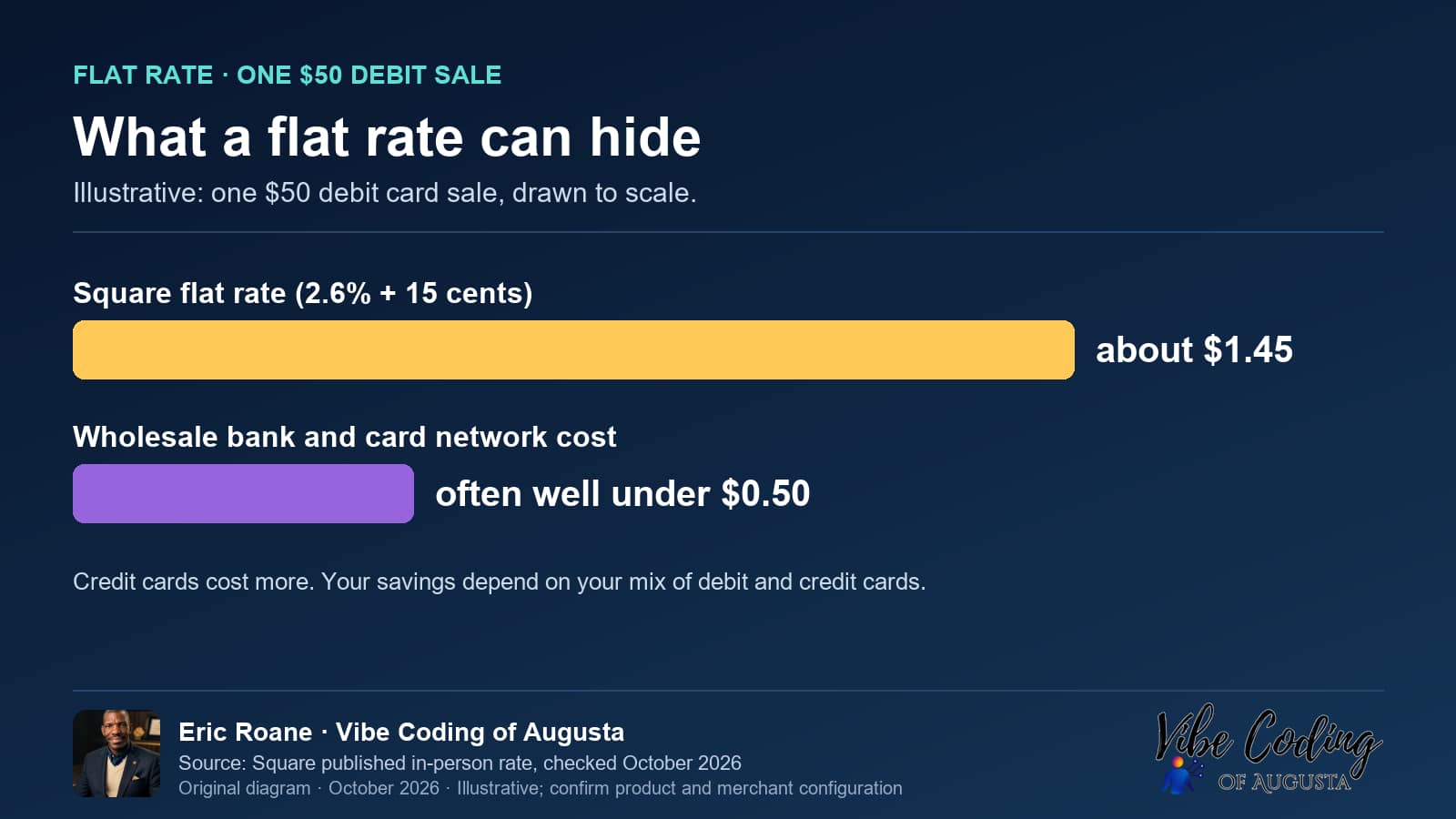
A customer pays fifty dollars with a debit card. On Square’s flat rate, that sale costs about $1.45: 2.6 percent plus 15 cents. The wholesale cost the banks and card networks charge for that same sale is often well under 50 cents.
One $50 debit card sale
What a flat rate costs compared with the wholesale cost of the same sale. Illustrative example.
Bar lengths are drawn to scale using $0.50 as the upper limit for the wholesale cost. Credit cards cost more. Your savings depend on your mix of debit and credit cards.
Interchange-plus passes that wholesale cost to you and adds one small, clear markup. Credit cards cost more everywhere, so how much you save depends on your mix of debit and credit cards. That is why we start with a free statement audit.
Why do flat-rate companies not show you this?
Because on a flat rate, the processor keeps the difference. Regulated debit cards cost processors less than one percent to process. When Square charges you 2.6 percent plus 15 cents on a debit card, there is a wide gap between what you pay and what the bank charges.
Interchange-plus pricing passes the exact wholesale bank rate directly to you, plus one small, transparent markup. You see every fee line by line. No hidden categories, and no surprise rate hikes.
A dedicated account with NMI
Moving to a dedicated account with NMI gives you more control of your data, a price you can read, and direct support right here in the CSRA.
My honest take
I took a close look at how card processing is priced, and I will be honest with you: it surprised me. A flat rate and interchange-plus can look the same at first, but they are not the same at all. With a flat rate, you pay one set percent no matter what. With interchange-plus, you see the real cost of each card, plus one small, clear markup. A lot of business owners have no idea how much extra they may be paying. The good news is you can start keeping more of your money. Knowing which product your business needs, and having the right fees set up from the start, can make a real difference.
Stop guessing what you pay. Contact CSRA Merchant Services today for a free fifteen-minute statement audit, and see where you stand.
Ready to look at a merchant account for your business? Start with a short form, and we will walk you through the next steps.
Square’s published in-person rate was 2.6% + 15 cents when this was written; rates can change. Examples are illustrative, not a promise of savings. Prices and savings depend on your business and card mix.